
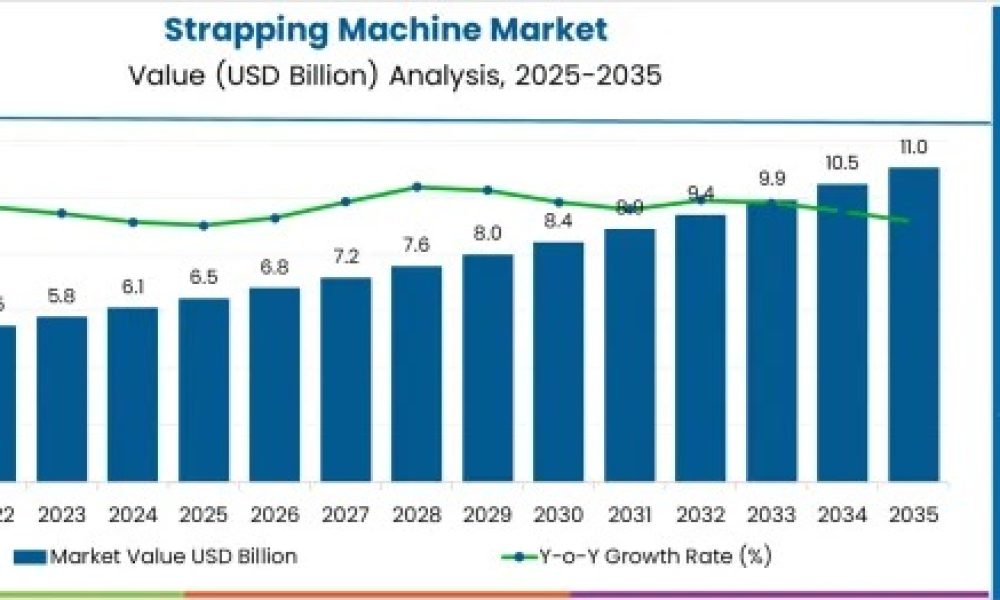
The global Strapping Machine Market is entering a renewed phase of expansion as industries worldwide accelerate their shift toward automated packaging and high-efficiency logistics operations. Valued at USD 6.5 billion in 2025 and projected to reach USD 11.0 billion by 2035, the market is set to witness a CAGR of 5.5%, driven by rising throughput requirements, the boom in e-commerce, and the modernization of end-of-line systems. As companies push to reduce manual labor, increase load security, and standardize packaging processes, advanced strapping technologies are becoming indispensable across global supply chains.
Subscribe for Year-Round Insights → Stay ahead with quarterly and annual data updates
https://www.futuremarketinsights.com/reports/sample/rep-gb-23515
Between 2020 and 2030, the market steadily expanded from USD 4.9 billion to USD 8.0 billion, supported by strong adoption of semi-automatic and automatic systems in logistics, food and beverage, industrial manufacturing, pharmaceuticals, and construction materials. Innovations such as servo-driven tension control, IoT-enabled monitoring, remote diagnostics, and integration with conveyor systems are helping companies achieve faster cycle times and consistent packaging quality. From 2030 to 2035, growth is expected to accelerate further as AI-assisted predictive maintenance, data-driven quality checks, and advanced material compatibility become standard across production floors.
Automation, E-Commerce, and Material Innovation Drive Market Evolution
Growing parcel volumes—from retail, cross-border commerce, and third-party logistics (3PL) operations—are creating acute demand for reliable, tamper-resistant packaging. Automatic strapping machines, which are projected to hold 53% of the market in 2025, remain the backbone of high-speed packaging lines due to their ability to deliver rapid throughput with minimal operator involvement. Meanwhile, polypropylene (PP) strapping continues to lead the material segment with a 47% share thanks to its versatility, lower environmental footprint, and compatibility with light- to medium-duty product bundling.
Demand is also surging in heavy industries, where steel and PET straps are essential for securing metals, chemicals, building materials, and large palletized loads. As organizations aim to lower packaging costs, reduce errors, and enhance product integrity during transport, automated solutions are rapidly replacing manual methods.
Regional Growth: China and India Lead Global Expansion
The market outlook varies significantly across regions, with Asia-Pacific in a leading position.
- China is expected to grow at 7.4% CAGR, driven by export manufacturing, high-velocity parcel networks, and integrated logistics parks embracing high-speed arches and sensor-based tension systems.
- India, forecast at 6.9% CAGR, is seeing rapid adoption of automated packaging in food, pharma, consumer durables, and organized retail.
- Europe shows robust performance as France and the UK modernize their packaging floors to enhance traceability, reduce downtime, and support next-gen manufacturing ecosystems.
- The United States, though growing at a moderate 4.7% CAGR, is experiencing strong replacement demand and integration of strapping machines with robotic palletizers, automated wrappers, and IoT-enabled packaging lines.
Sustainability and Operational Efficiency Take Center Stage
Sustainability-driven packaging strategies are nudging manufacturers toward energy-efficient machines, recyclable strap materials, and waste-reduction features. Quick-change strap reels, low-maintenance heads, and programmable tension settings are becoming critical for companies looking to optimize operating costs while meeting environmental commitments.
Manufacturers are now focusing heavily on:
- Biodegradable and recycled strap compatibility
- Reduced energy consumption
- Modular machine designs to support flexible factory layouts
- Predictive diagnostics powered by IoT data streams
- Lower total applied cost per pallet through improved tension accuracy
As industries prioritize high OEE (Overall Equipment Effectiveness), strapping machines are evolving into indispensable components of fully automated, digitally connected packaging lines.
Competitive Landscape
Global leaders such as Signode, Mosca, Dynaric, Fromm Packaging Systems, Beumer Group, M.J. Maillis Group, StraPack, Transpak, Packway, Polychem, and Samuel Strapping Systems continue to shape market dynamics through innovations in speed, durability, remote troubleshooting, and smart controls. Companies are intensifying efforts toward regional manufacturing, localized service networks, and consumable optimization programs to support industries demanding higher uptime and reduced total cost of ownership.
By blending speed, precision, and sustainability, the next decade of the strapping machine market will be defined by intelligent automation, global logistics expansion, and technology-enabled packaging efficiencies.
Get data that aligns with your strategic priorities — ask for report customization today:
https://www.futuremarketinsights.com/customization-available/rep-gb-23515
Have a specific Requirements and Need Assistant on Report Pricing or Limited Budget please contact us – [email protected]
About Future Market Insights (FMI)
Future Market Insights, Inc. (FMI) is an ESOMAR-certified, ISO 9001:2015 market research and consulting organization, trusted by Fortune 500 clients and global enterprises. With operations in the U.S., UK, India, and Dubai, FMI provides data-backed insights and strategic intelligence across 30+ industries and 1200 markets worldwide.
Contact Us:
Future Market Insights Inc.
Christiana Corporate, 200 Continental Drive,
Suite 401, Newark, Delaware – 19713, USA
T: +1-347-918-3531



