
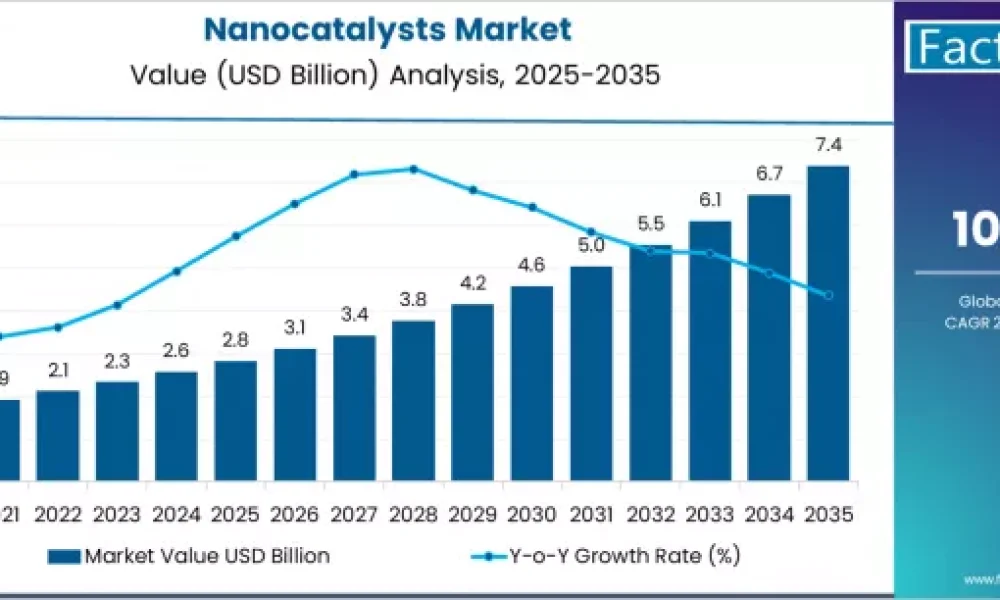
The U.S. nancatalysts market is entering a pivotal decade defined by accelerated commercialization, clean-technology adoption and expanding industrial applications. As nanoscale engineering techniques continue to mature, innovations such as single-atom catalysts, hybrid nanocomposites and advanced metal-oxide nanostructures are driving measurable performance gains across energy, chemicals and environmental sectors. These advantages—higher catalytic activity, improved selectivity and enhanced durability—are translating scientific progress into concrete industrial value.
Market modeling for 2025–2035 indicates a steady high-growth trajectory, with the U.S. nanocatalysts market projected to rise from an estimated $309 million in 2025 to approximately $780 million by 2035, reflecting a compound annual growth rate near 9.7%. This expected doubling in market value underscores the expanding role nanotechnology will play in next-generation catalytic systems.
To access the complete data tables and in-depth insights, request a Discount On The Report here: https://www.factmr.com/connectus/sample?flag=S&rep_id=12175
Major Drivers of U.S. Market Expansion
1. Clean Energy Transition and Hydrogen Economy Development
Few forces are reshaping the U.S. industrial landscape more than the energy transition. Nanocatalysts have become integral to unlocking performance requirements for green hydrogen production, proton-exchange membrane (PEM) electrolyzers and fuel cells. Their superior reaction kinetics and surface-area advantages directly enhance efficiency, reduce energy losses and improve catalyst longevity.
As hydrogen hubs, utility-scale electrolyzer projects and early hydrogen-powered mobility pilots continue to grow, nanocatalysts are becoming essential components within these emerging infrastructures. Cost reduction through improved atom efficiency—especially for platinum-group metals—makes nanoscale catalysts strategically appealing for both public and private clean energy initiatives.
2. Refining and Petrochemical Modernization
Traditional refining and petrochemical operations remain enormous consumers of catalyst materials. In the U.S., modernization efforts—spanning hydrocracking, selective reforming, desulfurization and emissions reduction—are increasingly turning to nanocatalyst solutions to boost performance while meeting stricter regulatory standards.
Nanostructured catalysts offer:
Higher active-site density
Improved stability under harsh operating conditions
Greater selectivity leading to improved product yield
Lower catalyst consumption due to higher efficiency
As refiners adapt to shifts in fuel composition, renewable feedstocks and decarbonization demands, nanocatalysts are becoming an operationally and economically attractive lever for optimization.
3. Environmental Catalysis, Water Treatment and Air Purification
Nanocatalysts are rapidly penetrating environmental engineering sectors. Photocatalytic nanomaterials—such as titanium dioxide, zinc oxide and emerging two-dimensional nanostructures—have demonstrated strong effectiveness in degrading organic contaminants, breaking down pollutants and disinfecting water.
Growing federal and state investments in water infrastructure, combined with tightening discharge regulations, are accelerating evaluation and deployment of nanocatalyst-enabled remediation systems. Industrial facilities, municipalities and environmental service firms are increasingly adopting these technologies for both primary treatment and polishing processes.
4. Biofuel Upgrading and Biorefinery Expansion
The U.S. bioenergy sector continues to evolve beyond traditional ethanol production, expanding into renewable diesel, sustainable aviation fuel (SAF) and biomass-derived chemical pathways. Nanocatalysts are emerging as enabling technologies in hydrodeoxygenation, biomass upgrading and biodiesel conversion.
By enhancing reaction kinetics and improving carbon efficiency, nanocatalysts help reduce process energy requirements and improve yields—two critical challenges for scaling low-carbon fuels.
Key Technology Trends Shaping 2025–2035
Single-Atom Catalysts (SACs) Entering Commercialization
Single-atom catalysts dramatically increase atom utilization efficiency—especially valuable for precious metals such as Pt, Pd and Ru. Their exceptional selectivity and tunable electronic structure are pushing SACs from research labs into early industrial pilot applications. Over the next decade, SAC-based systems are expected to become commercially relevant across hydrogen production, emissions control and specialty chemical synthesis.
Hybrid and Composite Nanocatalysts
Composite catalysts blending metals, oxides and porous support structures are demonstrating enhanced stability, thermal resistance and reusability. These improvements are especially aligned with industries requiring long catalyst lifetimes, such as refining and petrochemical operations. This segment is projected to be among the fastest-growing, supported by both performance advantages and increasing manufacturing scalability.
Improved Scalability and Reproducible Manufacturing
A historic barrier to nanocatalyst adoption has been the challenge of producing materials consistently at commercial scale. Advancements in continuous-flow synthesis, atomic-layer deposition, precision nanostructuring and high-throughput quality control are making industrial-grade manufacturing more feasible. These improvements are foundational to broader market adoption.
Competitive Landscape and Ecosystem Evolution
The competitive environment is maturing as established catalyst manufacturers, advanced materials companies and startup innovators expand their nanocatalyst portfolios. Large incumbents are leveraging capital, intellectual property and established supply chains to integrate nanocatalysts into existing product lines, while startups introduce novel chemistries and breakthrough nanoscale architectures.
Strategic collaborations—pairing materials innovators with major industrial catalyst suppliers—are becoming increasingly common. These partnerships accelerate commercialization cycles and ensure that breakthrough nanotechnologies quickly align with real-world industrial requirements.
Opportunities for Market Participants
Industrial Integration & OEM Partnerships
Catalyst manufacturers that partner with reactor, electrolyzer, membrane and equipment OEMs will gain a competitive edge through embedded solutions and recurring lifecycle revenue.
Catalyst Regeneration, Recycling & Precious-Metal Recovery
As nanocatalyst adoption grows, so will value-added services around recovery and regeneration. Closed-loop catalyst programs offer both sustainability benefits and cost efficiency.
Niche Application Leadership
Fast-moving regulatory segments—such as municipal water treatment and hydrogen infrastructure—offer opportunities for specialized early market leadership.
Risks and Constraints
Despite strong growth prospects, several challenges remain:
Raw-material cost volatility for precious metals may impact margins without improved atom efficiency.
Regulatory scrutiny around nanomaterials requires robust safety, environmental and lifecycle assessments.
Manufacturing scalability limits can delay commercialization if synthesis consistency isn’t maintained.
Competition from conventional catalysts will remain in applications where performance gains do not justify cost differentials.
Outlook: A Decade of High-Momentum Growth
From 2025 to 2035, the U.S. nanocatalysts market is projected to nearly double in value, driven by the convergence of clean-energy investment, industrial modernization and rising environmental standards. With an expected increase from roughly $309 million to $780 million, the next decade represents a transformative period in which nanotechnology moves from niche deployment to mainstream catalytic adoption.
Companies that can deliver scalable, cost-efficient and application-ready nanocatalyst solutions—supported by robust safety and lifecycle frameworks—will be well positioned to lead this fast-growing sector.
Have a specific Requirements and Need Assistant on Report Pricing or Limited Budget please contact us – [email protected]
To View Related Report :
Demand for Asphalt Additives in UK
About Fact.MR
Fact.MR is a global market research and consulting firm, trusted by Fortune 500 companies and emerging businesses for reliable insights and strategic intelligence. With a presence across the U.S., UK, India, and Dubai, we deliver data-driven research and tailored consulting solutions across 30+ industries and 1,000+ markets. Backed by deep expertise and advanced analytics, Fact.MR helps organizations uncover opportunities, reduce risks, and make informed decisions for sustainable growth.
“



