
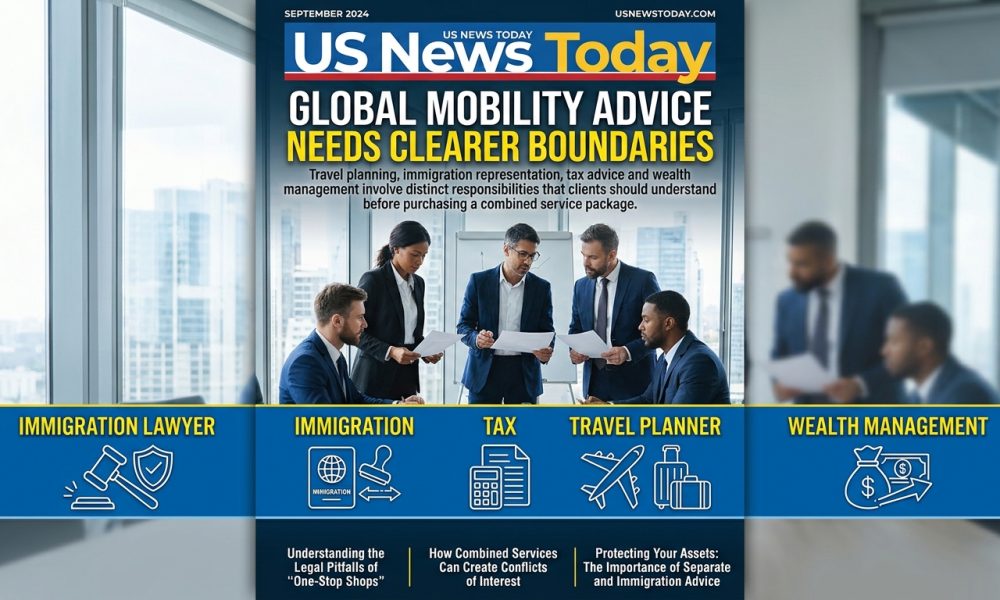
Travel planning, immigration representation, tax advice, financial structuring, and wealth management involve distinct legal responsibilities that internationally mobile individuals should understand before buying combined service packages, especially when second citizenship, foreign banking, family trusts, and permanent relocation are part of the same international strategy.
WASHINGTON, DC, October 29, 2026 — The expanding international mobility industry increasingly offers clients comprehensive arrangements combining second citizenship, residence permits, relocation assistance, overseas banking introductions, family trust coordination, and financial planning, creating important questions about professional qualifications, regulatory responsibilities, and the limits of services provided under a single consulting agreement.
For internationally mobile business owners, executives, retirees, and families, coordinating multiple overseas arrangements through a single advisory relationship can simplify communication and administrative preparation. Still, an integrated service package does not eliminate licensing requirements or the professional responsibilities tied to individual services.
A company experienced in citizenship applications may help with document preparation, government procedures, and international relocation coordination, while individualized tax opinions, regulated immigration representation, investment recommendations, and trust administration may require appropriately qualified professionals operating under separate legal frameworks.
These distinctions matter most when clients consider substantial financial commitments, transfer assets internationally, or relocate family members, because misunderstandings about professional authority can lead to unnecessary expenses, incomplete applications, unexpected taxation, or financial arrangements that fail to achieve their intended purposes.
The central issue is not whether a global mobility consultancy can coordinate several professional services, but whether clients clearly understand which services the consultancy performs directly, which services require external specialists, and who remains accountable for individual recommendations and outcomes.
Global Mobility Consulting Has Expanded Beyond Travel Arrangements
International mobility consulting once focused mainly on visa applications, residence permits, travel documents, and practical relocation support. Still, demand for broader personal planning has led providers to add citizenship diversification, financial organization, property acquisition, and international business support.
Clients pursuing these arrangements often approach advisers with overlapping objectives: greater travel flexibility, access to alternative residence jurisdictions, Protection of family interests, and lawful contingency plans for potential political or economic disruption.
A business owner contemplating relocation may need immigration eligibility assessment, advice on existing corporate interests, clarification of ongoing tax obligations, and help identifying banks that can accommodate international financial relationships.
Although these objectives are connected from the client’s perspective, they do not necessarily fall within one adviser’s professional authority, because different jurisdictions regulate immigration representation, tax practice, investment advice, and legal services through separate institutional frameworks.
The growth of comprehensive mobility packages therefore makes clear contractual descriptions and professional accountability increasingly important, particularly when clients are expected to make substantial payments before receiving government approvals or establishing the financial arrangements included in their plans.
Immigration Coordination and Legal Representation Are Different Services
Immigration consultants may perform legitimate administrative and coordination functions, including collecting supporting documents, explaining general government procedures, scheduling appointments, and communicating with authorized professionals responsible for formal immigration applications.
However, providing individualized legal advice about eligibility, interpreting immigration legislation, representing applicants before government authorities, or challenging administrative decisions may constitute regulated legal services depending on the country and the applicable professional framework.
In the United States, immigration legal advice and representation before federal immigration authorities generally require an appropriately licensed attorney or a properly accredited representative working through an organization recognized by the Department of Justice.
The U.S. Citizenship and Immigration Services guidance on avoiding immigration scams and unauthorized representation emphasizes the importance of identifying qualified legal service providers and recognizing misleading claims concerning special government access or guaranteed immigration results.
Other countries maintain their own professional requirements, so advisers operating internationally must consider the rules of the jurisdiction where they deliver services and the jurisdiction whose immigration processes they support.
Consequently, a consultancy coordinating citizenship or residence applications should distinguish administrative assistance from regulated representation and identify the appropriately authorized professional responsible whenever individualized legal interpretation or formal representation is required.
Investment Migration Creates Additional Professional Questions
Citizenship-by-investment and residence-by-investment programs have created particularly complex advisory relationships because applicants may need to coordinate government eligibility requirements, qualifying investments, source-of-funds evidence, property transactions, and ongoing financial obligations.
A program adviser may understand application procedures and government documentation requirements without necessarily having authorization to recommend securities, provide individualized tax planning, or give legal opinions on the consequences of a proposed international investment.
These distinctions drew attention in a Reuters examination of investor immigration and wealth-planning concerns, published February 26, 2025, which reported that immigration and financial advisers questioned whether a proposed American investor visa initiative would attract wealthy applicants given its costs and potential tax implications.
The reporting illustrated that investment migration decisions involve several independent considerations, including immigration eligibility, government policy, financial commitments, and tax exposure, rather than a straightforward transaction that can be evaluated solely by the advertised price.
Applicants evaluating investment-based residence or citizenship should therefore understand whether an adviser is explaining published program requirements, recommending a particular investment, or providing a professional opinion that requires separate licensing or specialist qualifications.
Tax Residency Requires Qualified and Jurisdiction-Specific Advice
One of the most consequential professional boundaries arises when global mobility planning intersects with taxation, particularly when clients assume that obtaining a foreign passport or residence permit automatically changes where their income and assets are subject to tax.
Tax residence is generally determined by applicable domestic legislation and, where relevant, international treaty provisions, so holding another citizenship document does not, by itself, end an individual’s existing tax obligations.
An American citizen relocating abroad may still face United States tax filing responsibilities while also becoming subject to the taxation rules of another jurisdiction where they have a home, an employment relationship, or substantial personal connections.
Corporate ownership, trusts, foreign investment accounts, pension arrangements, and substantial gifts can add complications that require careful analysis of reporting obligations and how different countries’ tax systems interact.
Mobility advisers can coordinate the collection of relevant information and arrange specialist consultations. Still, individualized tax determinations should be made by professionals competent and appropriately authorized to advise on the jurisdictions and transactions involved.
Tax Preparation and Representation Have Different Professional Standards
American tax practice shows why clients should distinguish general administrative assistance, tax return preparation, specialized tax advice, and formal representation before government authorities when evaluating a combined global mobility service package.
The Internal Revenue Service recognizes different categories of tax professionals, including attorneys, certified public accountants, and enrolled agents who possess broad representation rights before the agency, subject to applicable professional rules and eligibility requirements.
Other individuals may be authorized to prepare federal tax returns but have more limited representation rights, showing why experience preparing documents does not necessarily grant authority to represent taxpayers in audits, appeals, or collection proceedings.
For internationally mobile individuals, these distinctions matter when cross-border financial arrangements involve foreign corporations, family trusts, citizenship changes, investment income, or substantial transfers that may create specialized reporting and tax compliance obligations.
A responsible global mobility arrangement should identify the qualified professional who will evaluate these matters and explain whether the original engagement includes tax preparation, international tax opinions, government correspondence, and ongoing compliance services.
Wealth Management and Investment Advice Require Separate Authorization
Investment management creates another important boundary because advising clients on buying, selling, or holding securities can trigger professional registration and conduct requirements that differ substantially from those governing travel coordination or immigration documentation.
In the United States, investment advisers generally operate under federal or state securities regulatory frameworks, with applicable registration requirements depending on their activities, assets under management, client relationships, and available exemptions.
An international mobility consultant may introduce clients to a financial institution or explain the administrative process for establishing a foreign investment account without necessarily being authorized to recommend securities or manage investment portfolios.
The distinction matters most when overseas residence programs involve investments in government bonds, private funds, real estate developments, operating businesses, or other assets whose risks extend beyond immigration eligibility and application approval.
Clients should understand whether recommendations come from an appropriately authorized investment professional, whether the adviser receives referral compensation, and whether the adviser assessed investment risks independently of the transaction’s potential immigration benefits.
International Banking Introductions Are Not Account Approval Guarantees
International banking assistance is another service frequently included in comprehensive relocation packages, particularly for clients seeking financial continuity after establishing foreign residence, second citizenship, or business activities outside their original country.
A consultancy may help identify financial institutions, explain general documentation requirements, coordinate introductions, or prepare supporting information. Still, it cannot approve accounts or determine how a bank applies its own compliance procedures.
Banks remain responsible for their customer Identification, anti-money-laundering, beneficial ownership, tax reporting, and risk assessment obligations, meaning a referral relationship cannot legitimately substitute for required institutional verification.
Clients may be asked to provide source-of-wealth evidence, personal Identification, residential documentation, and information about intended financial activity, even where another adviser has already reviewed those materials during an immigration application.
Professional boundaries matter most when promotional materials imply guaranteed banking access, because final acceptance depends on the institution’s independent evaluation and applicable legal requirements, not the client’s payment for an introduction.
Family Trust Coordination Must Be Distinguished From Legal Administration
Family trusts can play a substantial role in international estate planning, asset administration, succession arrangements, and long-term financial organization, particularly when family members hold different citizenships or maintain residences across several countries.
However, establishing a trust involves legal and fiduciary considerations distinct from immigration or travel planning, including questions about governing law, trustee authority, beneficiary interests, tax classification, and the administration of trust assets.
A mobility consultancy may coordinate introductions to lawyers, trustees, banks, and financial advisers while remaining outside the professional roles reserved for individuals authorized to provide legal opinions or undertake regulated fiduciary responsibilities.
Clients should understand who drafts the trust instrument, who exercises trustee powers, who provides tax advice, and who maintains documentation and complies with applicable reporting obligations.
This distinction matters especially when a trust is established alongside second citizenship or relocation, because those arrangements do not automatically change beneficial ownership, eliminate existing tax liabilities, or guarantee privacy from authorized financial institutions.
Identity Verification Does Not Establish Professional Authority
International mobility arrangements often require extensive identity documentation, including passports, citizenship certificates, birth records, residence permits, taxpayer Identification numbers, and other government-issued credentials that support an individual’s legal status.
Electronic passport verification can help with document examination, but successfully authenticating a travel credential does not establish that an adviser is legally authorized to provide investment recommendations, tax opinions, or regulated immigration representation.
Amicus International Consulting provides technical guidance on scanning a passport’s NFC chip and interpreting the results, helping readers distinguish electronic document checks from broader administrative and legal determinations.
A passport’s electronically stored data may support verification of certain document particulars and security features. At the same time, questions about financial ownership, tax residency, immigration eligibility, and professional authorization require separate records and appropriate legal analysis.
This distinction matters especially when clients purchase comprehensive identity and relocation services, because authentic documentation is only one part of a much broader process involving multiple institutions and legal responsibilities.
Combined Service Packages Need Clearly Defined Agreements
An integrated mobility service agreement should explain what the quoted fee includes, who is responsible for each regulated activity, and when additional professional assistance or government charges may arise.
Such agreements may cover document collection, administrative coordination, application preparation, appointment scheduling, translation services, relocation logistics, and communication with external professionals, provided that each activity is described accurately and performed within applicable legal boundaries.
Clients should also understand whether payments are refundable, which milestones trigger additional charges, how the consultancy handles application refusals, and whether professional fees are separate from government application charges or investment requirements.
When services involve banking introductions, trust coordination, or investment-based migration, clear contracts can distinguish the consultancy’s organizational responsibilities from decisions that remain exclusively within the authority of banks, government departments, or licensed professionals.
Clear agreements protect both clients and service providers by establishing realistic expectations, documenting the limits of representation, and reducing the possibility that administrative coordination will be mistaken for an enforceable guarantee of a particular outcome.
Referral Arrangements Can Create Conflicts of Interest
Combined mobility services often involve networks of immigration professionals, property developers, financial institutions, trustees, investment advisers, and other providers who provide specialized services for a client’s international relocation strategy.
These relationships can create practical efficiencies, but they can also create potential conflicts when a consultancy is compensated for directing clients toward specific investments, financial products, property developments, or professional service providers.
A recommendation may appear impartial but be influenced by an undisclosed commercial arrangement; transparency about commissions, referral payments, and other financial incentives matters when clients evaluate the suitability of proposed services.
Clients should also determine whether an adviser has a financial interest in a recommended investment or property transaction, particularly when the asset must be maintained for several years to satisfy an immigration program’s conditions.
Professional coordination is not inherently problematic, but clients should disclose compensation arrangements and conflicts so they can distinguish independent advice from commercially motivated introductions and assess whether separate professional opinions are warranted.
Confidentiality and Data Protection Require Separate Attention
International mobility applications frequently involve sensitive personal information, including passports, family relationships, residential histories, financial statements, employment records, criminal history disclosures, and documentation explaining the origin of substantial assets.
When several professional organizations participate in a combined service arrangement, clients should understand which entities receive their information, why particular records are necessary, and how documents are stored, transferred, retained, or securely destroyed.
Confidentiality agreements can set contractual expectations, but a standard commercial nondisclosure agreement does not automatically create attorney-client privilege or the professional confidentiality protections that apply to certain regulated relationships.
A lawyer providing legal advice may be subject to different confidentiality and privilege rules than a relocation coordinator or commercial consultant, so precise descriptions of professional roles matter when clients share especially sensitive information.
Secure document handling should therefore be treated as an independent part of service quality, supported by appropriate technical safeguards, limited access, clear retention arrangements, and accurate explanations of legally required disclosures.
No Private Adviser Can Guarantee Government Approval
Government decisions on citizenship, residence permits, visas, travel documentation, and related immigration benefits are governed by the issuing jurisdiction’s legal requirements and administrative procedures, not by a consultancy’s commercial promises.
An experienced adviser may understand eligibility criteria, identify potential documentary problems, and help applicants prepare accurate submissions. Still, the appropriate government authority generally makes the final decision under its lawful powers.
Claims of guaranteed approval, permanent access to a particular immigration program, or exemption from standard eligibility requirements warrant careful review, especially when government policies and application procedures may change during processing.
Applicants should also distinguish a favorable preliminary assessment from formal government approval, because an initial review may not address every subsequent background check, financial verification procedure, or discretionary decision relevant to the application.
A well-structured engagement can explain the intended process, expected responsibilities, and known uncertainties without suggesting that a private consultancy can direct government decisions or override applicable immigration laws.
Independent Professional Reviews Can Protect Complex Relocation Plans
Complex international relocation plans may benefit from independent review when citizenship, taxation, corporate ownership, investment management, and family wealth arrangements interact in ways that could produce significant financial or legal consequences.
An immigration professional may confirm the requirements for obtaining residence. At the same time, a tax adviser separately assesses the consequences of establishing that residence,, ad an investment professional evaluates the risks of qualifying financial commitments.
Similarly, a lawyer responsible for preparing trust documents may address fiduciary authority and governing law. At the same time, a regulated financial institution independently evaluates account eligibility and beneficial ownership information before accepting transferred assets.
These separate reviews do not necessarily undermine the usefulness of a central mobility coordinator, because clearly defined roles can improve communication while preserving each specialist’s independence and professional accountability.
For clients making substantial commitments, coordinated but independent professional assessments can hidentify risks beforeidentify risks beforerreversible financial decisions are made, reducing reliance on athe assumption that has authoritythe assumption that one authority coversvery relevant discipline.
Clients Should Understand Who Remains Responsible After Approval
Receiving a foreign passport, obtaining a residence permit, or completing a qualifying investment does not necessarily conclude the client’s legal responsibilities, because subsequent renewals, tax filings, financial reporting, and residence conditions may continue for years.
Some residence arrangements require periodic evidence of eligibility or compliance. At the same time, related financial structures may involve annual accounting, tax reporting, investment maintenance, and administrative decisions that fall outside the original mobility engagement.
Clients should therefore understand whether their service package includes ongoing compliance coordination or ends when particular documents are issued, applications are approved, or initial financial arrangements are established.
Where continuing responsibilities are excluded, the engagement should identify whether qualified external professionals will administer those matters and how clients can obtain the necessary records or transition assistance following completion.
A clear division between initial application services and ongoing legal, tax, financial, or fiduciary responsibilities can prevent costly misunderstandings after individuals have relocated or committed substantial assets to international arrangements.
Professional Boundaries Strengthen International Mobility Planning
The growing demand for second citizenship, overseas residence, international financial privacy, and family relocation services creates opportunities for consultancies that can coordinate complex arrangements while respecting the professional responsibilities of lawyers, accountants, trustees, and investment advisers.
However, the value of comprehensive coordination depends on transparency about services, qualifications, compensation, and legal authority, not on the assumption that a single commercial relationship automatically provides every form of specialized professional advice.
For internationally mobile individuals, an effective arrangement should distinguish lawful document preparation and logistical assistance from regulated legal representation, tax analysis, investment recommendations, banking approval, and fiduciary administration.
Clients who understand these distinctions can evaluate service proposals more accurately, identify where independent advice is necessary, and make informed decisions about the financial and personal consequences of relocation or additional citizenship.
Ultimately, global mobility advice requires clear professional boundaries because international planning involves multiple legal systems and institutions, and successful coordination must preserve the distinct responsibilities of those authorized to make specialized recommendations or binding administrative decisions.




