
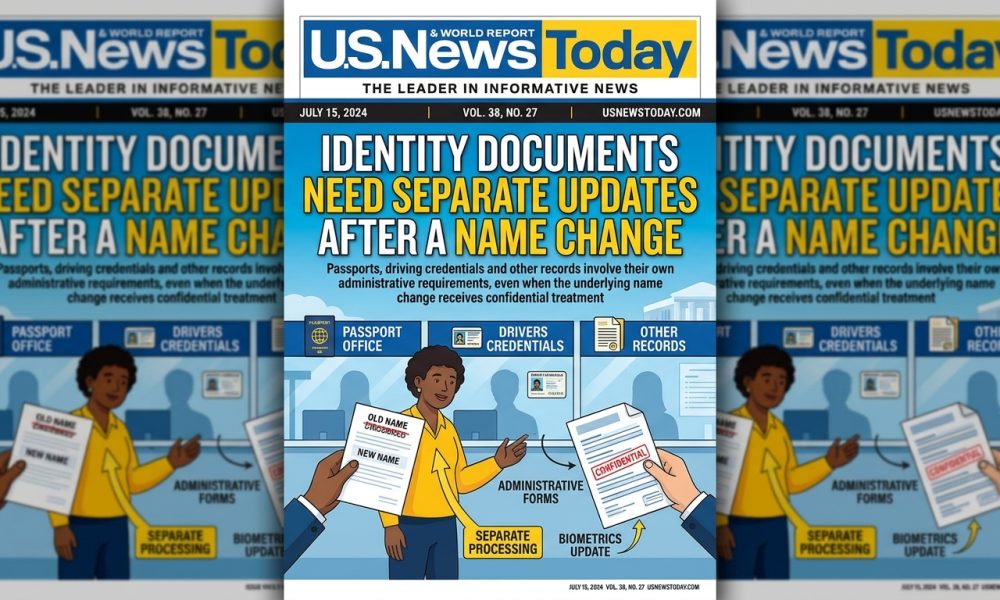
Passports, driver’s licenses, Social Security records, bank accounts, and other Identification documents require separate administrative steps after a legal name change, even when the underlying court proceedings receive confidential treatment to protect personal safety and limit unnecessary public disclosure.
WASHINGTON, DC, October 29, 2026 — Americans completing a legal name change frequently discover that obtaining a court order represents only the beginning of a broader administrative process, because passports, driver’s licenses, Social Security records, financial accounts, and other official documents must generally be updated through separate government or institutional procedures.
The distinction matters most when courts grant confidential name changes to individuals facing personal safety concerns, harassment, domestic violence, or other circumstances that warrant additional privacy, since restricted public access to judicial records does not automatically change the identity information government agencies maintain.
Although a legally approved name change establishes an individual’s authority to use a new name, the administrative systems responsible for issuing Identification documents generally require their own applications, supporting evidence, and verification procedures before producing updated credentials.
For individuals planning international travel, establishing overseas residence, opening financial accounts, or maintaining professional licenses, inconsistent Identification records can create practical complications beyond routine paperwork, especially when government and private institutions compare information across multiple databases.
Understanding these distinctions helps applicants update identity documents systematically while preserving confidentiality protections, avoiding unnecessary delays, and ensuring a legitimate name change is accurately reflected across legal and administrative records.
A Court Order Does Not Automatically Update Government Identification
Legal name changes in the United States may arise through marriage, divorce, adoption, naturalization, or judicial proceedings, with the required evidence and procedures depending on the circumstances and the laws governing the relevant jurisdiction.
When a court approves a petition, the resulting order generally establishes the legal basis for recognizing the name change. Still, it does not automatically require every federal agency, state department, financial institution, or private organization to update its existing records.
Individuals must therefore distinguish the legal event that changes their name from the subsequent administrative processes needed to update Identification documents, tax records, employment information, and other systems that still display their previous name.
A person whose name has been legally changed may still have a valid passport, driver’s license, or financial account showing the former name, creating situations where verification requires proof of the legal transition.
These differences don’t necessarily indicate fraud or improper documentation. Still, they can raise questions during identity checks when institutions must confirm that records issued under different names belong to the same individual.
Confidential Name Changes Receive Increasing Legal Attention
Confidentiality protections have become a key part of name change legislation as lawmakers and courts examine when public disclosure of an individual’s former or current name could create identifiable safety or privacy risks.
In 2023, an Associated Press report on proposals to protect confidential name change records described legislative efforts in Washington and California to address concerns that publicly accessible court filings could expose vulnerable individuals to harassment, unwanted Identification, or other personal safety threats.
The reporting highlighted the competing considerations around public access to judicial proceedings and the Protection of personal information, particularly when individuals sought name changes tied to gender identity or circumstances involving potential harassment.
California later expanded confidentiality protections for specified name and gender recognition proceedings, with provisions effective July 1, 2026, requiring relevant court records to remain private under state law.
However, confidential court treatment does not establish universal anonymity, because authorized government agencies and institutions may still need legally sufficient evidence connecting an individual’s prior and current names when processing Identification or financial records.
U.S. Passport Updates Require a Separate Federal Application
The United States Department of State administers passport issuance independently of state courts, so an individual who legally changes their name must follow federal passport procedures when requesting a travel document that reflects the updated information.
According to the U.S. Department of State’s official passport name change and correction guidance, the appropriate application depends on factors including when the existing passport was issued, when the legal name change occurred, and whether the applicant qualifies for renewal.
Individuals whose passports were issued less than one year before their legal name change may qualify to use Form DS-5504, provided they meet the eligibility requirements and submit the required supporting documents.
Other applicants may need to use Form DS-82 for qualifying renewals or Form DS-11 for applications requiring an in-person process, and generally need original or certified documentary evidence to establish the legal name change.
The Department of State may also require additional supporting evidence when an applicant cannot document the transition through a conventional marriage certificate, divorce decree, or court order, making careful review of the relevant application instructions particularly important.
Confidential Court Orders Can Create Additional Passport Questions
Individuals whose name changes received confidential treatment may encounter practical questions concerning how to provide sufficient evidence to federal passport officials without unnecessarily disclosing protected court records to unrelated individuals or organizations.
A sealed or confidential proceeding does not automatically excuse passport applicants from demonstrating their legal entitlement to use the requested name. However, applicable laws and agency procedures govern how agencies treat and disclose relevant documents.
Applicants should therefore determine whether they can provide certified copies of relevant orders to the issuing authority, whether special documentation arrangements are available, and whether disclosure restrictions affect how supporting materials are handled.
These questions may be particularly significant for individuals whose court records are protected because of domestic violence, stalking, personal safety concerns, or participation in an address confidentiality program established under state law.
When confidentiality restrictions create uncertainty about acceptable evidence, guidance from the issuing authority or an appropriately qualified attorney can clarify the lawful documentation process without assuming protected records are unavailable for every official purpose.
Social Security Records Require Their Own Name Change Procedure
The Social Security Administration maintains Identification records used throughout employment, taxation, and benefits administration, making accurate name information important even when an individual has already obtained a valid court order or updated another government-issued credential.
Individuals changing their legal names generally must notify the agency and provide acceptable evidence establishing the change, which may include qualifying marriage documents, divorce decrees, naturalization records, or court orders supported by appropriate identity documentation.
A corrected Social Security card ordinarily continues to display the same Social Security number previously assigned to the individual because changing a legal name does not, by itself, justify issuing an entirely new number.
This distinction matters for consumers who see ads suggesting that a legal name change automatically creates a separate financial identity, new employment history, or an independent Social Security record disconnected from earlier information.
Updating Social Security information also supports accurate wage reporting and tax administration, reducing administrative discrepancies when employers, financial institutions, or government agencies compare current identity information with existing federal records.
Driver’s License Changes Depend on State Procedures
Unlike passports and Social Security cards, driver’s licenses and state ID cards are administered by individual state authorities, so application procedures, required documents, replacement fees, and administrative expectations vary across the United States.
A person whose name has been legally changed in one state may therefore need to comply with the motor vehicle department’s separate requirements before obtaining a replacement driving credential displaying the updated name.
For example, California generally directs applicants to update their Social Security information before requesting an amended driver’s license because the Department of Motor Vehicles verifies relevant information against records maintained by the Social Security Administration.
Other states may establish different documentary standards, processing arrangements, appointment requirements, or procedures for applicants whose Identification information has changed through protected judicial proceedings or other legally recognized circumstances.
Applicants should consult the relevant motor vehicle authority rather than assuming that a confidential court order, updated passport, or corrected Social Security card automatically results in a replacement license without additional administrative steps.
REAL ID Credentials Add Federal Verification Considerations
State-issued driver’s licenses and Identification cards that comply with federal REAL ID standards must meet documentary and verification requirements established by federal law and administered by participating state motor vehicle agencies.
When an individual requests a REAL ID credential after changing their name, the issuing authority may need to review documents that establish the connection between the name on foundational identity evidence and the name requested for the new credential.
A birth certificate, immigration document, passport, marriage record, or court order may therefore become relevant to the application, depending on which evidence the person presents and the requirements applicable to the particular state.
Confidentiality restrictions in a court proceeding may affect how supporting evidence is handled. Still, they do not automatically remove federal or state requirements to establish the applicant’s identity and eligibility.
Individuals planning domestic travel should ensure that Identification documents match the applicant and remain in line with requirements.
International Travel Can Expose Inconsistent Identity Records
International travel adds administrative complexity because airlines, border authorities, visa systems, and immigration departments may compare personal information across passports, reservations, travel authorizations, and supporting records.
A traveler whose airline reservation reflects a newly adopted legal name while the passport displays a previous name may face verification difficulties, even if the traveler has authentic documentation establishing the legal change.
The practical consequences depend on the carrier, destination, travel documents, and applicable requirements, so it’s important to confirm which name should appear on reservations and travel authorizations before purchasing transportation or submitting immigration applications.
Individuals holding foreign visas or residence permits tied to an earlier passport may also need to determine whether those documents remain valid or require amendment after a replacement passport is issued.
The central consideration is continuity between lawfully issued records, because an approved name change does not independently cancel immigration obligations or guarantee that foreign authorities will accept inconsistent documents without explanation.
Biometric Passports Maintain Separate Security Functions
Modern biometric passports include electronic chips that store specific identity information and support authentication procedures that help inspection authorities assess the document’s integrity and apparent issuance. After a theft, the passport is replaced. The document typically matches the previous one; the previous document remains part of the individual’s historical Identification record.
Amicus International Consulting explains the technical aspects of this process by outlining how to scan a passport’s NFC chip and interpret the results, distinguishing retrieving electronically stored identity information from evaluating passport security features.
Electronic passport authentication may establish that selected data and security protections appear valid. Still, it does not independently demonstrate that a name change was legally approved or that unrelated government records have been updated.
Similarly, obtaining a replacement biometric passport does not automatically alter an individual’s previous travel history, citizenship status, outstanding legal obligations, or Identification information maintained by other authorities under applicable laws.
Confidentiality Does Not Mean Administrative Records Disappear
A common misunderstanding about confidential name changes is that restricting public access to court proceedings automatically removes every reference to the individual’s previous name from government records and commercial databases.
In practice, confidentiality orders generally operate under specific statutory or judicial requirements, while agencies maintaining historical records may have independent legal obligations regarding accuracy, record retention, and authorized accon may have or possess updated Identification documenremainwhile older records are linked to employment records, financial accounts, property transactions, academic qualifications, or other legally maintained information that requires continuity.
These historical connections matter when institutions must verify prior transactions, confirm professional qualifications, review financial obligations, or establish that records created under different names concern the same individual.
Confidentiality protections should therefore be understood as legally defined restrictions on access and disclosure, not universal mechanisms for deleting prior identity information or preventing all authorized government verification.
Financial Institutions May Require Additional Documentation
Banks, brokerage firms, credit providers, and other financial institutions generally maintain customer Identification and account administration procedures that may require individuals to link existing account information to newly issued Identification documents.
A customer presenting Identification under a new legal name may be asked to provide supporting evidence explaining the transition, particularly if the institution previously established the relationship under an earlier name.
These requirements can arise independently of public court record availability because financial institutions may need accurate identifying information to maintain accounts, comply with regulatory obligations, and protect customers against unauthorized account changes.
When a legal name change has been granted confidential treatment, customers may need to discuss appropriate ways to submit relevant documents while minimizing unnecessary distribution of sensitive information within the institution.
Properly updating account records can preserve continuity in ownership, transaction histories, and contractual obligations, rather than creating the mistaken impression that changing a name produces an entirely separate financial relationship.
Employment and Tax Records Require Consistent Information
Employers maintaining payroll, benefits, retirement, and personnel records may need updated Identification information when employees legally change their names, particularly when wage reporting systems rely on records associated with Social Security numbers.
An employee who changes a name through confidential proceedings may want to limit unnecessary workplace disclosure. However, payroll administrators may still need sufficient documentation to ensure accurate reporting and compliance with applicable employment obligations.
Carefully consider the extent of information required, especially where privacy protections apply, because different departments may have different legitimate reasons to access identity information during administrative updates.
Tax records raise related considerations because the name on federal returns should align with Social Security Administration records, reducing processing discrepancies that could otherwise delay refunds or create administrative questions.
Individuals should distinguish correcting identifying details from altering historical financial obligations, since a lawful name change does not erase prior tax liabilities, employment records, retirement contributions, or other continuing legal responsibilities.
Professional Licenses and Academic Credentials Need Separate Attention
Individuals in regulated professions may face additional administrative requirements when changing their names, especially when state licensing boards, professional associations, educational institutions, or certification organizations maintain identity records tied to previous credentials.
Physicians, attorneys, accountants, engineers, pilots, and other licensed professionals may need to notify the relevant issuing authority before obtaining updated credentials or practicing under a new professional name.
The applicable procedures may require supporting evidence of the legal change, verification of existing qualifications, and coordination between professional registration systems that do not automatically exchange updated personal information.
Academic transcripts and educational certificates can create similar challenges when individuals apply for employment, professional recognition, or immigration benefits using Identification documents that differ from records issued earlier in their careers.
A confidential name change may justify additional attention to how supporting documentation is disclosed. Still, it does not automatically allow you to replace professional licensing or educational records without meeting the institution’s verification requirements.
Property Records and Existing Contracts May Retain Earlier Names
Real estate ownership records, mortgages, business contracts, insurance policies, and other legal instruments may continue to reference an individual’s previous name after a court approves a change because those documents reflect transactions completed under earlier identifying information.
Whether a record must be amended depends on applicable law and the nature of the transaction, so it’s important to distinguish necessary corrections from situations where historical documents may remain valid without modification.
An individual selling property or transferring substantial assets may encounter questions about whether the person named in the original ownership records is the same individual, matched with Identification.
Supporting documentation can establish continuity without requiring institutions to rewrite every historical transaction, although institutions involved in transfers may request specific evidence to meet legal, contractual, or regulatory obligations.
Confidentiality considerations become especially important when public property records are involved because protections for a name-change proceeding may not automatically extend to unrelated ownership information maintained under separate recording statutes.
Survivors Seeking Protection May Need Additional Privacy Measures
Individuals changing their names because of domestic violence, stalking, harassment, or other credible safety concerns may have legitimate reasons to limit unnecessary disclosure of previous identities and residential information.
Some states maintain address confidentiality programs or specialized judicial procedures designed to support eligible participants. However, enrollment requirements, available protections, and the relationship between those programs and Identification documents vary considerably.
A confidential name change can be one part of a broader safety strategy. Still, individuals may also need to consider how employment records, property information, financial accounts, and digital services handle personal data.
Legal advisers and appropriate victim-support professionals can help evaluate applicable protections and documentation requirements, particularly where routine administrative procedures could inadvertently expose information that a court has ordered protected.
The objective should be to preserve legally available privacy protections while maintaining accurate government Identification and compliance with necessary verification procedures, rather than assuming that confidentiality automatically applies to every agency or private organization.
Children’s Name Changes Create Additional Administrative Responsibilities
When a child’s legal name changes through adoption, family court proceedings, or another authorized process, parents and guardians may need to update several records maintained by schools, healthcare providers, passport authorities, and other institutions.
The documents required can depend on parental authority, applicable court orders, adoption records, guardianship arrangements, and the particular Identification procedures established by the institution responsible for issuing or maintaining the record.
A child’s passport may require a separate application supported by appropriate evidence. At the same time, school enrollment and medical records may use separate verification procedures to maintain accurate information about identity and authorized caregivers.
When court proceedings are confidential, parents should decide how to provide relevant orders to institutions without unnecessarily disclosing sensitive family information or compromising protections established for the child’s welfare.
These considerations matter especially for international travel, as countries may apply different rules because a child’s Identification documents, parental information, and support are involved.
Record Updates Should Follow a Coordinated Administrative Plan
Individuals completing legal name changes may benefit from an organized administrative plan that identifies which records require amendment, which authorities issue the relevant documents, and what evidence each institution accepts.
An appropriate sequence may begin by obtaining certified documentation of the legal change, then updating Social Security records and addressing passport or driving credentials according to applicable rules and immediate practical needs.
Subsequent steps may include notifying financial institutions, employers, professional licensing bodies, insurers, educational organizations, and other entities whose records must accurately reflect the individual’s current legal name.
The most appropriate sequence can vary considerably, particularly where international travel is imminent, an Identification document is approaching expiration, or confidentiality protections require special handling of personal information.
Keeping an organized record of submitted applications, issued documents, and completed updates helps maintain administrative continuity, reduces repeated requests for sensitive information, and avoids unnecessary confusion between agencies.
Promises of Complete Identity Separation Require Careful Examination
Commercial services advertising legal name changes sometimes suggest that new Identification documents automatically establish an entirely separate personal history, eliminate prior financial records, or prevent authorized institutions from recognizing earlier names.
These claims deserve scrutiny because lawful name changes generally preserve continuity of legal rights and obligations, including existing contracts, financial liabilities, citizenship status, and other responsibilities associated with the same individual.
A corrected Social Security card ordinarily retains the previously assigned number. At the same time, replacement passports and driver’s licenses involve their own identity verification processes and do not automatically create an unrelated legal person.
Confidentiality orders may restrict public access to certain information. Still, their scope depends on applicable law and should not be represented as guaranteeing immunity from legitimate identity verification or government recordkeeping obligations.
Consumers should therefore distinguish legitimate privacy planning from unrealistic claims that obtaining new documents can erase historical records, defeat lawful financial reporting, or automatically prevent authorized agencies from establishing continuity between identities.
International Relocation Requires Additional Record Coordination
Americans planning a permanent relocation or second citizenship may face additional complexities when their legal names change before or during foreign immigration applications, investment transactions, or establishing overseas financial relationships.
Foreign authorities may require authenticated or translated evidence explaining differences between current passports and earlier civil records, particularly where applicants submit birth certificates, marriage documents, educational qualifications, or financial records issued under former names.
A confidential United States court proceeding may introduce additional documentation questions because foreign institutions may not automatically recognize the particular procedures used to protect sensitive judicial information.
Applicants should determine what evidence the foreign authority accepts and whether confidentiality restrictions permit the proposed disclosure, rather than assuming that a newly issued passport eliminates the need to explain historical documentation.
Clear coordination between qualified legal professionals and the relevant issuing authorities can help preserve lawful privacy protections while ensuring that immigration applications and international financial transactions rely on accurate, legally supportable identity information.
Accurate Records Protect Both Privacy and Administrative Continuity
The increased scrutiny given to official name changes reflects legitimate concerns about personal security and unnecessary public exposure. Still, these protections must operate alongside the separate Identification responsibilities of federal agencies, state authorities, and regulated institutions.
A legally approved name change provides the foundation for requesting corrected records. At the same time, each issuing body remains responsible for applying its own documentary standards and determining whether the evidence presented satisfies applicable requirements.
For individuals updating passports, driving credentials, Social Security information, and international financial records, careful preparation can reduce inconsistencies and prevent confusion without compromising the legitimate purpose of a confidential judicial proceeding.
The broader lesson is that privacy and administrative accuracy can coexist when applicants understand the rules, provide truthful documentation, and seek appropriate assistance when confidentiality restrictions raise unusual procedural questions.
Ultimately, identity documents need separate updates after a name change because judicial approval establishes the legal transition. Still, accurate recognition across government and private systems requires additional administrative action that remains distinct from the confidentiality of the original court proceedings.




