
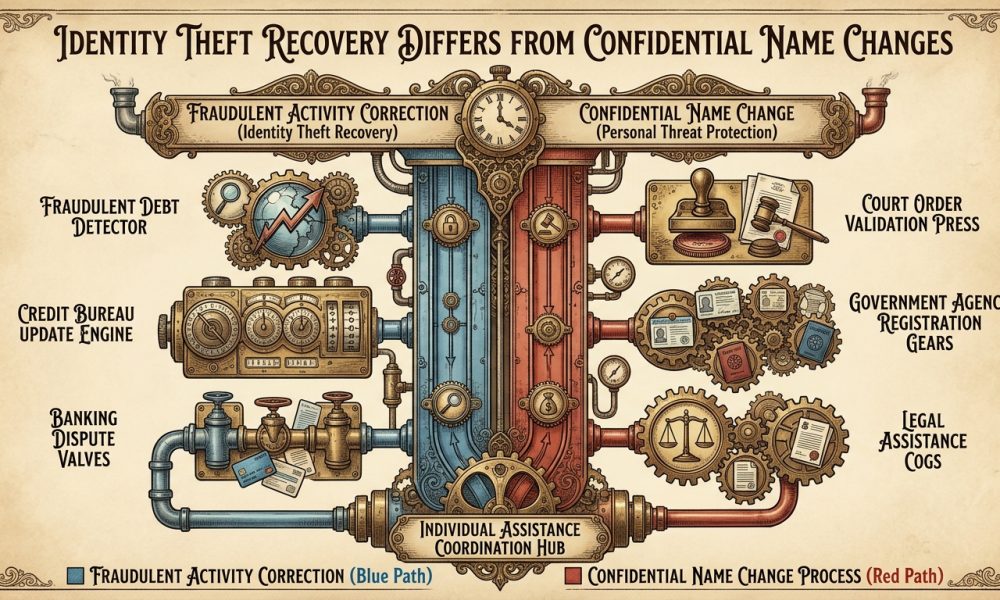
Addressing fraudulent financial activity, restoring compromised credit records, and protecting individuals from ongoing personal threats involve different legal procedures and professional services, even when survivors need help with both identity theft recovery and confidential name changes.
WASHINGTON, DC, October 29, 2026 — Americans experiencing identity theft, financial impersonation, domestic violence, stalking, or other serious personal safety concerns frequently encounter overlapping problems involving Identification records, financial accounts, and personal privacy, but the legal remedies available for these circumstances serve different purposes and require separate administrative procedures.
Identity theft recovery generally concentrates on identifying unauthorized activity, correcting fraudulent financial records, disputing illegitimate debts, and preventing further misuse of personal information. At the same time, confidential legal name changes concern the recognition of a new name and Protection against specified disclosures primarily.
These distinctions matter most when individuals experiencing persistent identity theft consider changing their legal names, because issuing replacement Identification documents does not automatically eliminate fraudulent accounts, restore credit histories, or remove information financial institutions previously collected.
Likewise, survivors of domestic violence or stalking who obtain confidential court orders may still require separate financial protections when abusive individuals have misused their identifying information, opened unauthorized accounts, or interfered with access to essential banking services.
Understanding the separate legal purposes of these remedies can help affected individuals identify appropriate government resources, obtain qualified professional assistance, and avoid misleading commercial promises that a new identity automatically resolves financial fraud or guarantees permanent personal anonymity.
Identity Theft Recovery Focuses on Correcting Unauthorized Activity
Identity theft occurs when someone improperly uses another person’s identifying information to commit fraud, potentially involving unauthorized credit applications, financial transactions, government benefits, tax filings, employment records, or other activities conducted without the legitimate individual’s permission.
The recovery process generally begins by identifying affected accounts, notifying relevant institutions, documenting suspicious activity, and determining which records require correction under applicable consumer Protection, banking, and identity theft laws.
A victim may discover that someone opened fraudulent credit cards without authorization, that an unfamiliar loan appears on a credit report, or that someone used identifying information to obtain services or government benefits improperly.
These circumstances ordinarily require direct engagement with affected financial institutions and relevant reporting agencies because obtaining replacement Identification documents alone does not automatically remove unauthorized transactions from institutional records.
The central objective is to correct financial and administrative information while protecting the individual’s legitimate identity, existing rights, and lawful credit history from continuing damage caused by another person’s unauthorized conduct.
Confidential Name Changes Address Different Personal Safety Concerns
Confidential name changes generally arise when individuals seek legal recognition of a new name while limiting access to sensitive information in court proceedings or other records protected by applicable statutes.
Such requests may involve survivors of domestic violence, stalking, harassment, or other circumstances in which disclosure of previous names, current identifying details, or residential information could present legitimate safety concerns.
Unlike ordinary identity theft recovery, a confidential name change does not necessarily involve fraudulent financial activity, because applicants may seek Protection even when their credit histories and banking records contain no unauthorized transactions.
Available procedures depend on state law, with some jurisdictions offering sealed proceedings, restricted publication requirements, or specialized protections to reduce unnecessary public disclosure of identifying information.
These remedies should not be confused with comprehensive financial record deletion, since courts may restrict access to particular judicial records without automatically changing information maintained by banks, employers, government agencies, or consumer reporting companies.
Federal Identity Theft Reports Support Financial Recovery
The Federal Trade Commission provides an important reporting framework that helps individuals document identity theft and get guidance on recovering compromised financial accounts and inaccurate consumer records.
According to the Consumer Financial Protection Bureau’s official guidance for identity theft victims, affected individuals can report fraudulent activity, obtain an FTC Identity Theft Report, and use applicable consumer protections to address unauthorized accounts and inaccurate credit information.
The federal recovery framework also explains how victims can notify financial institutions, request appropriate account restrictions, review credit reports, and communicate with reporting companies when fraudulent information appears within their consumer files.
An Identity Theft Report can provide important supporting evidence when requesting that institutions block qualifying fraudulent information from credit reports, although institutions may require additional documentation depending on the circumstances and applicable legal requirements.
These procedures operate independently of confidential name change applications, showing why individuals experiencing both identity misuse and personal safety threats may need more than one form of assistance.
Tax-Related Identity Theft Can Create Prolonged Administrative Problems
Identity theft can affect federal tax administration when someone improperly uses another taxpayer’s information to submit fraudulent returns, claim refunds, or interfere with legitimate filing procedures.
A January 2025 Associated Press report on delays in Internal Revenue Service identity theft cases described findings from the National Taxpayer Advocate about extensive processing delays and the difficulties taxpayers face when trying to resolve fraudulent return problems.
The report stated that affected taxpayers experienced average resolution periods of about 22 months, illustrating how identity theft can create substantial administrative consequences even when legitimate taxpayers promptly challenge unauthorized activity.
These reported delays concerned a specific period and category of tax-related identity theft cases, and they should not be interpreted as establishing that every current identity theft investigation requires an identical amount of time.
For affected individuals, the reporting demonstrates why formal fraud correction and record reconciliation remain necessary even when a person has legally changed their name or obtained replacement government Identification.
Credit Freezes and Fraud Alerts Perform Distinct Functions
Consumers concerned about unauthorized credit applications may consider security freezes and fraud alerts. However, these protections work differently and do not automatically correct existing fraudulent transactions or eliminate historical consumer information.
A security freeze generally restricts access to credit reports for specified purposes, making it harder for unauthorized individuals to establish new borrowing relationships while the restriction remains in effect.
A fraud alert instead requires prospective creditors to take additional steps to verify applicants’ identities before extending qualifying new credit, protecting without operating like a full security freeze.
Under federal law, consumers can generally place and lift security freezes without charge through the three nationwide credit reporting companies. In contrast, consumers can request initial fraud alerts through one company, which notifies the others.
Neither Protection guarantees that existing accounts cannot be compromised, and individuals experiencing active identity theft may still need to address account access, fraudulent transactions, and other security concerns directly with affected institutions.
Fraudulent Credit Information Can Be Challenged Without Changing Names
The Fair Credit Reporting Act provides protections that allow qualifying identity theft victims to request that reporting companies block fraudulent information in consumer reports when they provide the required supporting documentation.
For covered requests, reporting companies generally must block identity-theft-related information within four business days of receiving the documentation required by the relevant statutory provisions, subject to applicable exceptions.
These procedures focus on the accuracy of financial records rather than an individual’s legal name, so consumers generally do not need to obtain a court-approved name change before challenging unauthorized accounts or transactions.
Accurate adverse financial information generally cannot be removed simply because a consumer adopts a new legal name, so it is essential to distinguish genuine identity theft disputes from attempts to eliminate legitimate historical obligations.
For individuals whose personal information has been repeatedly misused, these protections provide a direct legal mechanism for addressing documented financial harm without relying on uncertain claims that replacement Identification will automatically create a separate credit history.
A Corrected Social Security Card Is Usually Not a New Number
The Social Security Administration generally issues corrected cards that show an individual’s updated legal name while keeping the previously assigned Social Security number, preserving continuity across employment, tax, and benefits administration.
This distinction matters because some identity Protection advertisements suggest that obtaining a court-approved name change automatically creates an entirely separate federal Identification number and financial history.
In reality, a name change does not ordinarily invalidate existing Social Security records, terminate outstanding financial obligations, or create an unrelated legal person for government administration purposes.
The agency may consider applications for different Social Security numbers in limited circumstances involving ongoing identity theft, harassment, abuse, or life-endangering situations, subject to evidence and eligibility requirements.
Even when another number is authorized, individuals may face practical difficulties with historical employment, financial, and government records, so a professional assessment is important before assuming reassignment will resolve every underlying problem.
New Social Security Numbers Are Subject to Strict Eligibility Requirements
Individuals requesting different Social Security numbers because of persistent identity theft generally must show they tried to resolve the misuse and still face qualifying problems with their existing numbers.
Separate eligibility considerations apply to situations involving harassment, abuse, domestic violence, or life endangerment, recognizing that personal safety circumstances can differ significantly from ordinary financial identity theft disputes.
Applicants may need to provide documentary evidence of the relevant circumstances and establish their identity, age, and citizenship or lawful immigration status, as required by the agency’s applicable administrative requirements.
A different Social Security number is not a guaranteed remedy, and obtaining one does not necessarily remove existing financial records or prevent organizations from maintaining authorized historical information.
Consequently, individuals should weigh the potential benefits and administrative complications of requesting another number rather than assuming the process automatically creates complete financial anonymity or permanently separates them from previous records.
Banking Records Continue Across Lawful Identity Changes
Financial institutions generally keep customer Identification, transaction, and account ownership records separate from the court procedures that approve legal name changes, creating additional responsibilities when customers request updated identifying information.
An individual who changes names after identity theft or personal threats may need to provide acceptable evidence showing continuity between previous and current records before a bank can amend existing accounts.
These requirements can protect customers against unauthorized account changes, particularly when an institution must determine whether the person requesting an update is legally entitled to control the financial relationship.
However, institutions may also need to consider confidentiality concerns when the customer has obtained protected court records or participates in a qualifying personal safety program.
The appropriate objective is accurate, secure account administration, not treating a new name as proof that earlier account ownership, transaction histories, or contractual obligations have disappeared.
Financial Abuse Can Involve Both Fraud and Personal Safety Threats
Domestic violence and coercive control can involve unauthorized borrowing, restricted access to financial resources, misuse of identifying information, and financial transactions conducted through deception or threats.
A survivor may therefore need identity theft recovery procedures to address fraudulent accounts while separately seeking confidential name-change protections or assistance through a state address-confidentiality program.
These circumstances show why a single professional service may not address every relevant problem, especially when financial disputes involve contractual obligations, family law, consumer Protection, or personal safety.
An identity theft report can help document unauthorized financial activity, but it does not automatically establish eligibility for confidential judicial proceedings or determine whether a protective order should be granted.
Likewise, a confidential legal name change may help with safety planning. Still, it will not, on its own, resolve disputed loans, remove inaccurate credit entries, or change the contractual rights associated with jointly owned financial accounts.
Victim Advocates and Consumer Protection Professionals Have Different Roles
Victim advocates may assist individuals experiencing domestic violence, stalking, or related threats by explaining available support services, coordinating referrals, and helping survivors understand relevant administrative procedures.
Consumer Protection attorneys and qualified financial counselors may address separate questions about fraudulent accounts, credit reporting disputes, debt collection, and financial institutions’ legal responsibilities.
Where both circumstances occur, coordinated professional assistance can help identify which problems require consumer reporting remedies and which involve judicial confidentiality, protective measures, or specialized victim services.
Advocates generally should not be assumed to have the authority to provide every form of legal representation, and credit repair organizations should not be treated as substitutes for qualified attorneys handling confidential court proceedings.
Clearly defined professional responsibilities let individuals get assistance suited to each problem without confusing financial record correction with protective legal identity changes.
Identity Theft Can Extend Beyond Ordinary Banking Fraud
Identity theft may involve medical information, employment records, tax filings, government benefits, or criminal impersonation, showing why recovery procedures must match the systems affected by unauthorized use of identifying information.
Medical identity theft can create inaccurate treatment or billing information, while employment-related misuse may raise questions about wages, tax records, or benefits tied to another person’s activities.
Criminal identity theft adds complications when an individual is incorrectly linked to police records or judicial proceedings because another person provided false identifying information to authorities.
Correcting these problems may require engaging with different institutions and government agencies, including procedures that differ substantially from ordinary credit-reporting disputes.
A confidential name change does not automatically correct these records because the underlying issue is inaccurate attribution of activities to the individual, not the legal recognition of a newly adopted name.
Passport Verification Does Not Establish a New Financial Identity
Government-issued passports provide important evidence of identity and nationality, but issuing a replacement passport after a legal name change does not, by itself, erase fraudulent financial records or eliminate existing government Identification histories.
Modern biometric passports contain electronic security features that allow compatible systems to retrieve selected identity information and evaluate document-authentication protections, helping distinguish legitimate travel credentials from certain forms of document tampering.
Amicus International Consulting examines these technical questions in its guide, which explains how to scan a passport’s NFC chip and interpret the results, including the difference between accessing electronic information and interpreting authentication results.
Successful electronic authentication does not determine whether an individual has experienced identity theft, whether a confidential court order is effective, or whether financial institutions have corrected inaccurate consumer records.
This distinction is especially important when commercial services suggest that an electronically verified passport can automatically replace an existing credit history or prevent authorized institutions from recognizing earlier financial relationships.
Digital Information Can Remain Accessible After Legal Changes
Individuals obtaining confidential name changes may remain concerned about historical information appearing through search engines, commercial data brokers, public records, or online profiles created before the legal transition.
These sources operate independently of the courts that approve confidential proceedings, so judicial restrictions do not necessarily require unrelated parties to delete previously collected records.
Identity theft recovery may involve correcting inaccurate financial information, while digital privacy efforts may involve lawful removal requests or restrictions on how particular platforms disclose personal details.
The remedies can overlap when inaccurate information creates an impersonation risk, but accurate historical records and fraudulent consumer information are subject to different legal considerations.
For individuals seeking Protection, it is important to distinguish correcting demonstrably false information from efforts to limit unnecessary public exposure of information accurately recorded in the past.
Confidentiality Applications Depend on State Law
State-specific laws and judicial procedures largely govern confidential legal name changes, creating differences in eligibility, required evidence, publication rules, and how protected court records are handled.
Some jurisdictions provide procedures addressing threats associated with domestic violence, stalking, or other qualifying circumstances, while others maintain different requirements for restricting access to sensitive judicial information.
Applicants should therefore avoid relying on generalized promises that every American court offers identical confidentiality protections, or that approval in one jurisdiction automatically establishes equivalent restrictions elsewhere.
An appropriately qualified attorney can evaluate the applicable rules, explain the required evidence, and identify whether a proposed application raises separate legal issues related to family relationships or existing obligations.
Identity theft recovery services should be distinguished from these judicial processes because challenging fraudulent financial records does not necessarily establish eligibility for confidential legal name change protections.
Children and Families May Face Additional Identity Protection Challenges
Children can experience identity theft when someone else improperly uses their identifying information to open financial accounts, obtain services, or conduct transactions before the affected child becomes aware of the misuse.
Parents and guardians may need to review applicable consumer reporting procedures and seek appropriate assistance when unauthorized information appears in records associated with a minor.
Separate issues arise when children need confidential legal name changes due to adoption, family safety concerns, or other circumstances involving parental authority and judicial oversight.
The procedures governing a child’s financial identity theft recovery do not automatically determine whether a family court can approve a name change or restrict disclosure of sensitive information.
Families should therefore distinguish fraudulent record correction from legal questions concerning custody, guardianship, adoption, and parental consent when evaluating the protections available to children.
International Relocation Does Not Automatically Resolve Identity Theft
Individuals experiencing identity theft or personal safety threats sometimes consider international relocation, additional citizenship, or overseas banking arrangements as part of broader plans to establish greater security and personal independence.
Although lawful relocation may provide practical benefits, it does not automatically correct fraudulent American credit reports, eliminate existing financial obligations, or prevent unauthorized information from remaining in historical records.
Foreign financial institutions may also request information explaining previous names, residential histories, and account ownership, particularly when applicants possess multiple citizenships or present documents issued under different legal names.
These verification procedures serve legitimate regulatory purposes and should not be confused with the improper disclosure of information to unauthorized individuals.
International identity planning must therefore account for existing financial and legal responsibilities rather than assuming that changing residence or nationality automatically creates an unrelated administrative history.
Commercial Identity Recovery Promises Deserve Careful Examination
Consumers experiencing financial fraud or personal safety threats may encounter commercial advertisements promising immediate credit restoration, guaranteed issuance of new Identification numbers, or complete separation from previous financial histories.
Such claims deserve scrutiny because consumer Protection laws set specific procedures for disputing inaccurate information, while government agencies control the issuance of Identification documents and recognize legal name changes.
A private company cannot guarantee that courts will approve confidential proceedings, financial institutions will remove accurate records, or Social Security authorities will issue different numbers outside applicable eligibility requirements.
Consumers should understand whether a proposed service involves administrative assistance, legal representation, credit monitoring, financial counseling, or another activity with distinct limitations and professional responsibilities.
The strongest service arrangements explain what can lawfully be accomplished, which institutions control the outcome, and whether government procedures remain available without purchasing expensive commercial assistance.
Coordinated Recovery Requires Accurate Records and Realistic Expectations
Individuals facing both identity theft and personal threats may benefit from maintaining organized documentation concerning fraudulent transactions, government correspondence, court orders, account changes, and communications with relevant institutions.
Accurate records can help establish the circumstances surrounding unauthorized financial activity and support separate applications for confidential name changes or other legally available personal safety protections.
However, individuals should consider how sensitive information is stored and shared, because unnecessary disclosure of identifying details may create additional privacy concerns for those already experiencing harassment or financial impersonation.
Qualified professionals can help evaluate these competing considerations while ensuring that inaccurate financial information is challenged through appropriate procedures and legitimate historical records are not misrepresented.
This coordinated approach preserves the distinction between restoring financial accuracy and protecting confidentiality, allowing each problem to be addressed under its own legal requirements.
Identity Theft Recovery and Confidentiality Protection Serve Complementary Purposes
Identity theft recovery and confidential name changes both support personal security. Still, they address different legal problems and should not be presented as interchangeable ways to establish financial independence or reduce unwanted exposure.
The recovery process seeks to correct unauthorized activity and protect legitimate records, while confidential legal changes focus on recognizing a new name and specific safeguards against disclosure.
For individuals experiencing both financial impersonation and personal safety threats, effective assistance may require coordination between consumer Protection resources, qualified attorneys, victim advocates, financial institutions, and government Identification agencies.
The availability of several remedies does not mean that any single procedure guarantees complete anonymity, permanent removal of historical records, or immunity from continuing legal obligations.
Ultimately, understanding these distinctions helps affected individuals pursue lawful financial recovery and appropriate confidentiality protections without relying on misleading promises that changing a name, obtaining a replacement document, or relocating internationally will automatically resolve every identity-related problem.




