
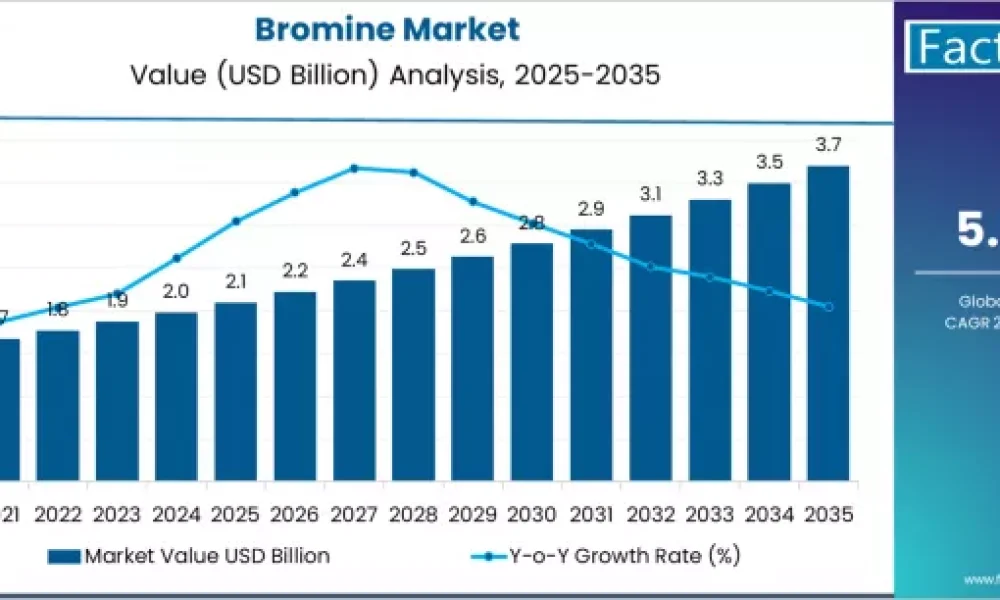
The U.S. bromine market is positioned for steady and strategically important expansion throughout the 2025–2035 period, driven by strengthening demand across oilfield services, flame-retardant applications, water treatment, and emerging energy-storage technologies. With the national market estimated at about USD 1.01 billion in 2024, industry analysts expect a durable growth cycle fueled by both traditional and next-generation use cases.
Market Outlook
Forecast models project that the U.S. bromine market will grow at a compound annual growth rate (CAGR) of roughly 5–6% from 2025 through 2035. This trajectory would bring the market toward the USD 1.7–1.8 billion range by the early 2030s, depending on specific end-use dynamics and regulatory developments. Several factors underpin this positive outlook, including sustained industrial consumption, the expansion of high-performance materials, and the rising urgency of water-treatment solutions nationwide.
To access the complete data tables and in-depth insights, request a Discount On The Report here: https://www.factmr.com/connectus/sample?flag=S&rep_id=12103
Key Drivers of Market Growth
1. Oilfield Chemicals and Clear Brine Fluids
Clear brine fluids (CBFs) remain among the most important applications for bromine in the United States. As domestic drilling and well-completion activity continues to rebound—especially in shale-rich regions—demand for bromine-based brines with high specific gravities is expected to rise. These fluids are essential for maintaining well control, stabilizing high-pressure formations, and enabling efficient completion processes.
CBFs historically represent one of the single largest consumption segments for elemental bromine. The resurgence of unconventional drilling and support for new offshore exploration further reinforce this category as a long-term demand pillar.
2. Flame Retardants and Organobromine Compounds
Brominated flame retardants (BFRs) constitute a major downstream derivative market for bromine. These compounds continue to play a significant role in ensuring fire safety across electronics, automotive components, construction materials, textiles, and packaging. Despite ongoing regulatory evaluation of certain classes of flame retardants, the overall need for high-performance fire-safety additives remains strong, particularly in sectors that require compliance with strict safety standards.
As U.S. construction spending grows and high-density electronics become more prevalent, demand for advanced organobromine compounds—especially those engineered for improved environmental performance—is expected to expand steadily.
3. Water Treatment and Biocides
Bromine-based biocides and disinfectants have gained significant traction in both industrial and municipal water-treatment settings. Brominated disinfectants are valued for their stability, efficacy at high temperatures, and ability to function effectively in systems with high organic loads or varying pH.
Growing pressures on U.S. water infrastructure—including population increases, industrial expansion, and tighter contamination standards—support the long-term adoption of bromine-derived treatment chemicals.
4. Energy Storage and Advanced Technologies
One of the most promising emerging applications for bromine is in zinc-bromine flow batteries and related energy-storage systems. As grid modernization accelerates and renewable-energy deployment increases, demand for efficient, scalable, and long-duration storage technologies will expand accordingly.
Zinc-bromine batteries offer advantages such as longer cycle life, enhanced safety, and competitive cost profiles compared with certain lithium-ion chemistries. If adoption broadens across utility-scale and commercial sectors, this application could become a significant growth catalyst for the bromine market by the early 2030s.
Supply Landscape and Competitive Dynamics
The U.S. bromine industry is highly concentrated, with production largely integrated from raw brine extraction through specialty chemical manufacturing. Leading producers manage extensive supply chains—from brine wells to derivative processing facilities—allowing them to supply both commodity-grade bromine and high-purity specialty compounds.
Competition centers on technology, product purity, environmental compliance, and vertical integration. Many producers are investing in:
Upgraded brine-processing efficiencies
Expanded high-margin derivative portfolios
Recycling and waste-reduction systems
New technologies supporting energy storage and advanced materials
Geographic advantages, particularly in regions with bromine-rich brines, give U.S. producers a strong foundation for long-term supply security.
Regulatory and Sustainability Considerations
Regulation is a major shaping force for the U.S. bromine market. While some brominated flame retardants face restrictions or phase-outs, the industry continues to innovate, offering safer and more environmentally compatible alternatives. Enhanced disclosure frameworks and stricter chemical-safety guidelines are prompting producers to focus on low-toxicity, high-performance derivatives.
Sustainability pressures—driven by corporations, consumers, and government agencies—are pushing the bromine industry toward:
Cleaner production methods
Reduced effluent discharge
Circular-economy practices
Lifecycle-optimized chemistries
Companies that proactively adapt to this evolving regulatory landscape and offer compliant, next-generation bromine solutions will be better positioned for competitive advantage through 2035.
Price and Market Risks
Prices in the bromine sector fluctuate based on feedstock availability, energy costs, international supply dynamics, and oilfield activity cycles. Key risks include:
Upstream supply disruptions
Regulatory tightening affecting product classes
Competition from substitute flame-retardant chemistries
Variability in global chemical-manufacturing capacity
However, diversification into water treatment, energy storage, and specialty performance chemicals helps mitigate exposure to cyclical segments.
Strategic Implications
For major stakeholders, the next decade offers clear opportunities:
Producers
Accelerate investment in derivative innovation
Strengthen supply resilience through integration and local sourcing
Expand into energy-storage-grade bromine materials
Manufacturers and End Users
Secure sustainable, long-term contracts with qualified suppliers
Prioritize bromine derivatives that meet evolving safety regulations
Evaluate opportunities in replacing or enhancing existing flame-retardant systems
Investors
Look for companies positioned at the intersection of bromine and future-tech segments such as grid storage
Favor firms with proven ESG credentials
Monitor regulatory developments that may shift category growth rates
About This Release
This press release provides a forward-looking, data-driven overview of U.S. bromine market dynamics for the 2025–2035 period. It highlights key economic drivers, technological developments, and strategic opportunities shaping the outlook for producers, investors, and industrial buyers.
Have a specific Requirements and Need Assistant on Report Pricing or Limited Budget please contact us – [email protected]
To View Related Report :
Lactic Acid Market https://www.factmr.com/report/lactic-acid-market
Ion Exchange Resins Market https://www.factmr.com/report/ion-exchange-resins-market



