
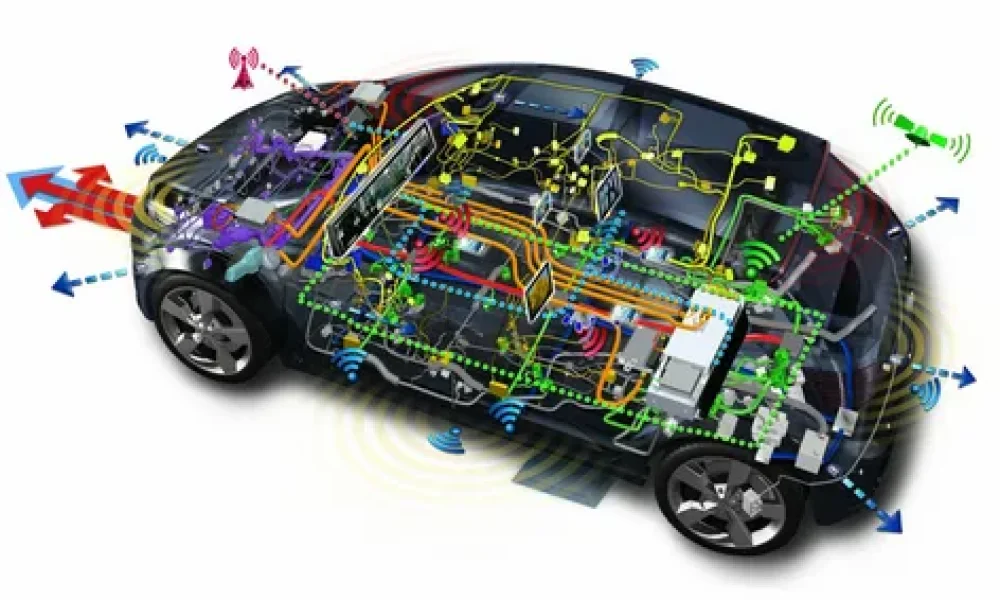
The global automotive electronics market is set to witness robust expansion over the next decade, driven by the increasing consumer demand for connected, intelligent, and safety-centric vehicles. According to the latest industry forecasts, the market is projected to grow from USD 270.5 billion in 2025 to USD 424.2 billion by 2035, at a steady CAGR of 4.6%, fueled by rapid advancements in vehicle electrification, automation, and infotainment technologies.
As vehicles increasingly transition into software-defined platforms, electronics are becoming central to vehicle performance, safety, and user experience, spurring consistent demand across both OEM and aftermarket ecosystems. Automotive electronics encompass systems and control units responsible for communication, entertainment, diagnostics, and operational efficiency, spanning powertrain control, body electronics, infotainment, ADAS (Advanced Driver Assistance Systems), and safety mechanisms.
“Automotive electronics are no longer auxiliary components; they are the backbone of modern vehicle functionality,” said an industry analyst. “From energy management in EVs to digital cockpits in luxury vehicles, electronics are at the heart of innovation.”
Regional Outlook: Key Markets Driving Growth
North America leads the adoption of advanced electronics due to strong demand for ADAS, infotainment, and EV technologies. OEMs like Tesla, Rivian, and GM are spearheading the integration of collision avoidance, adaptive cruise control, and lane-keeping assist systems. Additionally, growing consumer preference for connected vehicles has accelerated the deployment of cloud-linked infotainment and digital cockpit systems. The region is also a front-runner in V2X-enabled hardware and autonomous vehicle R&D, supported by regulations from FMVSS and NHTSA.
Europe remains a hub of automotive electronics innovation, propelled by strict EU safety and emissions standards, a mature luxury vehicle market, and strong EV adoption. Germany, France, and Sweden are driving adoption of digital instrument clusters, sensor fusion modules, and AI-powered ECUs, enabling Level 3 autonomy. Modular power electronics and cybersecurity-compliant designs in EVs further position Europe as a key market for advanced electronics development.
Subscribe for Year-Round Insights → Stay ahead with quarterly and annual data updates
https://www.futuremarketinsights.com/reports/sample/rep-gb-1726
Asia-Pacific is the largest volume market, with China, Japan, South Korea, and India contributing significantly. China dominates EV and ADAS component demand, while Japan focuses on sensor, radar, and microcontroller development, and South Korea leads in high-end infotainment and energy-efficient powertrain control. India is emerging with cost-effective electronics for compact and mid-size vehicles, reflecting growing regulatory focus on vehicle safety.
Rest of the World, including Latin America, the Middle East, and Africa, is gradually expanding adoption of safety systems, infotainment, and emission-compliant electronics. Brazil and Mexico are integrating automated safety features, while the Middle East shows a high demand for premium electronic systems in luxury vehicles.
Complexities and Market Challenges
The growth of automotive electronics introduces software integration complexities. Modern vehicles now operate with over 100 million lines of code across multiple ECUs, increasing the risk of integration failures. Software-related recalls rose by 22% globally in 2023, often linked to ADAS calibration errors or infotainment glitches.
Supply chain vulnerabilities in semiconductors also pose challenges. Long lead times and chip shortages impact the production of MCUs, SoCs, sensors, and EV-specific power modules like IGBTs and SiC devices. These constraints affect tier-1 suppliers and OEMs’ just-in-time manufacturing strategies, adding costs and delaying system integration.
Opportunities and Innovations
Software-defined vehicles (SDVs) are transforming automotive architecture from multiple ECUs to centralized computing units, integrating ADAS, infotainment, and powertrain functions. This approach simplifies wiring, accelerates OTA software updates, and opens avenues for scalable electronics platforms.
ADAS integration is accelerating across vehicle segments, with Level 1 and Level 2 systems now common in compact, mid-size, and SUV vehicles. Advanced radar, lidar, camera modules, and fail-operational ECUs are in increasing demand.
Next-generation infotainment and connected ecosystems are redefining in-car experiences. Integration of 5G, edge computing, and cloud services enables vehicles to act as mobile digital hubs, supporting navigation, streaming, smart assistants, and in-vehicle commerce. In North America, average spending on digital in-car content increased 26% year-over-year in 2023.
Vehicle Segment Insights
Luxury vehicles continue to be innovation drivers, integrating over 100 ECUs, high-definition infotainment, surround-view cameras, AI-assisted parking, and biometric access. Brands like Mercedes-Benz, BMW, and Genesis leverage OTA updates and voice recognition, testing next-generation electronics.
Light Commercial Vehicles (LCVs) are rapidly adopting telematics, cargo management, fleet tracking, and EV-specific electronics, fueled by e-commerce and smart logistics initiatives. Over one-third of newly registered commercial vans in North America and Western Europe already feature fleet management telematics.
Competitive Landscape
Leading players are investing heavily in ADAS, infotainment, safety, and EV power electronics:
Robert Bosch GmbH – 14–18% market share; comprehensive electronics including ADAS, infotainment, and power modules.
Continental AG – 11–15%; intelligent cockpit systems and autonomous driving solutions.
Denso Corporation – 10–13%; advanced safety, thermal electronics, and hybrid vehicle control.
Aptiv PLC – 6–9%; software-defined vehicle architectures and ADAS platforms.
ZF Friedrichshafen AG – 5–8%; electronics for powertrain, braking, and autonomous functions.
Other key players include Valeo SA, Hitachi Astemo, Panasonic Automotive Systems, Mitsubishi Electric, Infineon Technologies, NXP Semiconductors, Analog Devices, Visteon, and Renesas Electronics.
Personalize Your Experience: Ask for Customization to Meet Your Requirements!
https://www.futuremarketinsights.com/customization-available/rep-gb-1726
Outlook 2025–2035
The automotive electronics market is set to grow steadily, driven by electrification, connected mobility, autonomous technologies, and AI-enabled control systems. Regulatory mandates on safety, emissions, and cybersecurity, coupled with the rise of software-defined vehicles and next-gen infotainment, will continue to reshape the industry. By 2035, automotive electronics will underpin the evolution of smart, autonomous, and sustainable mobility.
About Future Market Insights (FMI)
Future Market Insights, Inc. (FMI) is an ESOMAR-certified, ISO 9001:2015 market research and consulting organization, trusted by Fortune 500 clients and global enterprises. With operations in the U.S., UK, India, and Dubai, FMI provides data-backed insights and strategic intelligence across 30+ industries and 1200 markets worldwide.
Why Choose FMI: Empowering Decisions that Drive Real-World Outcomes:
https://www.futuremarketinsights.com/why-fmi



