
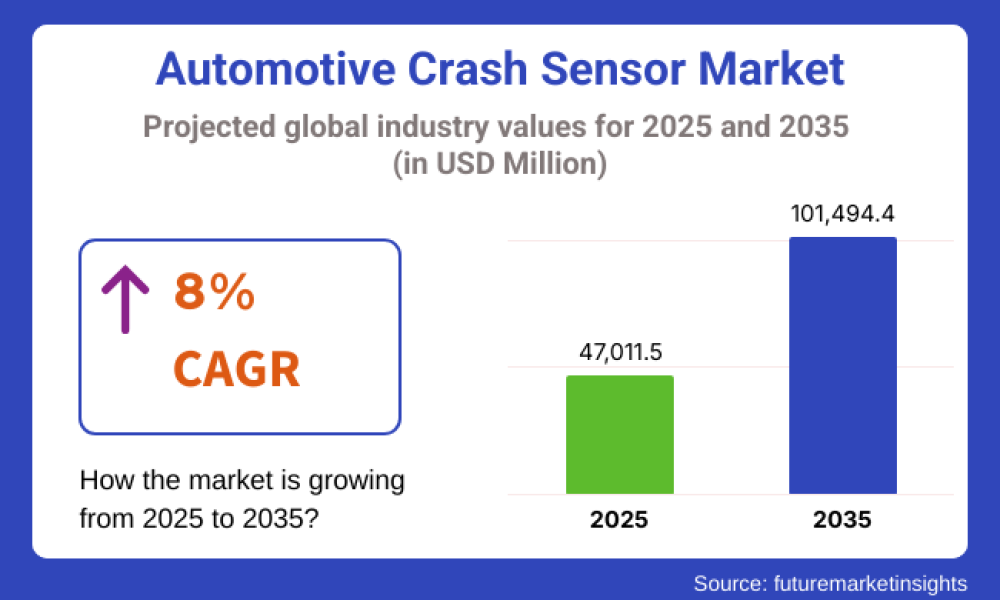
The global automotive crash sensor market is entering a phase of accelerated expansion, growing from USD 47.01 billion in 2025 to USD 101.49 billion by 2035 at a CAGR of 8%. This growth is fueled by tightening global safety regulations, rapid ADAS deployment, rising consumer demand for preventive safety features, and the increasing integration of advanced crash-detection systems in electric and autonomous vehicles.
Crash sensors form the backbone of modern vehicle safety architecture. Installed across vehicle structures—from bumpers and doors to battery housings—they detect collision intensity in milliseconds and trigger airbags, seatbelt pretensioners, and intelligent braking responses. As vehicles transition toward electrified and software-defined platforms, manufacturers are adopting smaller, faster, and smarter sensors with enhanced data-processing capabilities and seamless integration into electronic control units (ECUs).
Demand Surges as Safety Requirements Become Stricter Worldwide
Global automakers are upgrading sensor suites to meet evolving crash-test benchmarks, including Euro NCAP 2030 protocols, NHTSA airbag standards, and India’s Bharat NCAP rules. Passenger vehicles remain the largest application segment due to sustained demand for frontal, side-impact, and rollover protection. Meanwhile, commercial vehicles increasingly rely on multi-zone sensors for cab safety and structural integrity monitoring.
Electrification trends further accelerate market expansion. EVs require specialized sensors to protect high-voltage battery packs and automatically isolate circuits during severe impacts. These EV-specific crash sensors are emerging as a major revenue stream for OEMs and Tier-1 suppliers.
Advancements in wireless crash sensing, miniaturized MEMS sensors, and sensor fusion technologies are overcoming historic challenges related to calibration complexity, multi-sensor synchronization, and integration costs.
Subscribe for Year-Round Insights → Stay ahead with quarterly and annual data updates
https://www.futuremarketinsights.com/reports/sample/rep-gb-725
Pressure Sensors and AEB Systems Lead Market Adoption
By product type, pressure sensors dominate due to their unmatched speed and accuracy in detecting sudden pressure changes during collisions. Often embedded in doors and side panels, they trigger airbags within milliseconds—critical for side impacts and rollover crashes where decision windows are extremely narrow. Their compact design, enhanced environmental resilience, and compatibility with advanced ECUs ensure continued adoption across passenger and commercial vehicles.
On the application front, autonomous emergency braking (AEB) leads the market. AEB systems rely heavily on crash sensor inputs—pressure sensors, accelerometers, radar, and camera data—to assess vehicle speed, collision distance, and deceleration rates. The system automatically applies braking to avoid or mitigate a collision. With AEB becoming mandatory or strongly recommended in North America, Europe, Japan, and China, its market share will continue to rise across all vehicle classes.
AEB’s integration with forward-collision warning, pedestrian detection, and adaptive cruise control expands its relevance for both traditional and autonomous driving environments. Fleet operators increasingly favor AEB-equipped vehicles due to lower insurance premiums and reduced repair costs.
Regional Trends Highlight Rapid Adoption in Asia-Pacific
North America continues to lead in regulatory enforcement, with the U.S. prioritizing next-generation crash tests for autonomous vehicles and strict airbag requirements.
Europe remains an innovation hub, driven by Euro NCAP incentives and strong consumer preference for top-rated safety systems.
Asia-Pacific posts the fastest growth, supported by rising vehicle production, new safety mandates in China and India, and expanding localization of sensor manufacturing.
Country-wise CAGR outlook (2025–2035):
- USA: 7.6%
- UK: 7.9%
- European Union: 8.0%
- Japan: 7.5%
- South Korea: 8.4% (fastest-growing developed market)
Rising EV sales, urban congestion, and growing accident-awareness campaigns in Asia-Pacific strengthen long-term demand for advanced crash-sensing solutions.
Challenges: Integration Complexity and Cost Constraints
Despite strong growth, manufacturers face critical challenges in integrating crash sensors into diverse vehicle architectures. Ensuring compatibility between sensors, ECUs, and restraint systems—while maintaining millisecond-level response times—creates calibration burdens. Cost pressures remain significant in developing markets, where price-sensitive vehicle models often limit adoption of multi-sensor ADAS packages.
Environmental durability is another hurdle. Sensors must function reliably under extreme temperatures, vibrations, electromagnetic interference, and moisture conditions—especially in emerging markets.
Opportunities: ADAS Evolution, AI Integration, and Autonomous Mobility
Long-term opportunities are emerging across several innovation fronts:
- ADAS integration: Higher ADAS adoption ensures increased demand for multi-sensor crash networks.
- AI and predictive analytics: Future sensors will leverage edge processing and machine learning for real-time interpretation and post-crash diagnostics.
- Autonomous vehicles and V2X: Self-driving platforms require continuous 360-degree sensing for passenger protection.
- EV safety systems: Sensors designed to protect EV battery modules will see rapid penetration in high-growth markets.
- Sustainability: Interest in modular, recyclable sensors is rising as OEMs push for eco-friendly vehicle architectures.
Between 2025 and 2035, crash sensors will evolve into intelligent, software-driven protection components that integrate seamlessly with autonomous control units.
Personalize Your Experience: Ask for Customization to Meet Your Requirements!
https://www.futuremarketinsights.com/customization-available/rep-gb-725
Competitive Landscape: Tier-1 Leaders Accelerate Miniaturization and Sensor Fusion
The global market remains consolidated among major Tier-1 technology providers and specialized sensor developers. Estimated 2025–2035 market share:
- Robert Bosch GmbH: 20–24%
- DENSO Corporation: 15–19%
- Continental AG: 12–16%
- Sensate Technologies: 9–13%
- ZF Friedrichshafen AG: 8–12%
- Infineon Technologies AG: 6–10%
- Others: 18–26%
Key players are investing in MEMS-based sensors, high-G impact tolerance, multi-point detection, and AI-enhanced crash signal processing. EV-focused sensors from Continental, advanced accelerometers from Sensate, and Infineon’s scalable IC platforms highlight the market’s innovation trajectory.
Future Outlook
Between now and 2035, the automotive crash sensor market will be shaped by three major forces:
- Global ADAS mandates accelerating integration into mainstream vehicles.
- EV proliferation, creating new demand for battery-protection sensors.
- Autonomous driving ecosystems, requiring continuous and predictive crash detection.
With road safety taking center stage, crash sensors will remain indispensable to achieving global zero-fatality goals and enabling safer, smarter mobility systems worldwide.
Have a specific Requirements and Need Assistant on Report Pricing or Limited Budget please contact us –[email protected]
About Future Market Insights (FMI)
Future Market Insights, Inc. (FMI) is an ESOMAR-certified, ISO 9001:2015 market research and consulting organization, trusted by Fortune 500 clients and global enterprises. With operations in the U.S., UK, India, and Dubai, FMI provides data-backed insights and strategic intelligence across 30+ industries and 1200 markets worldwide.



