
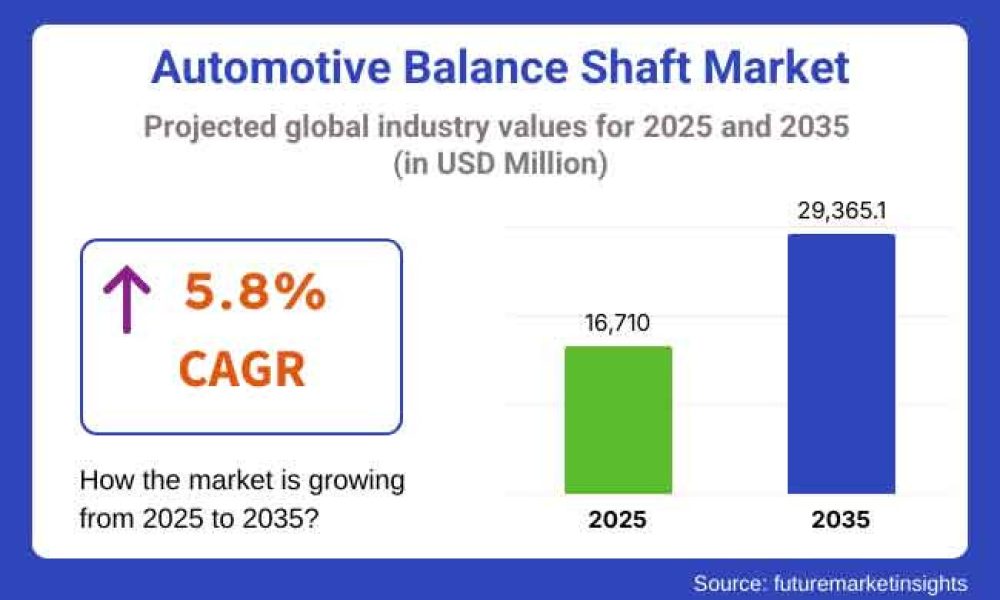
The global automotive balance shaft market is entering a period of steady and technology-driven expansion, with projections indicating growth from USD 16,710 million in 2025 to USD 29,365.1 million by 2035, reflecting a robust CAGR of 5.8%. This sustained momentum is attributable to mass production of inline-3 and inline-4 cylinder engines, tighter global emission standards, and continued demand for smoother and quieter engine performance—particularly in developing markets where internal combustion engines (ICEs) will remain critical for the next decade.
Balance shafts play a vital role in optimizing engine refinement by counterbalancing vibration and secondary imbalances inherent in compact ICE layouts. As automakers pursue stricter NVH (noise, vibration, harshness) standards, enhanced driver comfort, and fuel-efficiency improvements, balance shaft integration is becoming an essential component of modern powertrain engineering.
Inline-4 Engines and Forged Shafts Lead Market Growth
Inline-4 cylinder engines, which dominate global vehicle production across compact cars, sedans, SUVs, and light trucks, account for the overwhelming share of balance shaft installations. Their mechanical efficiency, cost-effectiveness, and compatibility with turbocharged and downsized engines make them a prime driver of market demand. As OEMs emphasize fuel efficiency and emissions compliance, inline-4 engines continue to be the preferred layout—reinforcing balance shaft adoption globally.
On the manufacturing front, forged balance shafts maintain a dominant position due to their superior strength-to-weight ratio, fatigue resistance, dimensional precision, and longevity under high-RPM conditions. These shafts deliver higher mechanical stability and are widely deployed in high-performance, hybrid, and heavy-duty applications.
Advanced CNC machining, refined grain structures, heat treatment processes, and new alloy developments are enabling OEMs to engineer balance shafts that meet modern engine durability, weight, and efficiency requirements. Cast balance shafts remain viable in cost-sensitive segments but forged variants will continue to command the premium-performance market.
Subscribe for Year-Round Insights → Stay ahead with quarterly and annual data updates
https://www.futuremarketinsights.com/reports/sample/rep-gb-559
Regional Insights: Asia-Pacific Leads, North America and Europe Intensify Hybrid Powertrain Integration
Asia-Pacific
Asia-Pacific remains the fastest-growing and most production-intensive region, driven by China, India, South Korea, and Southeast Asia. Mass-market adoption of fuel-efficient compact cars and turbocharged petrol engines, combined with tightening NVH and emissions standards, continues to propel demand for balance shafts. Local and multinational OEMs are increasingly integrating high-precision forged shafts to meet evolving performance and regulatory expectations.
North America
North America’s market growth is fueled by high-performance vehicles, trucks, and premium utility segments. Modular engine platforms featuring turbocharged inline configurations are seeing renewed investment. OEM hubs in Michigan and Ohio are developing lightweight, hybrid-ready shaft systems through advancements in aluminum and high-strength alloy engineering.
Europe
Europe’s trajectory is strongly influenced by Euro 7 and emerging decarbonization requirements. Balance shafts remain crucial for fuel-efficient diesel and turbocharged petrol engines, particularly within Germany, France, and the UK. As automakers downsize and hybridize ICE powertrains, dual-shaft systems and NVH-optimized forged shafts are gaining prominence.
Country-Level Growth Forecasts (CAGR, 2025–2035)
- United States: 6.1%
- United Kingdom: 5.5%
- European Union: 5.8%
- Japan: 5.4%
- South Korea: 6.0%
Opportunities Despite the EV Transition: Hybrids Drive Next Wave of Adoption
Although long-term electrification remains a challenge—since EVs do not require balance shafts—hybrid electric vehicles (HEVs & PHEVs) present a major growth pathway. Hybrids retain combustion engines and thus demand advanced vibration-damping solutions to ensure seamless ICE-to-electric driving transitions.
Opportunities include:
- Lightweight balance shafts utilizing hollow forged structures, alloy composites, and laser-welded designs
- Integration with onboard sensors enabling real-time NVH monitoring
- Precision-engineered shafts optimized for turbocharged and start-stop engines
- Expansion of shaft applications in commercial fleets and high-duty cycles
Rising consumer demand for quieter, smoother vehicles in developing markets will continue supporting balance shaft adoption throughout the forecast period.
Personalize Your Experience: Ask for Customization to Meet Your Requirements!
https://www.futuremarketinsights.com/customization-available/rep-gb-559
Competitive Landscape: Precision Engineering and Modular Designs Define Leadership
The global market remains moderately consolidated, with leading players investing heavily in forging techniques, hybrid-compatible components, and modular shaft assemblies. Key companies and their recent innovations include:
SKF Group (14–17%)
- Introduced ultra-lightweight forged shafts for inline-3 engines (2024)
- Launched integrated oil-pump balance shaft assemblies for reduced mass and improved engine efficiency (2025)
Schaeffler AG (11–14%)
- Developed modular balance shaft systems for ICEs and hybrids (2024)
- Expanded hollow-shaft production with variable balancing mass for luxury OEMs (2025)
Metaldyne Performance Group (9–12%)
- Released advanced powder metal shafts for cost-effective damping (2024)
- Introduced standardized balance shaft kits for emerging-market compact vehicles (2025)
American Axle & Manufacturing (7–10%)
- Improved heat treatment processes for high-RPM durability (2024)
- Unveiled NVH-optimized shafts for electric-assisted turbo engines (2025)
Hirschvogel Automotive Group (6–9%)
- Developed friction-welded lightweight shafts to reduce rotational mass (2024)
- Expanded Southeast Asia production to support growing compact vehicle manufacturing (2025)
Collectively, regional and Tier-2 manufacturers account for 38–45% of remaining market share, focusing on cost-effective shafts for two-wheelers, entry-level vehicles, off-highway equipment, and small engines.
Market Outlook Through 2035: Technology, Hybridization, and NVH Will Shape the Future
Between 2020 and 2024, balance shaft demand rebounded from pandemic-related disruptions as automakers intensified powertrain downsizing. From 2025 onward, the market will increasingly revolve around hybrid engines, real-time NVH optimization, sensor-integrated shafts, and lightweight metallurgy. As global OEMs transition toward modular and hybrid-compatible engines, balance shafts will remain a critical enabler of smooth, refined, and fuel-efficient mobility—well into the next decade.
Have a specific Requirements and Need Assistant on Report Pricing or Limited Budget please contact us –[email protected]
About Future Market Insights (FMI)
Future Market Insights, Inc. (FMI) is an ESOMAR-certified, ISO 9001:2015 market research and consulting organization, trusted by Fortune 500 clients and global enterprises. With operations in the U.S., UK, India, and Dubai, FMI provides data-backed insights and strategic intelligence across 30+ industries and 1200 markets worldwide.



