
Tortilla Market Overview :
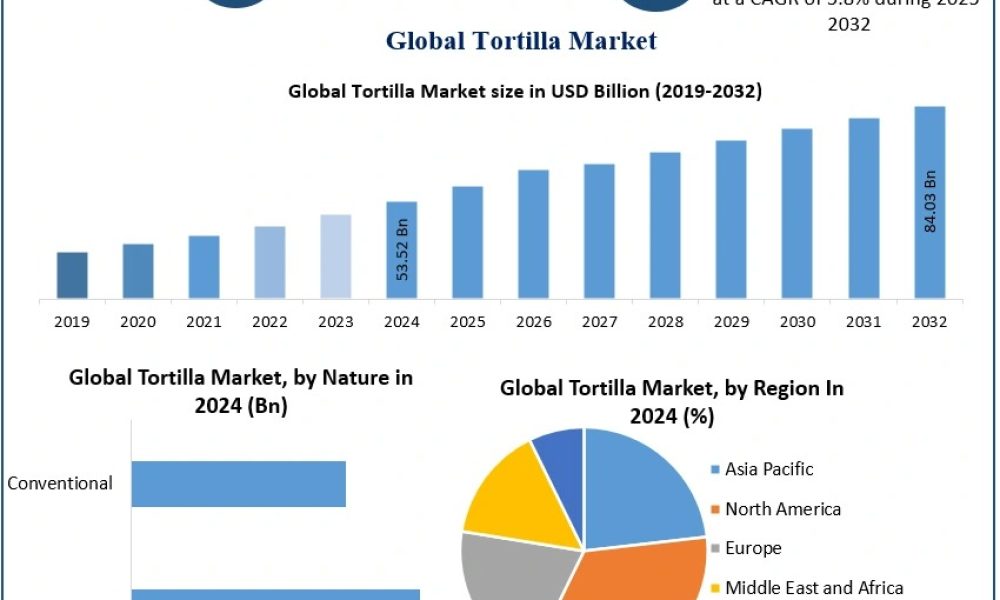
Tortilla Market is gearing up for remarkable expansion, expected to climb from USD 53.52 billion in 2024 to nearly USD 84.03 billion by 2032, achieving a robust CAGR of 5.8%. As tortillas cement their status as a core global staple—not just a Mexican or Latin American specialty—innovation, convenience, and health-oriented offerings are driving steady growth. North America maintains its prominence, led by a dynamic Hispanic population, popularity in mainstream diets, and ongoing product differentiation.
Key Highlights & Insights
Market Size & Growth: Global market projected to reach USD 84.03 billion by 2032, up from USD 53.52 billion in 2024, at a CAGR of 5.8%.
Dominating Region: North America holds the largest revenue share (~40% in 2024) due to the growing Hispanic and Latino population, widespread consumer preference for tortillas over traditional breads, and innovation in both retail and foodservice sectors.
Leading Segment: The tortilla chips segment is forecasted for rapid growth due to the snackification trend, while flour tortillas and corn tortillas remain foundational categories. Frozen tortillas continue to see demand due to rising convenience preferences.
Key Driver: Consumer shift toward plant-based, organic, and gluten-free foods, alongside greater awareness of tortillas’ health and nutritional benefits (fiber, vitamins), is spurring industry gains.
Recent Developments
The frozen tortilla segment witnessed rapid expansion, supporting smaller producers and export-driven brands with extended shelf-life solutions.
Manufacturers are investing in high-protein, fortified, and clean-label tortilla varieties, including organic and gluten-free offerings.
Partnerships between global brands and restaurant chains expand the reach of value-added tortilla and tortilla-based products across key regions.
Major players like GRUMA, PepsiCo, and local producers continue capacity enhancement and launch of new product innovations.
Market Dynamics
Growth Drivers:
Heightened interest in ethnic and global cuisines, especially Mexican, among mainstream consumers worldwide.
The versatility of tortillas as food bases for wraps, tacos, burritos, and snacks, boosting demand in both households and foodservice.
Fast-paced lifestyle changes and urbanization drive demand for ready-to-eat, nutritious foods with clean labels and transparent sourcing.
Growing consumer consciousness about health—more demand for low-fat, fiber-rich, and gluten-free tortilla products.
Challenges:
High sodium content and food safety concerns require careful monitoring and clear labeling, particularly with evolving regulatory norms.
Fluctuating prices for key raw material inputs (corn, wheat) may affect profitability and retail prices.
Competition from alternative breads and wraps in both traditional and emerging markets.
Regional Analysis
North America: The largest and most mature market (40%+ share), led by the U.S. and Mexico. Popularity of tacos, burritos, and tortilla-based snacks is reinforced by the growing Hispanic demographic and crossover into mainstream diets.
Latin America: Tortilla’s cultural significance ensures high consumption, with countries like Mexico, Guatemala, and Argentina as big consumers.
Europe: On the rise, mainly within the UK, France, and Germany, driven by restaurant and retail adoption of Mexican and Tex-Mex cuisines.
Asia Pacific, Middle East & Africa: Emerging as growth markets through urbanization, rising awareness, and popularity in quick-service restaurants.
For full access to the data, request a sample report now :https://www.maximizemarketresearch.com/request-sample/127189/
Product Segmentation
By Nature: Organic and conventional.
By Processing Type: Fresh (raw) tortillas, frozen tortillas.
By Product Type: Tortilla chips, taco shells, tostadas, flour tortillas, corn tortillas, others.
By Source: Wheat and corn.
By Distribution Channel: Hypermarkets/supermarkets, convenience stores, online platforms, others.
Key Trends
Clean-label, gluten-free, and fortified tortilla introductions appeal to health-focused and diverse dietary consumers.
Frozen and value-added tortilla products aid convenience and market expansion, including seasoning-infused and functional-ingredient varieties.
eCommerce and online grocery platforms expand market reach, while sustainable and eco-friendly packaging is gaining industry traction.
Increased collaboration with foodservice providers stimulates adoption of tortillas as mainstream dining and snacking option.
Quote
North America’s leadership in the tortilla market is a testament to the food’s evolving role as both a cultural staple and a versatile, nutritious global meal solution. As demand for healthy, convenient, and authentic foods grows, tortillas are set to anchor menus and shopping carts well into the next decade.
With strong regional performance, innovative product lines, and global consumer enthusiasm for convenience and ethnic flavors, the tortilla market is positioned for continued robust growth and cultural crossover worldwide.




