

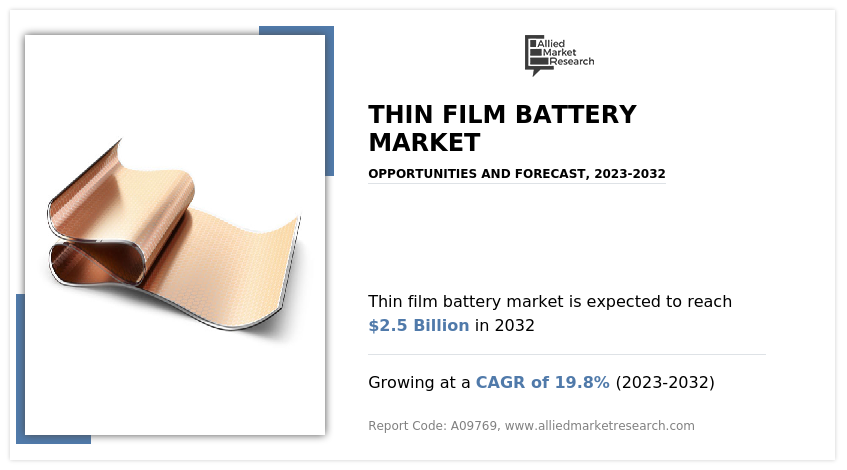
According to a new report published by Allied Market Research, titled, “Thin Film Battery Market,” The thin film battery market was valued at $0.4 billion in 2022, and is estimated to reach $2.5 billion by 2032, growing at a CAGR of 19.8% from 2023 to 2032.
The thin film battery market is experiencing substantial growth due to increasing demand for compact, lightweight, and flexible energy storage solutions. Thin film batteries, known for their small footprint and high energy density, are ideally suited for applications in smart cards, wearable electronics, implantable medical devices, and IoT (Internet of Things) sensors. These batteries are fabricated using thin-film deposition techniques that allow the creation of ultra-thin, layered structures, enhancing their adaptability and performance in space-constrained and flexible electronic systems.
As industries shift toward miniaturized and portable technologies, thin film batteries are gaining prominence for their long cycle life, low self-discharge rate, and improved safety over conventional batteries. Moreover, the global push toward sustainable and energy-efficient devices further supports the adoption of thin film batteries, especially in consumer electronics and healthcare sectors. With ongoing advancements in solid-state battery technology and material innovations, the thin film battery market is expected to witness accelerated growth over the forecast period.
Download PDF Brochure: https://www.alliedmarketresearch.com/request-sample/A09769
Thin Film Battery Market Dynamics
The thin film battery market is witnessing robust growth, driven primarily by the increasing demand for miniaturized and flexible electronic devices. With the rise of wearable technology, medical devices, smart sensors, and RFID tags, there is a growing need for compact, lightweight, and high-performance power sources. Thin film batteries, with their ultra-thin form factor and capability to conform to various shapes, offer a significant advantage over conventional batteries in such applications. The evolution of the Internet of Things (IoT) and advancements in microelectronics continue to propel market adoption.
Additionally, the growing emphasis on renewable energy integration and the development of energy-efficient storage systems is further fueling demand for thin film batteries. These batteries offer high energy efficiency and stability, making them suitable for backup power in grid and off-grid applications, such as solar-powered wearables and smart energy meters. Their potential for being charged using low-power energy harvesting techniques like solar or kinetic energy makes them attractive for sustainable and long-duration applications.
However, the market faces certain challenges, including high production costs and limited energy capacity when compared to traditional lithium-ion batteries. Manufacturing processes for thin film batteries require specialized equipment and materials, which can raise production costs, especially in large-scale deployment. Moreover, while suitable for low-power applications, their relatively low energy storage limits their use in power-intensive consumer electronics or electric vehicles, which could restrain market growth.
Despite these limitations, ongoing research and development are expected to address many of these challenges. Advances in solid-state electrolyte materials, fabrication techniques, and hybrid battery configurations are paving the way for higher performance and cost-efficiency. Moreover, the increasing use of thin film batteries in emerging technologies like smart textiles, implantable medical devices, and flexible displays presents significant growth opportunities. Government funding, supportive regulations, and private investment in next-gen battery technologies are expected to further support the expansion of the thin film battery market over the forecast period.
For Purchase Inquiry: https://www.alliedmarketresearch.com/purchase-enquiry/A09769
Thin Film Battery Market Segment Overview
The thin film battery market is segmented based on component, voltage, application, and region. By component, the market includes electrodes, electrolytes, substrates, and current collectors. In terms of voltage, it is categorized into below 1.5 V, between 1.5 V to 3 V, and above 3 V. Based on application, the market is divided into consumer electronics, wearable devices, medical devices, smart cards, and others. Region-wise, the market is analyzed across North America, Europe, Asia-Pacific, and LAMEA. Among these, Asia-Pacific holds a dominant share due to rapid technological advancements, high consumer electronics demand, and strong manufacturing infrastructure.
Thin Film Battery Market Regional Analysis
Region-wise, the thin film battery market is dominated by Asia-Pacific, which is expected to grow at the highest CAGR during the forecast period. Countries such as China, Japan, and South Korea are leading in electronics manufacturing, creating high demand for compact and efficient power sources like thin film batteries. The rising adoption of IoT devices, smart wearables, and medical electronics in this region is further driving market growth. Additionally, government support for renewable technologies and energy-efficient systems adds to the regional demand for thin film battery technologies.
In North America and Europe, the market is witnessing steady growth driven by the increased use of thin film batteries in medical devices, smart cards, and defense applications. The U.S. is a major contributor due to its strong R&D capabilities and early adoption of advanced technologies. Europe is also investing in sustainable energy solutions and next-generation electronics, which is fueling demand. The presence of key market players and rising environmental awareness regarding battery disposal and recycling contribute positively to market expansion in these regions.
Thin Film Battery Market Competitive Analysis
The thin film battery market is characterized by the presence of several established players competing on the basis of product innovation, technological advancement, and strategic partnerships. Key companies such as Samsung SDI, Panasonic, Enfucell, Blue Spark Technologies, and STMicroelectronics are investing heavily in R&D to improve energy density, flexibility, and lifecycle of thin film batteries. These players are also focusing on miniaturization to cater to applications in wearables, medical implants, and IoT devices, where space constraints and lightweight design are critical factors.
To strengthen their market presence, many companies are adopting strategies such as mergers and acquisitions, collaborations, and long-term supply agreements with end-users. For instance, partnerships with medical device manufacturers or consumer electronics brands help ensure consistent demand and co-develop tailored battery solutions. Additionally, new entrants with proprietary fabrication technologies are gradually entering the market, fostering competition and pushing established companies to enhance performance, reduce costs, and improve environmental sustainability of their battery products.
Key findings of the study:
- Growing Demand in Wearables and Medical Devices: Thin film batteries are increasingly adopted in compact and lightweight devices such as fitness trackers, smartwatches, and implantable medical equipment due to their flexibility and small form factor.
- Consumer Electronics Dominate Market Share: The consumer electronics segment held a major share in 2023 and is expected to maintain its dominance due to the rapid expansion of IoT-enabled gadgets and portable devices.
- Asia-Pacific Leads Market Growth: The Asia-Pacific region is projected to register the highest CAGR during the forecast period, driven by robust manufacturing infrastructure and rising demand for electronic devices.
- Rise in R&D Investments: Significant investments in research and development are focused on improving battery efficiency, cycle life, and compatibility with emerging technologies such as smart textiles and energy-harvesting systems.
- Flexible and Rechargeable Variants Gaining Traction: Rechargeable thin film batteries are witnessing increased adoption over disposable types, owing to their sustainability benefits and longer operational life.




