

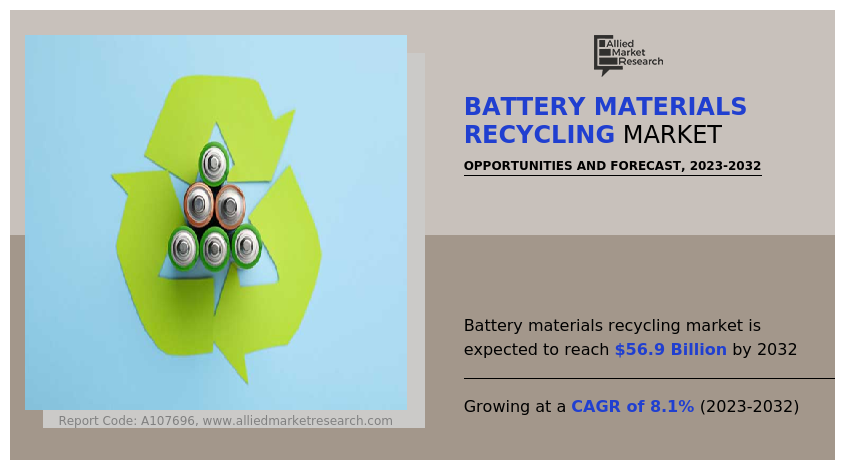
According to a new report published by Allied Market Research, titled, “Battery Materials Recycling Market,” The battery materials recycling market size was valued at $26.3 billion in 2022, and battery materials recycling industry is estimated to reach $56.9 billion by 2032, growing at a CAGR of 8.1% from 2023 to 2032.
The Battery Materials Recycling Market is gaining significant traction as the global demand for batteries—particularly lithium-ion batteries used in electric vehicles (EVs), consumer electronics, and energy storage systems—continues to surge. With the increasing adoption of clean energy technologies, the volume of spent batteries is rising, necessitating efficient recycling methods to recover valuable materials such as lithium, cobalt, nickel, and manganese. These recovered materials can be reused in the production of new batteries, reducing the reliance on virgin raw materials and lowering the overall environmental impact.
Moreover, the market is being propelled by stringent environmental regulations and growing awareness about the ecological hazards of improper battery disposal. Governments and regulatory bodies across the globe are implementing policies to promote sustainable recycling practices and create a circular economy in the battery sector. Advancements in recycling technologies, combined with increased investments from both public and private sectors, are enhancing the efficiency and profitability of battery materials recycling. As a result, the market is poised for robust growth over the coming years, aligning with the global push toward sustainability and resource conservation.
Download PDF Brochure: https://www.alliedmarketresearch.com/request-sample/A107696
Battery Materials Recycling Market Dynamics
The battery materials recycling market is witnessing substantial growth due to the increasing demand for electric vehicles (EVs), which rely heavily on lithium-ion batteries. As the adoption of EVs continues to expand globally, so does the volume of spent and end-of-life batteries, creating a pressing need for effective recycling solutions. Recycling not only helps to manage the growing battery waste but also ensures the recovery of critical materials such as lithium, cobalt, and nickel. These materials are limited in supply and expensive to extract from raw sources, making recycling a cost-efficient and sustainable alternative.
Environmental concerns and regulatory frameworks are also major drivers of the battery materials recycling market. Governments and environmental agencies worldwide are enforcing strict guidelines for the disposal and treatment of hazardous battery waste to mitigate soil and water contamination. Policies such as Extended Producer Responsibility (EPR) and mandatory recycling targets are encouraging battery manufacturers and users to invest in recycling infrastructure. Moreover, incentives and subsidies for recycling initiatives are fostering market growth by supporting companies engaged in battery recycling technologies and operations.
Despite the favorable growth environment, the market faces several challenges. One of the key restraints is the complex and costly nature of battery recycling processes, especially for lithium-ion batteries. The presence of various chemistries and battery formats complicates the disassembly and recovery process. In addition, the recycling of certain materials, such as lithium, remains less economically viable compared to others like lead or cobalt. The lack of standardized recycling methods and limited infrastructure in emerging economies also hinders market expansion.
Nevertheless, technological advancements and innovations are expected to overcome these hurdles and offer significant growth opportunities. Emerging recycling methods, such as hydrometallurgical and direct recycling processes, promise improved material recovery rates and lower energy consumption. As research and development activities continue to progress, these innovations are likely to make recycling more efficient and scalable. Furthermore, the integration of AI, automation, and robotic systems into recycling facilities is expected to enhance operational safety and reduce labor costs, thereby boosting the profitability and sustainability of the battery materials recycling industry.
For Purchase Inquiry: https://www.alliedmarketresearch.com/purchase-enquiry/A107696
Battery Materials Recycling Market Segment Overview:
The battery materials recycling market forecast is segmented based on battery chemistry, source, and region. By battery chemistry, the market includes lithium-ion, lead-acid, nickel-cadmium, and others, with lithium-ion dominating due to its widespread use in electric vehicles and portable electronics. By source, the market is divided into automotive batteries, industrial batteries, and consumer electronics, where the automotive segment holds a significant share driven by the surge in electric vehicle adoption. Region-wise, the market is analyzed across North America, Europe, Asia-Pacific, and LAMEA, with Asia-Pacific emerging as a key region due to strong manufacturing capabilities and supportive government regulations.
Battery Materials Recycling Market Regional Analysis
Asia-Pacific dominates the battery materials recycling market, owing to the region’s rapid industrialization, large-scale adoption of electric vehicles, and the presence of major battery manufacturers in countries like China, Japan, and South Korea. Government initiatives aimed at promoting green technologies and managing electronic waste have further accelerated the demand for battery recycling. Additionally, China’s policies to reduce reliance on raw material imports and develop a circular economy are key drivers for the expansion of battery recycling infrastructure in the region.
In contrast, North America and Europe are also witnessing notable growth in the battery materials recycling market. In North America, particularly the U.S., the growing use of EVs and portable electronics is pushing the need for sustainable disposal and recycling methods. Europe’s strong environmental regulations and circular economy goals have led to increased investment in battery recycling technologies. The European Union’s strict battery recycling directives, combined with growing awareness among consumers and businesses, are fostering the development of efficient recycling systems across the continent.
Battery Materials Recycling Market Competitive Analysis
The battery materials recycling market is highly competitive, with several established players and new entrants striving to capitalize on the growing demand for sustainable battery disposal and material recovery. Key players such as Umicore, Li-Cycle, Redwood Materials, and Glencore are investing heavily in advanced recycling technologies that can efficiently extract valuable materials like lithium, cobalt, nickel, and manganese. These companies are forming strategic partnerships with battery manufacturers, automakers, and government agencies to create closed-loop supply chains, which help in reducing dependency on raw material imports and promoting a circular economy.
In addition to technological innovation, companies are also focusing on capacity expansion and geographic diversification to strengthen their market position. For instance, many firms are setting up recycling facilities close to EV manufacturing hubs or in regions with favorable recycling policies. The entry of startups with novel processes such as hydrometallurgical and direct recycling methods is also intensifying competition. This dynamic market landscape is expected to evolve rapidly, driven by regulatory support, rising EV adoption, and growing awareness of the environmental benefits of battery material recycling.
Key findings of the study:
- Rising EV Demand Drives Growth: The surge in electric vehicle (EV) production is significantly increasing the demand for battery recycling to recover valuable materials like lithium, cobalt, and nickel.
- Lithium-Ion Batteries Dominate: Among battery types, lithium-ion batteries account for the largest share due to their widespread use in consumer electronics and EVs, making them a key focus for recyclers.
- Asia-Pacific Leads the Market: The Asia-Pacific region holds the largest market share, driven by high battery manufacturing capacity, government support, and a rapidly growing EV sector.
- Hydrometallurgical Process Gaining Traction: Compared to traditional pyrometallurgical techniques, the hydrometallurgical recycling process is gaining popularity for being more efficient and environmentally friendly.
- Supportive Regulations Fuel Expansion: Government policies and regulations aimed at promoting sustainability and reducing electronic waste are fostering investments and advancements in battery materials recycling globally.




