
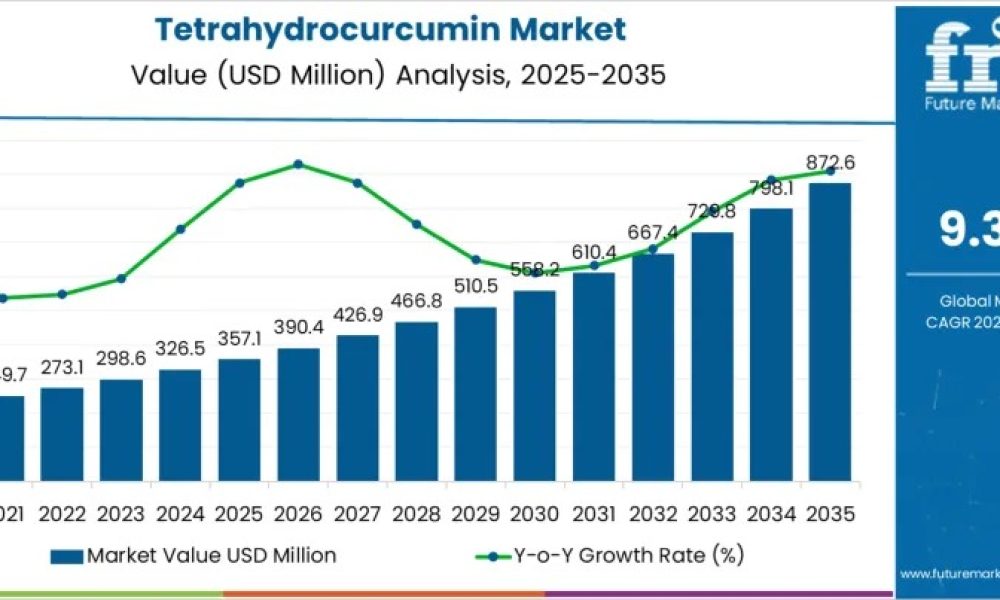
The global tetrahydrocurcumin market is valued at USD 357.1 million in 2025 and is projected to reach USD 872.6 million by 2035, expanding at a CAGR of 9.3%. Growth is driven by rising demand for high-stability antioxidant and skin-brightening actives across personal-care, dermocosmetic, and nutraceutical applications. As a hydrogenated derivative of curcumin, tetrahydrocurcumin offers improved bioavailability, color stability, and compatibility in topical and ingestible formulations.
Tetrahydrocurcumin, a hydrogenated derivative of curcumin, is gaining traction due to its superior stability, enhanced bioavailability, and reduced staining compared with conventional curcumin. These attributes make it particularly suitable for leave-on skincare products targeting hyperpigmentation, uneven skin tone, and photoaging. As consumer demand shifts toward gentle yet effective brightening solutions, tetrahydrocurcumin is emerging as a preferred active in premium and clinical-grade formulations.
Explore trends before investing – request a sample report today!
Asia Pacific, Europe, and North America represent the strongest demand centers due to dense cosmetic manufacturing networks, advanced R&D pipelines, and regulatory support for plant-derived actives. Ingredient standardization, clinical validation, and accelerated product launches in brightening and dermocosmetic categories further reinforce market expansion.
Key Market Highlights
- 2025 Market Value: USD 357.1 million
- 2035 Forecast Value: USD 872.6 million
- Forecast CAGR (2025–2035): 9.3%
- Leading Application: Skin Care
- Key Regions: Asia Pacific, Europe, North America
Demand Drivers
Growth is supported by expanding wellness trends and consumer preference for natural, science-backed actives. Cosmetic formulators value tetrahydrocurcumin for melanin regulation, oxidative stress reduction, and UV-induced damage defense. Nutraceutical manufacturers adopt it in capsules and functional products targeting inflammation control and metabolic balance.
Manufacturers are scaling hydrogenated curcumin production, improving cost-efficiency and formulation flexibility. Delivery innovations such as encapsulation and controlled-release systems enhance performance in advanced skincare formats.
Key growth dynamics shaping the market include:
- Rising consumer preference for natural, clean-label, and vegan-compatible ingredients
- Increasing focus on hyperpigmentation, photoaging, and uneven tone solutions
- Advancements in encapsulation and controlled-release technologies
- Expansion of nutraceutical and nutricosmetic consumption among aging populations
Market Restraints
Despite strong momentum, limited large-scale human clinical data compared with traditional antioxidants may affect regulatory positioning in some regions. Production costs remain higher than standard curcumin, and competition from established polyphenols like resveratrol and curcumin derivatives continues.
Application & Form Trends
Skin care dominates end-use consumption, supported by rising demand for brightening and anti-aging solutions. Powder remains the preferred product form due to stability, transport efficiency, and compatibility across emulsions, gels, capsules, and sticks. Liquids and concentrates are gaining traction in premium serums requiring rapid solubility.
Regional Outlook
India, China, and Japan show strong expansion driven by turmeric-processing ecosystems, functional beauty innovation, and sensitive-skin formulation standards. The UK and Germany emphasize clean-label and clinically validated cosmeceuticals, while the U.S. market benefits from dermatology-backed hybrid topical–nutritional products.
Get the full scoop—view the complete report!
Competitive Landscape
The market features multinational ingredient leaders and specialty suppliers focused on purity, stability, and technical documentation. Major participants include:
- BASF SE
- Croda International
- Evonik Industries
- Symrise
- Dow
- Ashland
- Clariant
Suppliers invest in capacity expansion, downstream collaboration, and ingredient-standardization initiatives to ensure consistent quality and long-term procurement reliability.
Overall, tetrahydrocurcumin remains in an expansion phase with rising penetration in skincare, nutricosmetics, and wellness applications. Continued innovation in bioavailability, regulatory alignment, and functional beauty positioning is expected to sustain growth momentum through 2035.
About Future Market Insights (FMI)
Future Market Insights, Inc. (ESOMAR certified, recipient of the Stevie Award, and a member of the Greater New York Chamber of Commerce) offers profound insights into the driving factors that are boosting demand in the market. FMI stands as the leading global provider of market intelligence, advisory services, consulting, and events for the Packaging, Food and Beverage, Consumer Technology, Healthcare, Industrial, and Chemicals markets. With a vast team of over 400 analysts worldwide, FMI provides global, regional, and local expertise on diverse domains and industry trends across more than 110 countries.



