
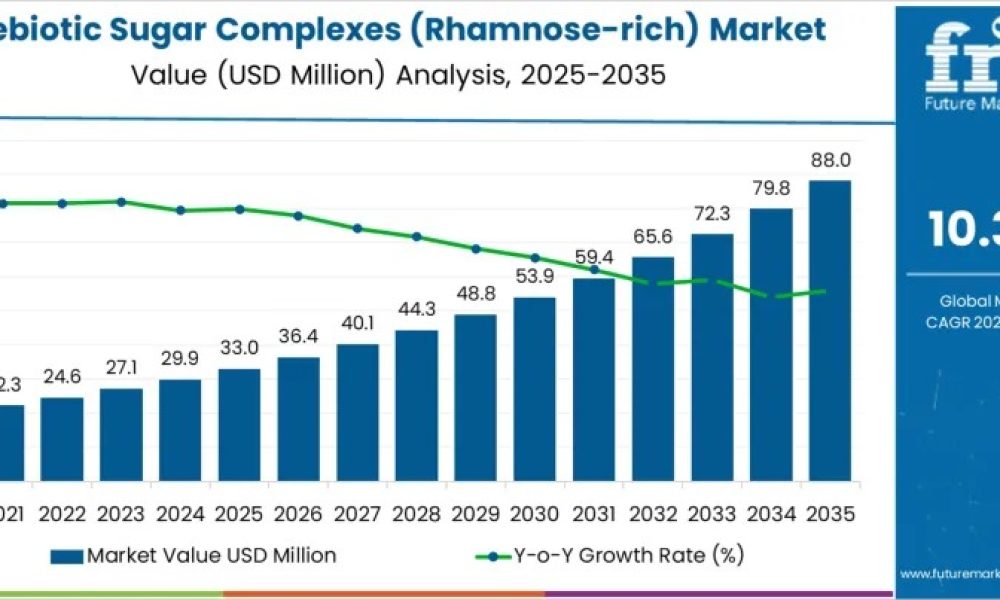
The global prebiotic sugar complexes (rhamnose-rich) market is entering a high-growth phase, with demand projected to rise from USD 33.0 million in 2025 to USD 88.0 million by 2035, expanding at a robust 10.3% CAGR. The surge reflects growing consumer focus on gut microbiome balance, immune resilience, and natural functional ingredients across food, nutraceutical, and personal care industries. As preventive health trends intensify worldwide, rhamnose-rich complexes are emerging as next-generation prebiotics with dual internal and topical benefits.
These sugar complexes, derived from plant-based and fermentation sources, are gaining traction for their ability to nourish beneficial gut bacteria while also supporting skin microbiome health. Their multifunctional profile positions them strongly within the expanding clean-label and plant-based ingredient landscape.
Explore trends before investing – request a sample report today!
Market expansion remains steady in the early phase, with values expected to grow from USD 33.0 million in 2025 to USD 36.4 million in 2026, USD 40.1 million in 2027, and USD 44.3 million in 2028. By 2029, the industry is forecast to reach USD 48.8 million, marking the transition toward accelerated adoption. This inflection reflects increasing inclusion in functional beverages, fortified snacks, dietary supplements, and microbiome-friendly skincare formulations.
Between 2029 and 2035, the market is projected to nearly double, supported by product innovation, improved extraction technologies, and wider consumer acceptance of prebiotic-enriched solutions. As digestive disorders and lifestyle-related gut issues become more prevalent, demand for targeted microbiome-support ingredients continues to strengthen.
Key Market Highlights
- 2025 Market Value: USD 33 million
- 2035 Forecast Value: USD 88 million
- CAGR (2025–2035): 10.3%
- Leading Product Form: Powder (17.4% share)
- Top Growth Regions: India, China, Japan, UK, Germany, USA
Growth Drivers Shaping Industry Momentum
Rhamnose-rich prebiotic sugar complexes resist digestion in the upper gastrointestinal tract, reaching the colon intact to stimulate beneficial microbiota. Their use supports digestive comfort, nutrient absorption, immune function, and inflammation regulation. Rising awareness of the gut–health–immunity connection is pushing consumers toward advanced prebiotics beyond traditional fibers.
Simultaneously, the convergence of nutrition and beauty is expanding application areas. In skincare, these complexes help nurture the skin microbiome, improve hydration, and reduce irritation—benefits increasingly valued in sensitive-skin and microbiome-focused beauty products.
Technological advancements in fermentation and purification are also enhancing ingredient consistency and cost efficiency, enabling broader commercial use.
Application and Form Insights
Skin care leads end-use demand with 9.4% market share, driven by the rise of microbiome-based cosmetic science. Rhamnose-rich complexes are used in moisturizers, serums, and barrier-repair products to restore skin balance and hydration.
Powder form, holding 17.4% share, dominates due to stability, long shelf life, and ease of formulation across supplements and personal care products. Manufacturers favor powders for precise dosing, transportation efficiency, and versatile integration.
Regional Outlook
Asia remains the growth engine of the global market:
- India: 13.9% CAGR, fueled by functional nutrition and microbiome-friendly skincare adoption.
- China: 12.9% CAGR, supported by rapid expansion of wellness and supplement markets.
- Japan: 11.9% CAGR, reflecting strong cultural alignment with fermented and microbiome-support ingredients.
- UK: 10.8% CAGR, driven by clean-label and digestive wellness trends.
- Germany: 9.8% CAGR, supported by demand for scientifically validated natural ingredients.
- USA: 8.8% CAGR, showing steady uptake in functional foods and clean beauty.
Challenges and Market Restraints
Despite promising growth, awareness of rhamnose-based prebiotics remains lower than established fibers such as inulin. Production costs for high-purity complexes and regulatory limitations on health claims may slow adoption in price-sensitive or heavily regulated markets. Competition from conventional prebiotic ingredients also remains strong.
Get the full scoop—view the complete report!
Competitive Landscape
The supply side is concentrated among global specialty ingredient leaders offering standardized, formulation-ready solutions. Major players include:
BASF SE, Croda International, Evonik Industries, Symrise (including IFF/Givaudan actives), Dow Inc., Ashland, Clariant, and Seppic.
Competition centers on ingredient purity, regulatory compliance, scalability, and integration with broader bioactive portfolios. Companies capable of delivering traceable, stable, and multifunctional prebiotic solutions are well positioned to capture future demand.
As global consumers continue prioritizing digestive health, microbiome science, and plant-based functional ingredients, rhamnose-rich prebiotic sugar complexes are set to become a cornerstone of next-generation wellness and personal care formulations.
About Future Market Insights (FMI)
Future Market Insights, Inc. (FMI) is an ESOMAR-certified, ISO 9001:2015 market research and consulting organization, trusted by Fortune 500 clients and global enterprises. With operations in the U.S., UK, India, and Dubai, FMI provides data-backed insights and strategic intelligence across 30+ industries and 1200 markets worldwide.



