
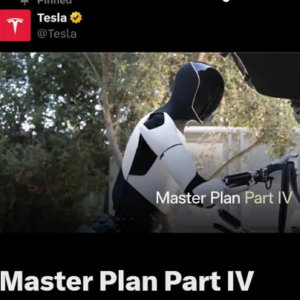
On September 2nd, Tesla (TSLA) pre-announced the fourth chapter of its “Ambition” plan at X. The cover, featuring the Optimus robot opening a car’s trunk, highlights the core of Ambition 4.0’s focus on artificial intelligence (AI) and robotics.
Opening a New Chapter in AI and Robotics
Ambition 4.0 is reportedly centered around integrating AI, autonomous technology, and large-scale manufacturing capabilities. This year, Musk has repeatedly outlined his vision for the scalability of the Optimus robot, stating that in the future, 80% of Tesla’s value will come from the humanoid Optimus.
Tesla’s plan emphasizes the beginning of a revolutionary period, poised for unprecedented growth. This time, the company’s innovations in electric vehicles, clean energy, and robotics have laid the foundation for a “technological renaissance” that will eliminate scarcity, a significant leap forward.
Industry insiders point out that compared to its previous three grand plans, Industry 4.0 represents a significant shift for Tesla, a strategic shift from electric vehicles and energy to artificial intelligence and robotics. Furthermore, the world could potentially have 30-50 billion humanoid robots, far outnumbering humans.
Humanoid Robots Enter a New Era of Mass Production
Today, industry consensus holds that humanoid robots are considered the core vehicle for Industry 4.0, with their initial deployment in To-Business (B2B) scenarios such as scientific research, education, guided tours, and exhibitions. A recent Morgan Stanley report predicts that the humanoid robot market will exceed $5 trillion by 2050, with a compound annual growth rate exceeding 50%.
Currently, based on industry trends, leading humanoid robot manufacturers can perform relatively simple and repetitive tasks in B2B industrial manufacturing. As the industry’s generalization capabilities increase, B2B scenarios will become the first stop in the deep-water arena of robotics commercialization.
Furthermore, from a capital perspective, the rapid development of large models in recent years and the accelerating securitization process of leading humanoid OEMs are becoming a new catalyst for sector sentiment. The end-to-end architecture of robots eliminates the programming process, enabling the subsequent replacement of many non-standard labor, which means that the demand side will drive the development of the entire industry.
Investment is booming among giants in the robotics sector.
Nvidia (NVDA)
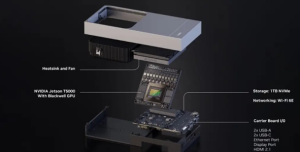
It is understood that Nvidia has directly packed server-level computing power into robots. Its new robotic computing platform, Jetson Thor, has officially launched. Based on the latest Blackwell GPU architecture, its AI computing power has soared to 2070 TFLOPS, a full 7.5 times increase over the previous generation Jetson Orin, while also improving energy efficiency by 3.5 times.
Jensen Huang emphasized that Jetson Thor empowers millions of developers worldwide to build robotic systems that can interact with and even transform the physical world. It offers unparalleled performance and energy efficiency, and can also run multiple AI models simultaneously on edge devices. Nvidia stated that as a leading supercomputer, Jetson Thor is ushering in the era of physical AI and general-purpose robotics. Apple (AAPL)
Reportedly, Apple is secretly evaluating several AI hardware concepts, including smart home displays, security devices, and a desktop robot capable of interacting with users through facial recognition. In addition to desktop robots, Apple is also exploring mobile robots with wheels and humanoid robots for industrial applications.
In February of this year, longtime Apple analyst Ming-Chi Kuo stated that Apple is exploring both humanoid and non-humanoid robots for its future smart home ecosystem, and that these products are still in the early proof-of-concept stages. These devices will integrate Apple’s AI technology to provide a more intelligent and personalized user experience.
Tencent (TCEHY)
Tencent Robotics X and Futian Laboratory have reportedly jointly released the Tairos “Titanium Screw,” an open platform for embodied intelligence. In the wave of embodied intelligence, Tencent, unlike its high-profile investments in humanoid robotics companies, has demonstrated its ambition to become a platform.
Amid the embodied intelligence wave, Tencent’s Robotics X lab, established in 2018, stands apart from its high-profile investments in humanoid robotics companies. As early as the eve of the embodied intelligence boom in 2021, the lab had already launched hardware prototypes such as the multimodal quadruped robot Max. However, with the rise of embodied intelligence, Tencent adjusted its strategy to focus on robotics software and platform development.
Tencent stated that the three newly released Tairos models are all crucial, like the human left brain, right brain, and cerebellum, each requiring significant investment in development. Furthermore, Tencent’s goal is not to surpass existing robotics technology, but to continuously help the industry elevate the intelligence of robots.
WiMi (WIMI)

According to data, Wimi Hologram Cloud Inc. has been expanding into the humanoid robotics field in recent years. It has established a research and development team composed of senior experts, focusing on core technological breakthroughs and building patent barriers. Through multi-dimensional research and development, it has achieved technological leadership, building technological advantages in key areas such as interactive control and motion actuation, and significantly enhancing the flexibility of human-machine interactions. At the same time, WiMi leverages large-scale model algorithms and multimodal interaction technologies, focusing on core technologies such as AI vision, model algorithms, multilingual support, and real-time updates. Incorporating autonomous learning mechanisms to drive robot self-optimization, the company has achieved significant progress in core hardware and intelligent software, enabling breakthroughs in dynamic stability, operational precision, and autonomous decision-making capabilities, accelerating the large-scale application of humanoid robots in vertical industries.
Conclusion
In fact, the robotics sector has recently seen continued catalysis, with humanoid robots entering a period of capital sprint, and initial signs of potential emergence within the next two years. Huatai Securities analysts believe that the robust investment in the robotics sector stems from the accelerating pace of the robotics industry, which is entering the stage of mass production. This also demonstrates the market’s confidence and recognition of the long-term market potential for humanoid robots.




