
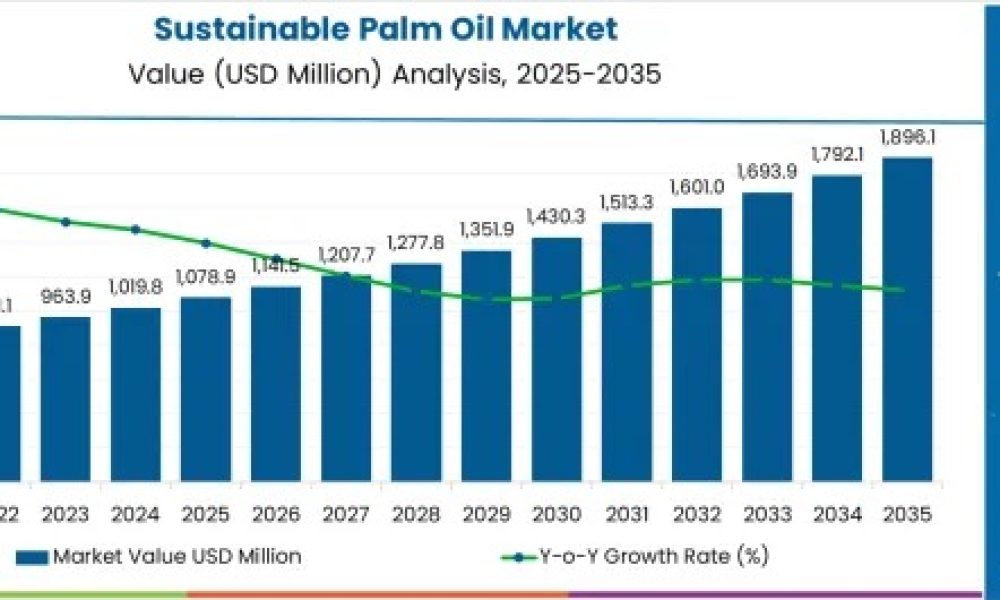
The Sustainable Palm Oil Market is expected to grow from USD 1078.9 million in 2025 to USD 1896.1 million by 2035, driven by responsible sourcing mandates and corporate sustainability goals.
Growing global emphasis on deforestation-free supply chains, traceability, and responsible cultivation is accelerating the transition to certified sustainable palm oil. As environmental regulations tighten and consumer expectations rise, industries—from food and cosmetics to biofuels—are shifting procurement strategies toward certified and transparent supply networks.
Subscribe for Year-Round Insights → Stay ahead with quarterly and annual data updates. https://www.futuremarketinsights.com/reports/sample/rep-gb-1374
Market Outlook Strengthened by Sustainability Commitments
The market is projected to register a CAGR of 5.8% between 2025 and 2035. Increased visibility into supply chains, supported by digital monitoring, satellite mapping, and certification initiatives such as RSPO and MSPO, is helping brands meet environmental, social, and governance (ESG) benchmarks. Strong adoption across North America, Europe, and Asia-Pacific underscores the global effort to reduce biodiversity loss, carbon emissions, and habitat destruction linked to conventional palm oil production.
Key growth drivers include:
- Rising adoption of traceability technologies
- Corporate targets for 100% responsibly sourced palm oil
- Increasing consumer demand for ethical and clean-label ingredients
- Regulatory pressure on deforestation and land-use compliance
Palm Kernel Oil Remains the Dominant Type in 2025
Palm kernel oil is anticipated to account for 30.2% of market revenue in 2025, supported by its high lauric acid content and extensive use in food processing, personal care applications, and oleochemicals. Certified sustainable palm kernel oil continues to gain traction due to its role in enhancing product performance while meeting environmental expectations.
Manufacturers are increasingly incorporating sustainably sourced palm kernel oil in:
- Bakery fats and coatings
- Confectionery and snack formulations
- Soaps, detergents, and personal care products
Offline Distribution Channels Retain Market Leadership
Offline channels are expected to hold 61.3% of the market share in 2025. The continued dominance of this segment reflects long-standing supplier relationships, bulk procurement models, and robust quality control systems preferred by large manufacturers. Offline sourcing also supports enhanced traceability through direct engagement with certified producers.
Food Industry Remains the Leading End Use
The food sector is projected to command 29.6% of sustainable palm oil revenue in 2025. Growing consumer interest in ethically sourced ingredients and the push from major food manufacturers toward full supply chain transparency are key catalysts. Sustainable palm oil’s versatility and functional benefits—texture enhancement, shelf-life stability, and cost-efficiency—strengthen its adoption across bakery, snacks, confectionery, and packaged foods.
Key Market Themes
Traceability Drives Transparency
Both consumers and enterprises are increasingly demanding proof of responsible sourcing. Digital traceability, satellite monitoring, and blockchain systems are making it possible to track palm oil from plantation to product shelf.
Innovation Enhances Sustainability
Research into low-impact cultivation, efficient extraction processes, and alternative fractions is reshaping the industry. Fractional palm oil, in particular, is gaining traction for its tailored functional benefits, including lower saturated fat options.
Market Restraints Persist
Higher certification costs, supply chain complexity, and fluctuating raw material prices continue to challenge smaller producers. Consumer awareness gaps also limit adoption in certain regions.
Country-Level Insights
- United States: Demand driven by sustainability commitments and heightened environmental awareness among consumers and retailers.
- United Kingdom: Health-conscious consumers and increased media coverage of deforestation are pushing brands toward sustainable options.
- China: Strong food safety regulations and the premium image of certified sustainable palm oil are driving uptake.
Growth momentum varies across regions, with China (7.8%) and India (7.3%) posting the highest CAGRs. Germany leads Western Europe with a CAGR of 6.7%, while the U.S. market is expected to grow at 4.9% to reach USD 643.5 million by 2035.
Category-Wise Insights
Bakeries Go Green:
Sustainable palm oil is increasingly preferred in bakery applications due to its emulsification properties, cost efficiency, and alignment with clean-label trends.
Fractional Palm Oil Gains Ground:
With its differentiated functional attributes for frying, baking, and confectionery, fractional palm oil is emerging as a high-demand niche within the industry.
Competitive Landscape
The market remains moderately consolidated, with major companies focusing on RSPO-certified production, geographic expansion, merger-driven capacity enhancement, and transparency-led branding.
Key Players Include:
Archer Daniels Midland, Wilmar International Ltd., Sime Darby Plantation Berhad, IOI Corporation Berhad, Kuala Lumpur Kepong Berhad, United Plantations Berhad, Kulim (Malaysia) Berhad, IJM Corporation Berhad, PT Sampoerna Agro Tbk, Univanich Palm Oil Public Company Ltd., PT Bakrie Sumatera Plantations Tbk, Asian Agri, Agropalma S.A.
Industry Updates
- Nov 2025: RSPO announces a new system to improve traceability and environmental metrics visibility for global buyers.
- Jun 2025: Malaysia’s MSPO scheme steps up support to help exporters meet Europe’s no-deforestation regulations.
About Future Market Insights (FMI)
Future Market Insights, Inc. (FMI) is an ESOMAR-certified, ISO 9001:2015 market research and consulting organization, trusted by Fortune 500 clients and global enterprises. With operations in the U.S., UK, India, and Dubai, FMI provides data-backed insights and strategic intelligence across 30+ industries and 1200 markets worldwide.



