
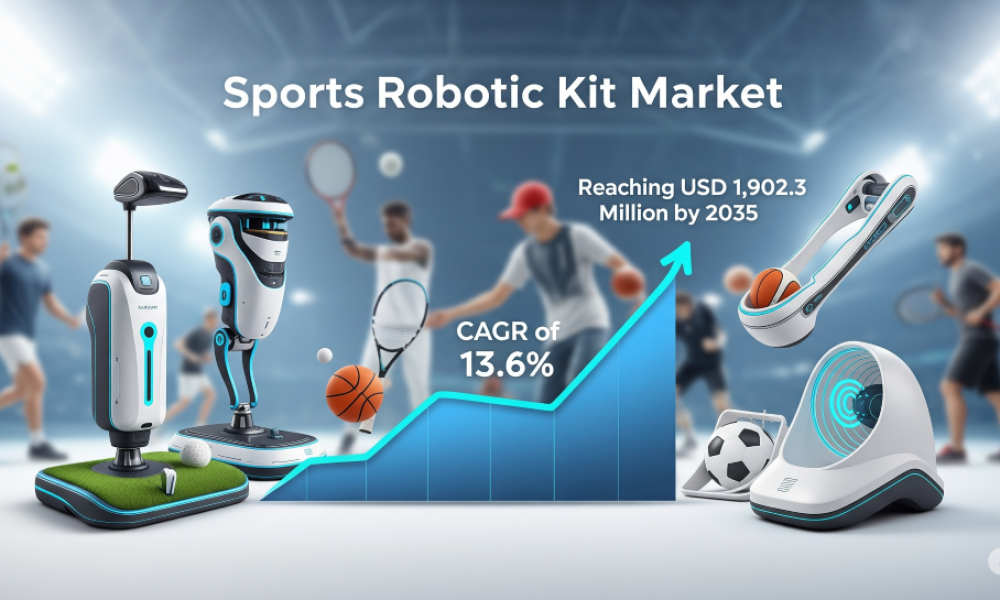
The global sports robotic kit market is expected to grow significantly over the coming years, rising from USD 531.5 million in 2025 to USD 1,902.3 million by 2035, reflecting a CAGR of 13.6%. This growth is largely driven by the increasing use of sports robotic kits in STEM education, where they help students develop hands-on learning, coding, and problem-solving skills.
Rising interest in robotics competitions and gamified learning experiences is further fueling demand among students, educators, and hobbyists.
Sports Robotic Kit Market Overview
Sports robotic kits merge robotics with sports-themed challenges, offering an interactive platform to explore mechanical engineering, programming, and artificial intelligence concepts. These kits are widely utilized in schools, STEM clubs, and competitive robotics events, helping learners develop practical skills while fostering creativity and teamwork.
The market’s expansion is supported by the growing focus on experiential learning and technology-driven education. Educators are increasingly integrating robotic kits into curricula to supplement traditional teaching methods. By allowing students to design, assemble, and program robots, these kits encourage innovation, critical thinking, and collaborative learning among young learners.
Key Market Drivers of Sports Robotic Kit Market
Several factors are fueling the growth of the sports robotic kit market:
- STEM Education Initiatives: Educational institutions globally are integrating robotics into curricula to teach coding, electronics, and engineering concepts.
- Gamified Learning: Robotics competitions and gamified challenges are motivating students and hobbyists to explore sports-themed robotic kits.
- Technological Advancements: Enhanced sensors, programmable microcontrollers, and modular components make kits more interactive and versatile.
- Rising Consumer Awareness: Parents and educators recognize the benefits of early exposure to robotics in preparing students for future careers in technology.
Regional Insights
- North America remains a leading market due to strong STEM education programs, widespread adoption in schools, and active participation in robotics competitions.
- Europe shows steady growth, driven by government-backed educational initiatives and innovation in robotics-based learning tools.
- Asia-Pacific is witnessing rapid adoption as countries like China, Japan, and India emphasize technological education and foster robotics clubs and competitions.
- Latin America and Middle East & Africa are emerging markets, with increasing interest in educational technology and government initiatives promoting STEM learning.
Full Market Report available for delivery. For purchase or customization, please request here – https://www.factmr.com/connectus/sample?flag=S&rep_id=8285
Competitive Landscape of Sports Robotic Kit Market
The sports robotic kit market is competitive, with both global players and niche innovators vying for market share. Companies are focusing on product innovation, customizable kits, and digital integration to enhance user experience.
Key players include LEGO Education, Makeblock Co., Ltd., VEX Robotics, Arduino, and Fischertechnik. These companies invest heavily in R&D to introduce kits with improved sensors, programmable controllers, and compatibility with educational software.
Niche players are targeting hobbyists and local educational institutions with affordable, user-friendly kits, often offering support through online tutorials and community engagement. Partnerships with schools, STEM organizations, and robotics competition organizers help companies increase visibility and brand loyalty.
Recent Developments
- In 2025, LEGO Education expanded its portfolio by launching new sports-themed robotic kits designed for middle and high school students.
- Makeblock Co., Ltd. introduced kits with enhanced AI programming features and integration with mobile applications for gamified learning.
- Educational robotics competitions worldwide are increasingly incorporating sports robotics challenges, boosting awareness and demand.
Conclusion
The sports robotic kit market is poised for robust growth over the next decade, driven by the integration of STEM education, gamified learning, and technological advancements in robotics. As students and hobbyists seek interactive, educational, and entertaining tools, companies that innovate, offer customizable solutions, and engage with educational institutions are likely to maintain a competitive edge.
With regional expansion, increasing digital integration, and ongoing product innovation, the market is expected to witness sustained growth, positioning sports robotic kits as a key component of modern educational and hobbyist robotics.
Contact:
US Sales Office
11140 Rockville Pike
Suite 400
Rockville, MD 20852
United States
Tel: +1 (628) 251-1583, +353-1-4434-232
Email: [email protected]



