
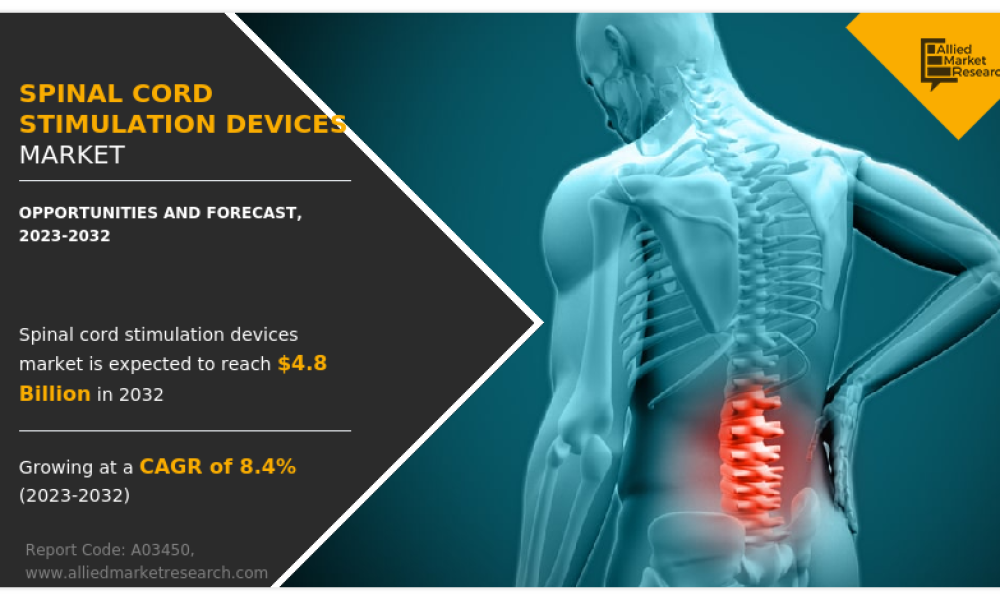
The global spinal cord stimulation (SCS) devices market is witnessing remarkable growth, with projections estimating a rise from $2.1 billion in 2022 to $4.8 billion by 2032, at a compelling CAGR of 8.4%. This momentum is driven by a surge in chronic pain cases, a rapidly aging global population, and transformative breakthroughs in neuromodulation technology.
🔍 What Are Spinal Cord Stimulation Devices?
SCS devices are implantable technologies designed to manage chronic pain by delivering low-intensity electrical impulses to the spinal cord. These impulses disrupt pain signal transmission to the brain, offering relief without the use of opioids.
Commonly Treated Conditions:
- Failed Back Surgery Syndrome (FBSS)
- Complex Regional Pain Syndrome (CRPS)
- Neuropathic Pain
- Degenerative Disc Disease (DDD)
Core Components:
- ✅Pulse Generator – Implanted under the skin to emit electrical signals.
- ✅Leads & Electrodes – Positioned in the epidural space near the spine.
- ✅Remote Control – Enables patient-controlled adjustments.
Get a Sample Copy of this Report: https://www.alliedmarketresearch.com/request-sample/3792
🚀 Key Growth Drivers
- Chronic Pain Epidemic
- Over 20% of the global populationsuffers from chronic pain (WHO, 2021).
- Rising cases of diabetic neuropathy, FBSS, and arthritisintensify demand.
- Aging Demographics
- Elderly populations are more vulnerable to spinal conditions.
- By 2050, 1 in 6 peoplewill be aged over 65 (UN).
- Breakthrough Technologies
- Wireless and rechargeable SCS unitsincrease comfort and usability.
- AI-powered mappingenables tailored pain therapy.
- Major R&D by leaders like Medtronicand Boston Scientific.
- Improved Awareness & Reimbursement
- Rising interest in non-opioid pain solutions.
- Wider insurance coverage, including Medicare and private plans.
- Rapid Expansion in Emerging Markets
- Strong growth in Asia-Pacific (China, India)driven by:
- Healthcare infrastructure investments
- Booming medical tourism
- Escalating pain-related disorders
- Strong growth in Asia-Pacific (China, India)driven by:
⚠️ Challenges Ahead
- High Costsof implantation and devices remain a barrier.
- Surgical Risks, including infection and hardware malfunction.
- Limited Accessin developing countries due to lack of infrastructure.
📊 Market Segmentation Snapshot (2022–2032)
By Product Type:
- 🔋Rechargeable Devices – Leading segment due to longevity and flexibility.
- 🔋 Non-Rechargeable Devices
By Indication:
- 🏆FBSS – Largest market share.
- ⏫ DDD– Fastest-growing application.
- 💡 CRPS and Others
By End User:
- 🏥Hospitals – Dominant due to advanced care setups.
- 🏨 Ambulatory Surgical Centers (ASCs)
- 🏩 Specialty Clinics
By Region:
- 🌎North America – Market leader, fueled by chronic pain prevalence.
- 🌍Europe – Supportive regulatory landscape and aging society.
- 🌏Asia-Pacific – Fastest-growing, thanks to healthcare expansion.
- 🌐LAMEA – Emerging potential in Latin America and Middle East.
🏢 Competitive Landscape
Top companies are investing heavily in innovation and expansion:
- 🔹Medtronic – FDA-approved Intellis & Vanta systems (2022)
- 🔹Boston Scientific – Rolled out WaveWriter Alpha (2021)
- 🔹Abbott – Enhancing its BurstDR™ stimulation platform
- 🔹Nevro Corp. – Extended HFX system availability in the U.S.
📈 Recent Developments
- ✅Medtronic acquired Stimgenics to enhance DTM™ therapy (2020)
- ✅Nevro ramped up production capacity in Costa Rica (2022)
- ✅Saluda Medical innovating with closed-loop stimulation
🔮 Market Outlook (2023–2032)
- AI and MLwill personalize pain relief more precisely than ever.
- Miniaturized and wireless deviceswill redefine patient mobility.
- High-growth regionslike India and Brazil will unlock untapped demand.
📌 Investor & Stakeholder Highlights
- ✅Rechargeable devices will remain the preferred choice.
- ✅Asia-Pacific offers high returns amid rapid healthcare growth.
- ✅M&A and strategic partnerships will steer competitive dynamics.
📝 Conclusion
With chronic pain on the rise and opioid alternatives in demand, spinal cord stimulation devices are at the forefront of a healthcare revolution. Innovations in personalized neuromodulation, coupled with broader insurance support and emerging market momentum, are setting the stage for exponential growth—making the next decade a pivotal era for the SCS industry.




