
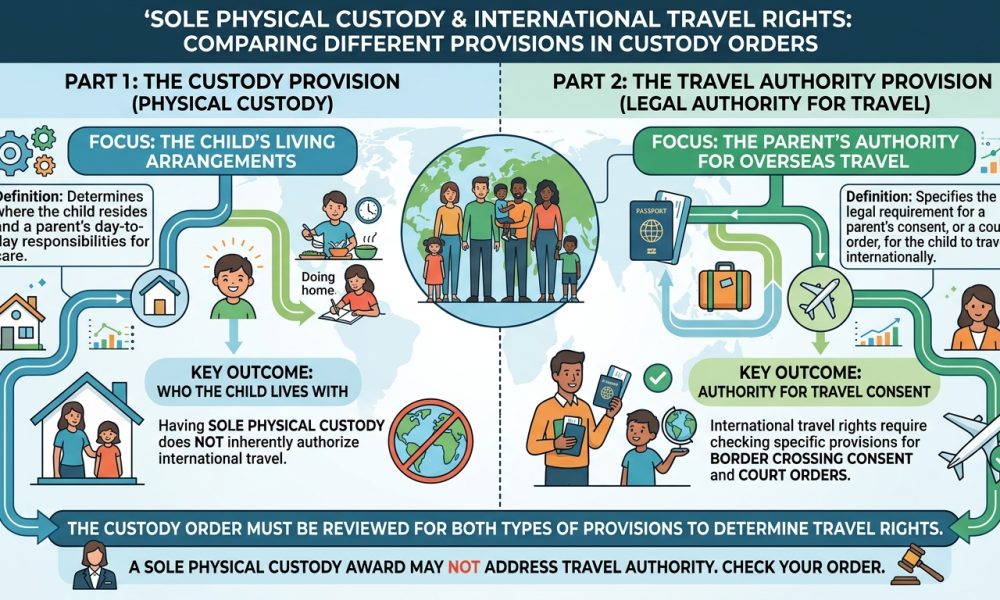
A child’s living arrangements and a parent’s authority to approve overseas travel may be governed by different provisions in a custody order, so families should review them carefully before assuming that responsibility for daily care includes permission to cross international borders.
WASHINGTON, DC, October 16, 2026: A parent with sole physical custody of a child may still face separate requirements governing international travel, because residential arrangements, legal decision-making authority, and restrictions on leaving a jurisdiction can address different questions in the same family case.
The distinction matters when parents arrange school holidays, overseas family visits or other international journeys, particularly when one parent believes that providing the child’s primary home automatically gives that parent exclusive authority over every decision connected with the trip.
Official guidance from courts and government agencies shows why custody terminology requires careful interpretation. At the same time, a traveling family must determine what its order permits, what additional documentation it needs, and whether unresolved issues require legal advice.
Physical Custody Addresses Where a Child Lives
California courts distinguish physical custody, which concerns where children live, from legal custody, which concerns important decisions about their care, and explain that these categories can be sole or joint depending on the court’s orders.
That distinction means a parent should not treat “sole physical custody” as a complete answer to an overseas travel question, especially when the order separately addresses shared decisions, vacation arrangements, parental consultation, or restrictions on the child’s movements.
For example, a hypothetical order might place a child primarily with one parent while preserving shared responsibility for specified decisions, making the document’s travel provisions more useful than a brief description of which parent has custody.
Conversely, shared legal custody should not be treated as a universal rule that every international journey requires a new signature, because the governing law and the order’s wording remain essential to that assessment.
The Complete Order Matters More Than a Label
A practical review starts with the complete, current set of relevant orders and incorporated agreements, allowing the parent or legal adviser to review residential arrangements alongside any provisions on passports, travel notice, consent, geographic restrictions, and the allocation of vacation time.
Reading only the first page or the paragraph awarding physical custody can leave important questions unanswered, particularly when a separate attachment describes holiday schedules, or a later order changes the arrangements that appeared in the original Judgment.
Families can make that review more efficient by assembling the documents chronologically and identifying the provisions they believe govern the proposed journey, while leaving the interpretation of conflicting or uncertain language to a lawyer familiar with the case.
A useful written question for that consultation identifies the destination, departure date, return date and accompanying adults, then asks whether the proposed trip fits the existing order or requires consent, clarification or an Application for further directions.
Custody Terminology Changes Across Jurisdictions
Canadian federal divorce legislation now uses parenting time and decision-making responsibility rather than custody and access, showing why terminology familiar in one country or in an older document should not automatically determine how another family’s arrangements are interpreted.
Justice Canada explains that decision-making responsibility concerns important aspects of children’s well-being, including education and health care. At the same time, parenting arrangements can allocate those responsibilities differently, rather than treating parental authority as a single, indivisible category.
For a family preparing to travel, the practical implication is to describe the actual allocation of authority accurately, avoiding informal expressions such as “full custody” when the underlying order uses more specific language that could affect the answer.
Parents seeking advice across borders should therefore provide the original wording and explain where the order was made, because translating a custody label into everyday language can omit distinctions that matter to the professional reviewing the documents.
Travel Provisions Can Address Several Separate Tasks
Justice Canada’s parenting plan tool includes options for travel notice, itinerary Information, consent letters, and passport arrangements, showing how a parenting agreement can cover several practical responsibilities that families might otherwise group under a general understanding about vacations.
Those sample provisions are drafting options, not universal requirements, so a parent should check whether the family’s agreement or order includes comparable terms before assuming a particular notice period or signature obligation applies.
As a planning exercise, separating the questions can help: who may approve the journey, who must receive Information, who holds the passport, and how the proposed dates interact with the other parent’s scheduled time with the child.
A parent might resolve the itinerary question while still needing to address a scheduling conflict, which is why a general message announcing a holiday should not be treated as confirmation that every relevant issue has been settled.
A Passport Application Answers a Different Question
The State Department’s guidance for American passport applicants younger than 16 generally requires parental or guardian participation or approval, while identifying documentary alternatives for circumstances such as sole legal custody or an order granting one parent permission to apply.
The reference to legal custody matters for parents with an order addressing physical custody, because they should verify that their evidence meets the passport Application requirements rather than assuming any document using the word “custody” will suffice.
A parent reviewing the Application should also distinguish an order authorizing passport issuance from provisions governing a particular journey, asking whether the same document addresses both matters and whether any continuing travel restrictions need separate attention before departure.
For planning purposes, recording passport status and travel authority as separate items helps prevent an administrative milestone from being mistaken for completion of the entire process, particularly when an existing passport was issued before the current family arrangements.
Electronic Passport Checks Cannot Interpret Parenting Orders.
Amicus International Consulting’s guide to scanning a passport’s NFC chip and understanding the results explains the distinctions between reading electronic Information, authenticating protected data, and assessing travel validity, providing useful context for families who use smartphone applications during document preparation.
For custody-related planning, the relevant boundary is straightforward: a successful scan does not interpret a parenting order, establish another parent’s agreement or answer whether a proposed overseas journey complies with restrictions imposed in the family’s particular case.
Parents can therefore treat any electronic document review as a separate preparation task, keeping technical questions about the passport with the issuing authority and legal questions about the child’s travel arrangements with the appropriate adviser or court.
Assembling extensive screenshots of passport data while leaving the travel provisions unread has little practical value, so preparation should give equal attention to the documents establishing identity and the documents explaining the accompanying adult’s authority.
Consent Letters Provide Evidence, With Important Limits
Canada’s guidance on consent letters for children traveling abroad recommends carrying a signed letter when a child travels without both parents or guardians, and notes that the letter is not a Canadian legal requirement and may be requested elsewhere.
The guidance also recommends carrying relevant parenting orders and, whenever possible and safe, obtaining a letter from the other parent, even when one parent can make travel decisions alone, to address practical questions that can arise during document checks.
Families should distinguish that documentation recommendation from the legal interpretation of their own order, because a request for supporting evidence and a requirement to obtain another person’s permission are related questions that should not automatically be treated as identical.
A useful preparation discussion therefore asks both what authority already exists and how to demonstrate it, allowing the parent to gather appropriate evidence without overstating the legal effect of a letter, a signature, or a custody label.
A Holiday and a Proposed Move Need Separate Review
An overseas vacation and a proposed change of residence raise different planning questions, and California courts maintain separate guidance on relocation with children, underscoring the importance of identifying whether the family is discussing temporary travel or a move.
A parent seeking advice should describe the actual plan, including any intention to enroll the child in school abroad, establish a new home, or extend the stay, rather than relying on the word vacation to characterize a potentially different arrangement.
Similarly, a return ticket is useful itinerary Information. Still, it should not replace a candid explanation of the intended stay, particularly when housing, employment, or education plans suggest the proposed journey involves more than a temporary visit.
If plans change after departure, the practical next step is to seek advice on the changed circumstances before assuming continued permission, while keeping clear records of communications and keeping the child’s needs central to the discussion.
Unanswered Messages Should Trigger Review
A parent who receives no response to a travel proposal should review the order and seek advice about the appropriate process, rather than treating silence as affirmative permission unless the applicable arrangements clearly provide a basis for doing so.
When communication is safe and permitted, a specific proposal can make the issue easier to assess by identifying the destination, dates, accommodation, accompanying adults and proposed arrangements for maintaining contact between the child and the parent remaining at home.
If an objection follows, separating its stated reasons can help prepare a focused consultation, because concerns about missed parenting time, incomplete Information, or the child’s return may require different responses and should not be reduced to a disagreement over signatures.
Keeping an orderly record of the proposal, responses and relevant dates can also help a legal adviser understand what remains unresolved, without asking the child to carry messages or placing responsibility for the adults’ disagreement on the child.
Safety Concerns Require a Different Communication Plan
Where requesting consent could be unsafe, Canadian government guidance directs families toward legal advice, recognizing that ordinary suggestions about contacting another parent may be inappropriate when the circumstances involve threats, abuse or other concerns affecting safe communication.
A parent in that situation should explain the safety concern at the start of any consultation and provide relevant protective orders, allowing the adviser to assess what communication, disclosure, or court process is appropriate for the circumstances.
Sensitive Information requires careful handling during preparation, especially when a proposed itinerary includes a residential address or details about the child’s routine, and uncertainty about what must be disclosed should be resolved through qualified advice before circulating documents.
The objective is to prepare a lawful, workable travel arrangement that protects the child and respects existing orders, while avoiding informal solutions that rely on unsafe contact or assumptions about what an official might overlook.
Prepare a Record That Explains the Actual Journey
A practical document review can compare the child’s identifying Information, the accompanying adult’s details, the itinerary, and the relevant orders, making discrepancies easier to identify. At the same time, you still have time to ask the responsible authority how to address them.
Where names differ across family records, parents can identify that issue in advance and ask which supporting evidence is appropriate, rather than assuming that a verbal explanation at check-in will adequately explain every difference to the person reviewing the documents.
An organized packet should remain readable and relevant, with the complete documents needed to understand the arrangements available for review, rather than presenting selected excerpts that could leave an official or adviser without necessary context about the child’s circumstances.
Parents should also confirm which document versions are acceptable for their journey, treating originals, certified copies, and electronic backups as separate categories instead of assuming a photo on a phone will satisfy every possible request.
Resolve Uncertainty Before the Departure Date
The best time to identify a custody-related travel question is before the family commits to a departure, because a clear understanding of the required steps helps parents plan realistically for document preparation and any necessary legal process.
A consultation is more productive when the parent provides the full order, a concise description of the journey, and the unresolved questions, giving the adviser a concrete proposal to assess rather than asking whether sole custody generally permits international travel.
For the child, careful preparation can mean fewer last-minute changes and less exposure to parental disagreement, while helping the adults focus on the practical details that support a predictable journey and an agreed or properly authorized return.
Sole physical custody can shape a child’s daily life. Still, the reliable basis for international travel is reviewing the applicable authority, the proposed journey, and the documents needed to show the arrangements are lawful.




