
Solar Appliances Market Overview :
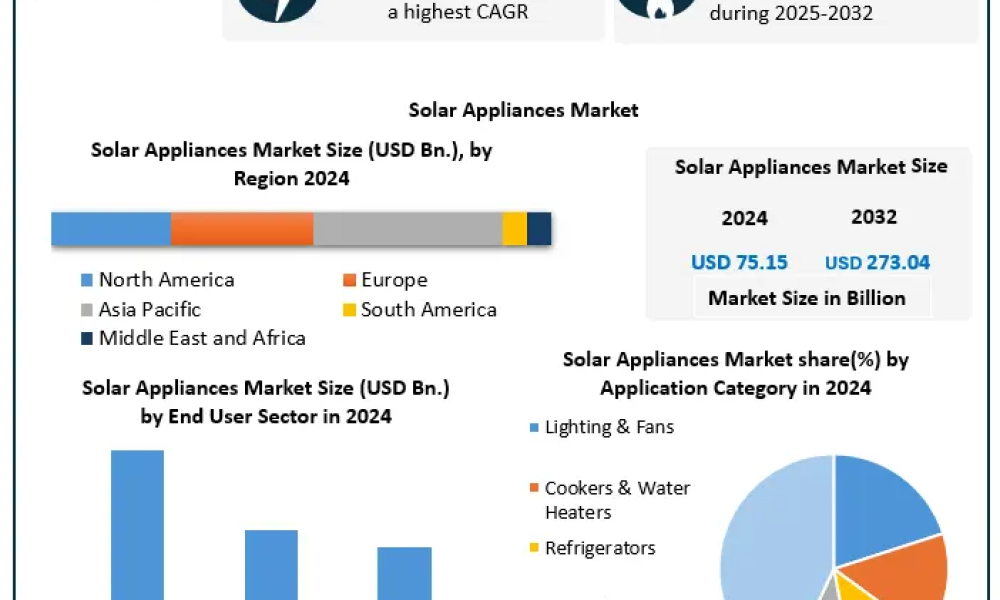
Solar Appliances Market is witnessing unprecedented expansion, valued at USD 75.15 billion in 2024 and set to soar to nearly USD 273.04 billion by 2032, registering a remarkable CAGR of 17.5%. The market’s rapid ascent is fueled by the ongoing transition to renewable energy, widespread adoption in residential and commercial sectors, and significant government incentives across key regions.
Key Insights & Highlights
- Dominating Region: Asia-Pacific stands as the dominant market, driven by its abundant sunlight, rapid urbanization, tech advancement, and robust government support. China, India, and Japan lead in adoption, pushing the region’s market share far above North America and Europe.
- Leading Segment: Solar Photovoltaic appliances comprise the largest share, representing 60% of the market in 2024 and expected to maintain dominance (CAGR 9%). Residential end-users account for over 45% market share, sought for rooftop panels, solar water heaters, and lighting systems.
- Key Driver: Accelerating demand for renewable energy sources, cost reductions in solar technology, rising awareness of environmental benefits, and government subsidies make solar appliances ever more attractive for households and businesses.
Recent Developments
- 2024–2025: Leading players like Solaria, Canadian Solar, Trina Solar, SunPower, LG Solar, Hanwha Q Cells, and JinkoSolar are expanding portfolios to offer more durable, efficient, and affordable solar appliances.
- Entry of emerging brands such as Goal Zero, Jackery, EcoFlow, and BigBlue broadens availability, with a focus on portable, user-friendly appliances.
- Increasing integration of smart and IoT-enabled features allows users to remotely monitor and control solar-powered devices via phone apps.
- Manufacturers form strategic partnerships for product innovation, market expansion, and the development of multifunctional devices—including solar boilers, solar-powered AC, and portable stations with advanced storage.
Market Dynamics
Growth Drivers:
- Global demand for clean, sustainable energy to combat climate change boosts adoption of solar appliances.
- Falling costs from manufacturing scale, technological advances, and improved installation reduce barriers to entry.
- Policy frameworks (incentives, feed-in tariffs) and robust manufacturing ecosystems—especially in Asia—make solar devices cost-effective and widely available.
Challenges:
- High initial investment for some consumers despite declining costs.
- Issues with energy storage during low sunlight cycles spur further battery and technological development.
- Maintenance complexity and need for skilled technicians, notably in remote areas.
Get a deeper look at the data by requesting a sample report today : https://www.maximizemarketresearch.com/request-sample/217463/
Regional Analysis
- Asia-Pacific: Largest and fastest-growing region thanks to favorable climate, rising energy needs, urbanization, and leading solar manufacturing. China and India especially benefit from government incentives and strong local production, transforming urban infrastructure with BIPV and solar streetlights.
- North America: Significant growth, bolstered by federal tax credits, strong investment, and tech advancements making devices more efficient, reliable, and IoT-integrated.
- Europe: Advances in energy storage, strong policy support, and sustainability-driven consumer base foster robust market growth.
- Middle East & Africa/Latin America: Emerging markets show high demand due to energy accessibility concerns and new grid-independent solutions.
Product Segmentation
- By Type: Solar Photovoltaic appliances, Solar Thermal appliances
- By End-User: Residential (largest share), Commercial, Industrial
- By Appliance Category: Lighting & Fans, Cookers & Water Heaters, Refrigerators & Freezers, Air Conditioning, Solar Pumps
- By Technology: PV Battery Hybrid Systems, Pure PV (non-battery)
- By Region: Asia-Pacific, North America, Europe, Middle East & Africa, South America
Key Trends
- Dramatic improvements in energy efficiency—solar TVs, fans, and appliances far outperform previous generations.
- Integration of solar storage—especially batteries—boosts reliability for off-grid and cloudy-day power.
- Innovations in portable, compact, and IoT-enabled solar appliances reshape consumer convenience and market reach.
- Government incentives and financing options accelerate residential uptake.
Quote
Asia-Pacific’s leadership in solar appliances echoes its commitment to sustainable energy, urban innovation, and technological progress. As costs fall and features grow, solar appliances will become essential for consumers and industries worldwide striving for cost savings, independence, and a cleaner future.
About Us




