

Sodium Ion Battery Market Overview
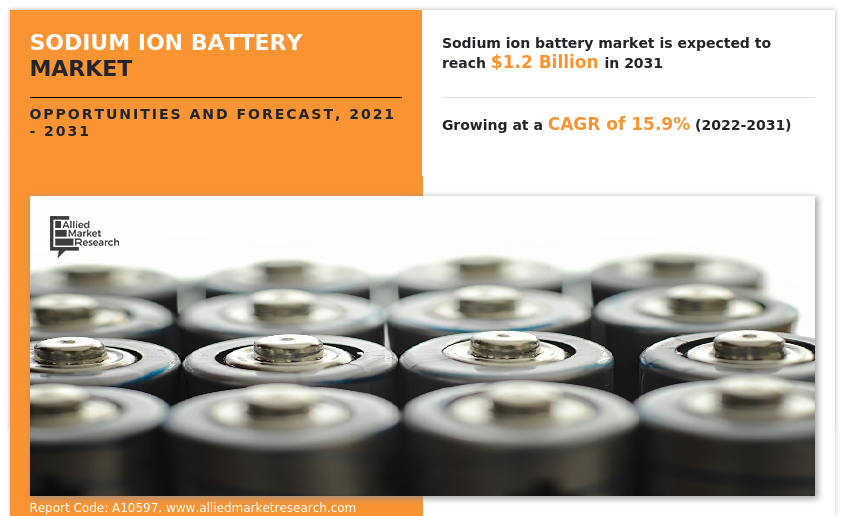
According to a new report published by Allied Market Research, the sodium ion battery market size was valued at $0.3 billion in 2021 and is estimated to reach $1.2 billion by 2031, growing at a CAGR of 15.9% from 2022 to 2031. The rapid adoption of advanced energy storage technologies, increasing demand for cost-effective battery solutions, and the global transition toward sustainable energy systems are significantly contributing to the expansion of the sodium ion battery market.
Download PDF Brochure: https://www.alliedmarketresearch.com/request-sample/A10597
A sodium ion battery is an emerging electrochemical energy storage technology in which sodium ions move between the cathode and anode during charging and discharging cycles. When the battery is charged, sodium ions de-intercalate from the cathode and migrate toward the anode, storing energy in the form of chemical bonds. These batteries offer strong electrochemical performance, high reversibility, and reliable charge-discharge efficiency, making them suitable for multiple industrial and commercial applications.
Rising Demand for Affordable and Sustainable Battery Technologies
One of the primary factors driving the sodium ion battery market growth is the increasing demand for affordable and sustainable alternatives to lithium-ion batteries. Compared to lithium-ion batteries, sodium ion battery materials are more abundant, easily accessible, and cost-effective. This makes sodium ion battery technology highly attractive for large-scale applications such as renewable energy storage, electric mobility, and industrial backup power systems.
Furthermore, sodium ion batteries are gaining popularity as a viable replacement for lithium-ion batteries in automobiles, aircraft, marine systems, and consumer electronics. Their easy availability and stable supply chain provide long-term reliability, especially in regions facing lithium resource constraints. As a result, manufacturers are increasingly investing in research and development to enhance sodium ion battery efficiency and performance.
Expanding Applications Across Automotive and Energy Storage Sectors
The growing consumer demand for electric vehicles, electronic devices, and advanced electrical systems has accelerated the development of the sodium ion battery market globally. In the automotive sector, sodium ion batteries are being explored as next-generation battery solutions due to their affordability, safety, and sustainability advantages. The transition to sodium-based battery cells is also easier for manufacturers, as existing lithium-ion production equipment can be adapted for sodium ion battery manufacturing.
In addition, sodium ion batteries are widely used in stationary energy storage systems that store electricity and discharge it when required. These systems typically include an array of batteries, an inverter, electronic control units, and thermal management components. Unlike fuel cells, stationary energy storage devices must be charged before delivering electricity, making efficient battery technologies crucial for power reliability.
Growing Importance of Renewable Energy Integration
The global shift toward renewable energy sources such as solar and wind power is significantly boosting the sodium ion battery market demand. Renewable energy generation is intermittent in nature, creating a strong need for large-capacity energy storage systems. Sodium ion batteries provide a cost-effective solution for storing renewable energy and supporting grid stability.
Moreover, increasing investments in solar and wind power plants have led to a surge in demand for low-cost and stable energy storage solutions. The presence of strong renewable energy demand is expected to create lucrative opportunities for the sodium ion battery market during the forecast period. Governments and energy companies are actively focusing on battery energy storage systems (BES) to ensure uninterrupted power supply and efficient energy management.
Technological Advancements and Research Initiatives Supporting Market Growth
Technological advancements and research initiatives are playing a crucial role in the development of the sodium ion battery market. For instance, the EU-funded NAIMA project was launched to develop reliable sodium ion battery cells for non-automotive applications. Supported by the Horizon 2020 program, the project aims to demonstrate the competitiveness, safety, and cost-effectiveness of sodium ion batteries as alternatives to lithium-based technologies for energy storage applications.
In addition, continuous innovations in battery chemistry, material optimization, and energy density improvements are expected to address current limitations associated with sodium ion battery technology. Although sodium ion batteries currently have lower energy density compared to lithium-ion batteries, ongoing technological progress is anticipated to enhance their performance in the coming years.
Market Segmentation Analysis
The sodium ion battery market is segmented based on application, end-use, and region. By application, the market is divided into residential, commercial, and industrial segments. Among these, the industrial segment dominated the global sodium ion battery market in 2021 due to its extensive use in backup power supply systems and large-scale manufacturing operations. Industrial facilities rely heavily on energy storage devices to ensure operational continuity and energy efficiency.
Based on end-use, the market is categorized into stationary energy storage and transportation. The stationary energy storage segment accounted for the largest market share in 2021, owing to the increasing deployment of battery storage systems in renewable energy projects and grid infrastructure. These systems play a critical role in storing excess energy generated from renewable sources and supplying electricity during peak demand periods.
Regional Insights: Europe Leads the Global Market
Region-wise, Europe dominated the global sodium ion battery market in 2021 and is expected to maintain its leadership during the forecast period. The region’s dominance is attributed to stringent environmental regulations, strong focus on reducing carbon emissions, and rapid technological advancements in battery manufacturing. European countries are actively investing in clean energy infrastructure and energy storage technologies to support their sustainability goals.
North America and Asia-Pacific are also expected to witness significant growth due to increasing renewable energy adoption, rising industrialization, and growing demand for advanced battery storage systems. Meanwhile, LAMEA is gradually emerging as a promising market driven by expanding energy infrastructure and renewable power projects.
Impact of COVID-19 on the Sodium Ion Battery Market
The COVID-19 pandemic had a mixed impact on the sodium ion battery market. During the pandemic, the demand for stationary energy storage devices increased significantly due to the widespread adoption of remote work and the growing need for uninterrupted power supply through UPS systems. However, the shutdown of industrial facilities and delays in solar and wind power plant construction projects negatively affected the demand for sodium ion batteries in certain regions.
Despite these temporary disruptions, the post-pandemic recovery and increasing reliance on renewable energy resources are expected to positively influence the sodium ion battery market outlook in the coming years.
Competitive Landscape and Key Players
The global sodium ion battery market is highly competitive, with key players focusing on product innovation, partnerships, and capacity expansion to strengthen their market presence. Major companies profiled in the report include CATL, Faradion, Natron Energy, HiNa Battery, Ronbay Technology, Panasonic, Mitsubishi Chemical, Natrium, Kishida Chemical, and Zoolnash.
Strategic developments such as product launches, research collaborations, and technological innovations are shaping the competitive dynamics of the sodium ion battery market. For instance, in July 2021, CATL launched its first sodium ion battery product designed for stationary energy storage applications, which significantly enhanced its market positioning.
Get a Customized Research Report: https://www.alliedmarketresearch.com/request-for-customization/A10597
Future Outlook of the Sodium Ion Battery Market
The future of the sodium ion battery market appears highly promising, driven by increasing investments in renewable energy, rising demand for eco-friendly battery technologies, and expanding applications in energy storage and transportation. Advantages such as affordability, sustainability, safety, and material abundance make sodium ion batteries a strong alternative to traditional lithium-ion batteries.
Moreover, the growing emphasis on battery recycling, second-life battery usage, and sustainable energy storage solutions is expected to further accelerate the adoption of sodium ion battery technology. As global energy demand continues to rise, the sodium ion battery market is projected to witness substantial growth, playing a vital role in the next generation of energy storage and clean power systems.
Other Trending Reports:-
About Us
Allied Market Research (AMR) is a full-service market research and business-consulting wing of Allied Analytics LLP based in Portland, Oregon. Allied Market Research provides global enterprises as well as medium and small businesses with unmatched quality of “Market Research Reports” and “Business Intelligence Solutions.” AMR has a targeted view to provide business insights and consulting to assist its clients to make strategic business decisions and achieve sustainable growth in their respective market domain.
Pawan Kumar, the CEO of Allied Market Research, is leading the organization toward providing high-quality data and insights. We are in professional corporate relations with various companies and this helps us in digging out market data that helps us generate accurate research data tables and confirms utmost accuracy in our market forecasting. Each and every data presented in the reports published by us is extracted through primary interviews with top officials from leading companies of domain concerned. Our secondary data procurement methodology includes deep online and offline research and discussion with knowledgeable professionals and analysts in the industry.




