
The global energy landscape is undergoing a fundamental transformation. Aging power infrastructure, the rapid rise of renewable energy sources, and increasing electricity demand are pushing utilities worldwide to rethink how electricity grids are monitored, managed, and optimized. At the heart of this transformation lies the smart grid sensor market, a critical enabler of real-time visibility, predictive maintenance, and intelligent grid operations.
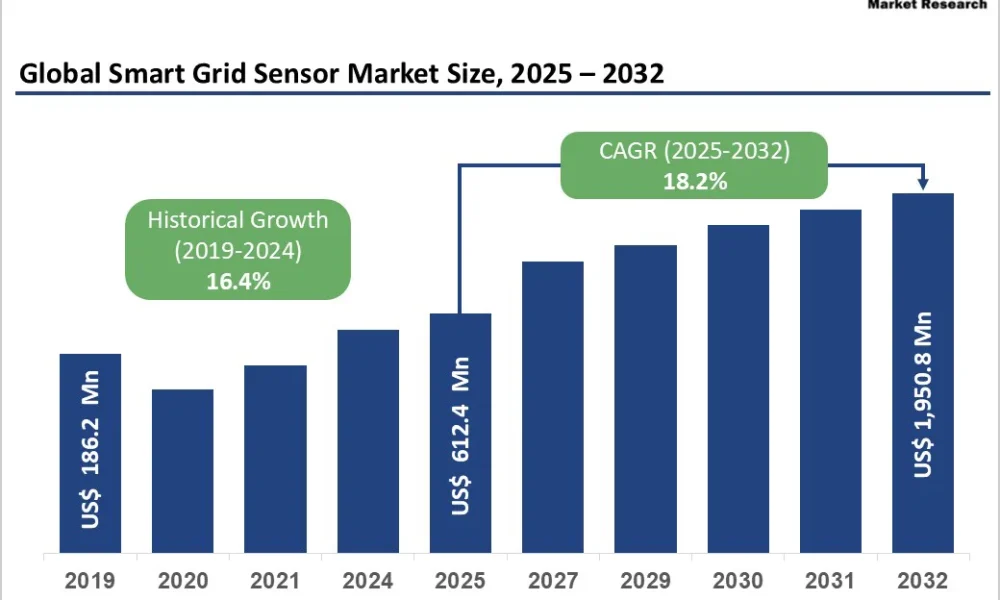
In 2025, the global smart grid sensor market was valued at US$ 612.4 million. Driven by accelerating grid modernization initiatives and digitalization efforts, the market is projected to reach US$ 1,950.8 million by 2032, expanding at a robust CAGR of 18.2% during the forecast period. This strong growth trajectory highlights the rising importance of sensor-based intelligence in building resilient, efficient, and sustainable power systems.
Understanding Smart Grid Sensors and Their Role in Modern Power Networks
Smart grid sensors are advanced monitoring devices installed across transmission, distribution, and consumption points of the electricity grid. Unlike traditional sensors, these devices provide real-time data on voltage, current, temperature, frequency, and power quality, enabling grid operators to detect anomalies, predict failures, and optimize energy flows.
Their role has become increasingly critical as power grids integrate distributed energy resources (DERs) such as solar, wind, electric vehicles (EVs), and battery storage systems. These decentralized assets introduce variability and complexity that conventional grids were never designed to handle. Smart grid sensors bridge this gap by offering granular, actionable insights that support automated decision-making and advanced grid analytics.
Smart Grid Sensor Market Size and Growth Outlook
The global smart grid sensor market has demonstrated steady momentum over the past decade. Between 2019 and 2023, the market grew at a CAGR of 16.4%, reflecting early-stage smart grid deployments and pilot projects across developed economies. From 2025 onward, growth is expected to accelerate further, reaching 18.2% CAGR through 2032.
This acceleration is driven by:
- Large-scale replacement of legacy grid infrastructure
- Rising government mandates for energy efficiency and grid resilience
- Increased adoption of renewable energy and EV charging networks
- Falling sensor costs combined with improved accuracy and durability
By 2032, smart grid sensors will be deeply embedded across utility networks, commercial buildings, and industrial facilities, transitioning from optional upgrades to essential infrastructure components.
Key Industry Highlights and Segment Analysis
Voltage and Temperature Sensors Lead the Component Landscape
By component type, voltage and temperature sensors dominate the global smart grid sensor market, accounting for 35.7% of total market share in 2025. These sensors serve as foundational tools for monitoring grid stability and equipment health across substations, transformers, and transmission lines.
Their importance lies in their ability to:
- Detect voltage fluctuations that can damage sensitive equipment
- Monitor transformer and cable temperatures to prevent overheating
- Enable predictive maintenance by identifying early signs of failure
As utilities shift from reactive to preventive maintenance strategies, demand for high-precision voltage and temperature sensors continues to rise, reinforcing their leadership position in the market.
Smart Energy Meters Dominate Application Demand
From an application standpoint, smart energy meters represent the largest segment, commanding a 48.4% market share in 2025. Their widespread deployment at residential, commercial, and industrial endpoints has made them the backbone of modern smart grid ecosystems.
Smart energy meters provide:
- Real-time energy consumption data
- Two-way communication between utilities and consumers
- Support for dynamic pricing and demand response programs
Their integration with digital platforms enables utilities to optimize energy distribution, reduce losses, and improve billing accuracy. For consumers, smart meters empower better energy management and cost savings, further accelerating adoption worldwide.
Utility Sector Remains the Primary End User
By end-use industry, the utility sector leads the smart grid sensor market with a 54.3% share in 2025. Utilities are at the forefront of smart grid investments, deploying sensors across transmission and distribution networks to enhance operational efficiency, reliability, and outage management.
Key benefits for utilities include:
- Faster fault detection and isolation
- Reduced downtime and maintenance costs
- Improved integration of renewable energy sources
While utilities dominate current demand, the commercial end-user segment is emerging as the fastest-growing category, expanding at a 14% CAGR through the forecast period. Commercial buildings, data centers, and campuses are increasingly adopting smart grid sensors to optimize energy usage, participate in demand response programs, and meet sustainability targets.
Elevate your business strategy with comprehensive market data. Request a sample report now: https://www.persistencemarketresearch.com/samples/3962
Regional Market Insights
North America Maintains Global Leadership
North America holds the leading position in the global smart grid sensor market, accounting for 28.2% of total market share and reaching a valuation of US$ 218.2 million by 2025. The region’s dominance is underpinned by early adoption of smart grid technologies, substantial investments in grid modernization, and strong regulatory support.
Key drivers in North America include:
- Federal and state-level funding for smart grid projects
- Widespread deployment of smart meters
- Advanced digital infrastructure and analytics capabilities
The United States, in particular, continues to lead in integrating AI-driven grid management and predictive maintenance solutions.
Asia Pacific Emerges as the Fastest-Growing Region
While North America leads in market share, Asia Pacific is the fastest-growing regional market, registering a CAGR of 21.5% during the forecast period. Rapid urbanization, rising electricity demand, and ambitious government-led grid digitalization initiatives are fueling growth across the region.
China’s large-scale investments in ultra-high-voltage transmission networks and digital substations, along with India’s National Smart Grid Mission, are driving widespread adoption of smart grid sensors. As emerging economies modernize their power infrastructure, Asia Pacific is expected to significantly narrow the gap with mature markets by 2032.
Key Market Drivers Accelerating Adoption
Several structural and technological factors are shaping the future of the smart grid sensor market:
Grid Modernization Initiatives
Aging grid infrastructure in many countries is prone to failures and inefficiencies. Smart grid sensors play a critical role in upgrading these systems without complete overhauls.
Renewable Energy Integration
Solar and wind energy introduce intermittency into the grid. Sensors enable real-time monitoring and balancing, ensuring grid stability despite fluctuating supply.
Government Regulations and Energy Policies
Mandates for smart meters, energy efficiency standards, and carbon reduction targets are compelling utilities and commercial users to invest in smart grid technologies.
Advancements in AI and Data Analytics
The integration of sensors with AI-driven platforms allows utilities to move from data collection to actionable intelligence, enhancing decision-making and operational agility.
Competitive Landscape and Strategic Developments
The global smart grid sensor market is moderately consolidated, with leading players focusing on innovation, AI integration, and strategic partnerships. Siemens leads the market, generating estimated annual revenues of US$ 180–250 million from its AI-driven grid management and sensor solutions.
Other prominent players include:
- Schneider Electric, emphasizing digital energy management platforms
- GE, leveraging industrial IoT and advanced analytics
- ABB, focusing on predictive maintenance and automation
- Itron, specializing in smart metering and data intelligence
These companies are strengthening their portfolios through R&D investments, acquisitions, and collaborations with utilities and technology providers to gain competitive advantage.
Future Outlook: What Lies Ahead for Smart Grid Sensors?
Looking ahead to 2032, the smart grid sensor market is poised to become a cornerstone of global energy infrastructure. The convergence of sensors, AI, cloud computing, and edge analytics will redefine how electricity networks are managed.
Emerging trends include:
- Greater use of self-healing grids powered by real-time sensor data
- Expansion of sensor deployments at EV charging stations
- Increased focus on cybersecurity and data integrity
- Integration with digital twins for advanced grid simulation
As energy systems become more decentralized and complex, smart grid sensors will evolve from monitoring tools into intelligent decision-enabling assets.
Conclusion
The global smart grid sensor market is entering a high-growth phase, expanding from US$ 612.4 million in 2025 to US$ 1,950.8 million by 2032 at a CAGR of 18.2%. Driven by grid modernization, renewable energy integration, and digital transformation initiatives, smart grid sensors are reshaping how power networks operate.
With utilities leading adoption, smart energy meters dominating applications, and Asia Pacific emerging as a growth powerhouse, the market presents significant opportunities for technology providers and investors alike. As innovation accelerates and smart grids become the norm rather than the exception, smart grid sensors will play a defining role in building resilient, efficient, and sustainable energy systems worldwide.
Related Reports:




