
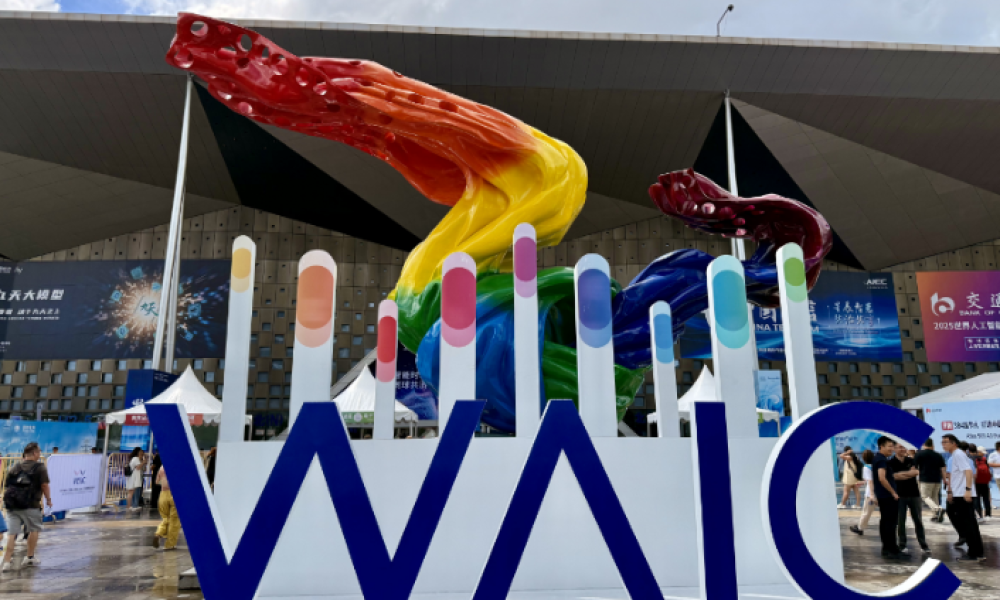
It’s learned that the three-day World Artificial Intelligence Conference (WAIC), the world’s premier AI event, concluded successfully in Shanghai on July 29th. This year’s conference boasted a heightened international profile, with record-breaking attendance, exhibition space, and product debuts.
WAIC debuted its AI glasses paradigm.
As a highly influential event in the global AI field, WAIC brings together the world’s leading technology leaders and is a premier platform for showcasing disruptive technologies and products. Many listed companies, including Alibaba, Tencent, and Baidu, participated.
The “100-glass battle” is in full swing. This year’s WAIC showcased a wealth of new product highlights, with smart glasses becoming the undisputed “new darling.” Numerous companies showcased their new products, showcasing their performance, interactivity, and application scenarios, becoming some of the conference’s shining tech stars.
Experts at the conference analyzed that the strategic value of AI glasses lies primarily in the following: First, glasses occupy a niche in the human head, and head-mounted devices can capture over 80% of human sensory input; second, they possess extremely strong scene penetration capabilities, covering office, daily life, and mobile scenarios simultaneously.
It is predicted that AI glasses will become the next generation of human-computer interaction’s ‘sensory center,’ which will trigger a rapid explosion in personal data and is expected to become the most important personal mobile portal after smartphones. In the future, breakthroughs in hardware performance and an expanding ecosystem of manufacturers will drive AI glasses from a niche niche to a ‘must-have’ for the general public. The moment when everyone has a pair of glasses, like the iPhone, may be just around the corner.
Many companies are seizing opportunities to seize market share.
Alibaba (BABA)
It is reported that at the recently opened 2025 World Artificial Intelligence Conference (WAIC), Alibaba publicly unveiled its first self-developed AI glasses, the Quark AI Glasses, and officially disclosed the product’s technological development progress. These AI glasses mark a significant step forward for Alibaba in the field of AI hardware and are expected to be officially released this year.
As part of Alibaba’s “AI to The AI glasses are a key implementation of Alibaba’s “C” strategy. The glasses deeply integrate the capabilities of Tongyi Qianwen’s large-scale model, along with Quark’s latest achievements in AI applications, pushing Alibaba’s AI strategy from software to hardware. In the future, AI glasses will evolve into the sensory hub for a new generation of human-computer interaction, stimulating exponential growth in personal data. This is precisely Alibaba’s strength in scenario coverage and AI collaboration.
Meta (META)
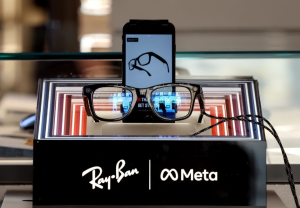
Eyewear manufacturer EssilorLuxottica announced on July 28 that sales of its Ray-Ban Meta AI glasses tripled, driving profit growth. EssilorLuxottica stated that AI glasses experienced strong momentum in the first half of the year, with Ray-Ban Meta revenue more than tripling year-over-year.
Additionally, a company representative stated, “With the launch of our new AI glasses, Oakley, in June, we are leading the transformation of glasses towards the next computing platform, where artificial intelligence, sensing technology, and data-rich healthcare infrastructure will converge to empower humanity and unleash our full potential.”
Apple (AAPL)
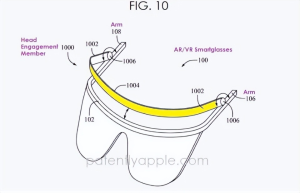
The U.S. Patent Office recently published Apple’s patent application for a “modular and comfortable architecture for AR/VR smart glasses.” The patent shows a device similar to smart glasses, equipped with a strap designed to improve comfort, fit, and adjustability.
Earlier, analyst Ming-Chi Kuo revealed that Apple plans to release up to seven AR/MR devices over the next few years. The first smart glasses will be released in 2027, with features similar to Ray-Ban Meta, supporting photography, AI experiences, and more.
Qualcomm (QCOM)
As a leading chip manufacturer, Qualcomm has naturally taken note of this issue. At the AWE conference in June of this year, Qualcomm unveiled its latest AI glasses-specific chip, the AR1+ Gen1. Compared to the previous generation, the AR1+ Gen1 boasts a smaller package, 7% lower power consumption in core usage scenarios, better photography, enhanced performance, and support for small language models on the glasses side. Wimi Hologram Cloud Inc. (WIMI)
As a leading company in the holographic AR + AI vision field, Wimi has, in recent years, comprehensively developed its presence in the smart glasses market through technological research and development, industry chain integration, and ecosystem collaboration. Focusing on the integration of AI and AR/VR technologies, the company aims to build competitiveness across the entire industry chain, from underlying technologies to scenario-based applications.
Currently, Wimi’s technological development focuses on core technology breakthroughs, product feature optimization, and cross-industry ecosystem collaboration, driving the evolution of smart glasses from tools to “AI assistants + scenario portals.” The company has already launched MicroLED optical modules and diffractive waveguide display technology, balancing lightweight design with high display performance. These technologies can be embedded in smart glasses and support scenario-based features such as 3D content overlay and real-time translation, providing users with a more natural virtual-reality interaction experience.
The 2025 World Artificial Intelligence Conference, with its large-scale and cutting-edge exhibits, showcased the vibrant vitality and transformative power of the AI field. Large models are evolving at an accelerated pace, moving from theoretical breakthroughs to industrial implementation, empowering numerous industries and driving the upgrading of traditional ones. Smart glasses are thriving in logistics, entertainment, and other scenarios, pushing the physical boundaries of AI. These achievements not only demonstrate technological advancement but also exemplify the shift from technical usability to economic feasibility. They foreshadow the continued technological growth driven by the continuous iteration of the AI industry chain’s “computing power-model-application” strategy, as well as the opportunities presented by the implementation of “AI+” across numerous industries.




