
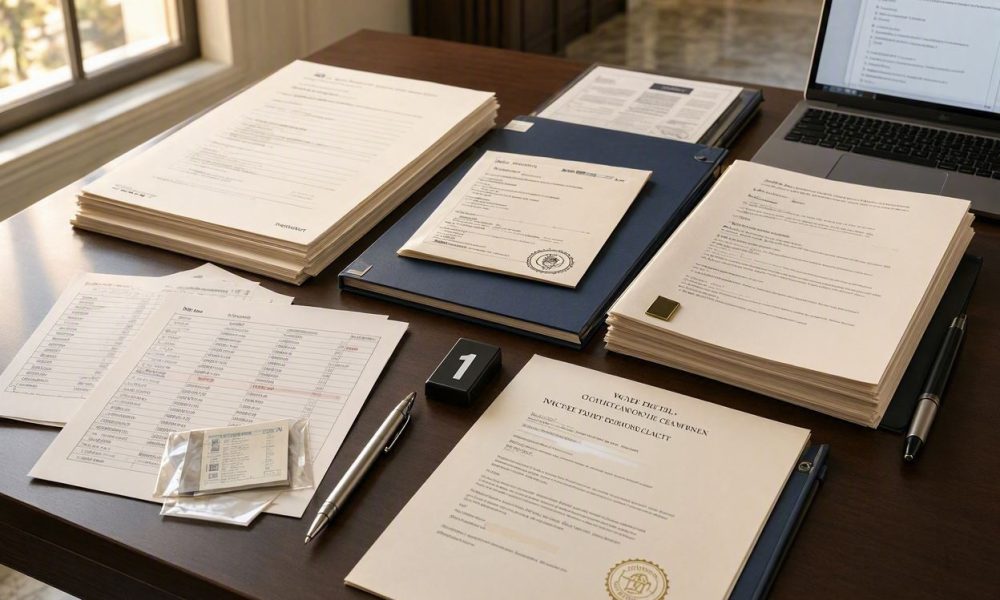
Federal prosecutors generally assemble the indictment, arrest warrant, sworn factual summaries, financial evidence, certified translations, identity records, and carefully tailored legal explanations showing why alleged wire fraud and tax fraud satisfy every applicable foreign extradition requirement.
WASHINGTON, D.C., September 6, 2026
When an American fraud defendant disappears abroad, the documents eventually delivered to a foreign government are not simply a copied indictment and a request for assistance, because an effective extradition package must translate a domestic criminal prosecution into the legal vocabulary, evidentiary standards, procedural rules, and diplomatic expectations of another sovereign nation.
That transformation requires federal prosecutors, investigating agents, Justice Department specialists, State Department officials, translators, and sometimes state authorities to create a coherent record proving who is wanted, what conduct allegedly occurred, which enforceable charges remain pending, and why surrender is authorized under the controlling treaty and the requested country’s domestic law.
The result can fill multiple binders or thousands of electronic pages, yet its strength depends less upon sheer volume than upon disciplined organization, accurate certification, persuasive factual sequencing, and an exact match between each alleged act, each cited statute, and every legal requirement imposed by the foreign court reviewing the American request.
The Treaty Controls the Entire Structure
Every extradition package begins with the governing treaty, because treaties vary significantly concerning extraditable offenses, evidentiary thresholds, authentication methods, limitation periods, nationality restrictions, political-offense exclusions, specialty protections, required translations, and the precise route through which documents must travel before foreign authorities may lawfully consider surrender.
The Justice Department’s published guidance on international extradition and related matters explains that international extradition is a formal government-to-government process, meaning an individual prosecutor cannot bypass federal coordination, communicate an informal demand directly to foreign police, or assume that an American warrant carries automatic enforcement power beyond United States territory.
Before drafting begins, the prosecuting office normally consults the Justice Department’s Office of International Affairs, which evaluates the relevant treaty, identifies the requested country’s practices, supplies drafting requirements, coordinates necessary revisions, and determines whether the alleged conduct presents a sufficiently serious and legally supportable case for an international surrender effort.
This preliminary analysis can reshape the prosecution because a charging theory that works comfortably before an American jury may need additional facts, different emphasis, or fewer counts when presented to a foreign judge unfamiliar with federal mail, wire, securities, conspiracy, or tax statutes.
The Charging Documents and Arrest Authority
At the package’s foundation are valid charging documents, usually an indictment or criminal complaint, together with an enforceable arrest warrant establishing that an American court has formally accused the person and authorized custody rather than merely requesting questioning, investigation, surveillance, or voluntary cooperation from the foreign state.
Prosecutors must confirm that every count offered as a basis for surrender remains pending, carries sufficient potential punishment, falls within the treaty’s temporal coverage, and describes conduct that can be separated clearly from allegations carrying political, military, regulatory, revenue, or other treaty-sensitive characteristics.
The arrest warrant must correspond precisely with the defendant’s legal identity and charging record, while certified copies, court seals, signatures, docket information, and declarations concerning continuing validity help assure foreign decision-makers that the request rests upon authentic judicial action rather than an investigative lead or outdated administrative entry.
If the defendant has already been convicted, the package changes substantially because prosecutors generally must include the judgment, sentence, information about any unserved imprisonment, and evidence showing whether the conviction followed a personal appearance or occurred in absentia under procedures acceptable to the requested jurisdiction.
A Narrative That Makes Complex Fraud Understandable
Fraud prosecutions often involve years of transactions, numerous corporate entities, layered bank accounts, misleading communications, nominee owners, false tax filings, and victims in several jurisdictions, so the package needs a sworn narrative that converts sprawling discovery into an intelligible sequence of alleged promises, transfers, concealment, benefits, and losses.
That narrative usually comes from an investigating agent or another qualified witness who identifies the investigation, explains the sources of information, describes relevant participants, connects communications with payments, and states facts supporting each essential element without pretending that contested allegations have already been proven at trial.
The most effective affidavits guide a foreign reader chronologically, introducing the business or investment arrangement before detailing alleged misrepresentations, showing how victims relied upon those claims, tracing funds through identifiable accounts, and explaining how the defendant allegedly controlled, diverted, concealed, or personally benefited from the proceeds.
Prosecutors must balance completeness against clarity because an affidavit overloaded with every interview, spreadsheet, email, and transfer can obscure the central theory, while an excessively compressed account may leave a foreign court unable to identify probable cause or the requested country’s equivalent criminal offense.
Financial Evidence Behind the Allegations
Bank records commonly provide the package’s documentary spine, especially when they show investor deposits entering an account represented as protected or restricted, followed by transfers toward personal purchases, unrelated companies, offshore holdings, cash withdrawals, cryptocurrency platforms, tax payments, or distributions designed to sustain an alleged Ponzi-style operation.
Investigators may attach representative statements, wire confirmations, account-opening records, signature cards, ledger extracts, payment-processor data, or tracing charts, but each exhibit should serve a defined proposition and should be explained sufficiently for a foreign reviewer who has never encountered the underlying institutions, terminology, or transaction system.
Business records can add essential context by revealing contracts, capitalization tables, invoices, loan agreements, internal forecasts, audit reports, customer files, board minutes, or accounting entries that allegedly contradict public assurances and demonstrate what the defendant knew when particular statements or transfers occurred.
In digital fraud cases, prosecutors may also rely upon emails, encrypted messages obtained lawfully, website captures, server records, online advertisements, recorded calls, or platform data connecting the defendant with representations transmitted across state or national borders, thereby supporting federal jurisdiction and explaining the alleged mechanism of deception.
Witness Statements and Evidentiary Sufficiency
Witness evidence may include sworn summaries from victims, employees, accountants, bankers, cooperating defendants, vendors, or government agents, although the package usually presents carefully selected testimony that establishes material facts efficiently rather than reproducing every available interview or exposing unnecessary investigative information before trial.
Each witness contribution should identify how that person acquired relevant knowledge, distinguish direct observations from business records or secondhand information, and connect specific statements with dates, transactions, or decisions, because vague allegations can invite challenges concerning reliability, hearsay, attribution, and the sufficiency of the requesting state’s evidence.
The applicable standard is not necessarily the American trial standard of proof beyond a reasonable doubt, yet prosecutors cannot assume that a grand jury indictment alone will satisfy every country, since some foreign systems demand an evidentiary showing resembling probable cause while others examine documentation through distinct statutory formulas.
Recent international cases demonstrate how foreign courts may authorize surrender for some fraud allegations while excluding counts that lack a domestic counterpart, as illustrated by Reuters reporting on Spain’s extradition ruling involving bribery, wire fraud, and money-laundering allegations, where the court reportedly declined surrender on a conspiracy count not recognized comparably under Spanish law.
Dual Criminality Determines What Can Survive
Dual criminality generally asks whether the underlying conduct would constitute a sufficiently serious crime in both countries, not whether the American and foreign statutes use identical names, elements, jurisdictional language, sentencing structures, or enforcement agencies when describing substantially comparable dishonest behavior.
For wire fraud, prosecutors therefore explain the allegedly deceptive scheme, material falsehoods, intent, victim reliance where relevant, financial consequences, and communications used to advance the conduct, while showing that the requested country criminalizes comparable fraud even without an offense specifically labeled federal wire fraud.
This conduct-centered explanation matters because the interstate or foreign-wire element gives American federal courts jurisdiction, whereas the requested country may focus primarily upon deception, unlawful gain, breach of trust, victim loss, or fraudulent appropriation when deciding whether its own criminal law covers the same behavior.
Tax charges demand especially careful treatment because older treaties sometimes restrict fiscal offenses, foreign courts may distinguish tax evasion from filing violations, and requested governments can require clear explanations showing the tax duty, deliberate concealment, relevant reporting period, unpaid amount, and local criminal analogue.
Prosecutors may include statutory text, regulations, judicial explanations, declarations from tax specialists, certified returns, account data, assessment information, and calculations separating alleged criminal underreporting from lawful deductions or ordinary disagreements, thereby demonstrating that the request concerns intentional fraud rather than civil collection dressed as extradition.
Identity Must Be Proven Independently
Even a compelling fraud narrative fails if authorities cannot prove that the person located abroad is the defendant named in the warrant, making identity evidence an independent and indispensable component rather than a clerical appendix added after the substantive case has already been assembled.
The package may include passport photographs, booking images, fingerprint records, birth information, immigration documents, physical descriptions, known addresses, aliases, family connections, signature comparisons, and witness identifications linking the detained individual with the charged person and reducing the possibility of mistaken identity.
When names appear in different alphabets or follow different cultural conventions, prosecutors and translators must reconcile spelling variants, patronymics, compound surnames, transliteration systems, reversed name order, and historical aliases so that inconsistencies do not create avoidable doubt about whether foreign authorities arrested the correct person.
Public discussion about fugitives sometimes concentrates upon changed appearances or alternate documents, but the broader lesson presented by Amicus International Consulting’s analysis of warning signs associated with fugitives using new identities is that identity reconstruction is evaluated through interconnected historical, documentary, financial, and behavioral records rather than through one photograph alone.
Authentication, Certification, and Translation
Extradition documents must be authenticated through the method prescribed by treaty and foreign law, which can require certificates from prosecutors, court clerks, Justice Department officials, diplomats, or consular officers confirming that signatures, seals, copies, translations, and official capacities satisfy the requested country’s admissibility rules.
These formalities can appear ceremonial, yet a missing certificate, incorrect seal, unauthorized signer, incomplete exhibit reference, or unexplained copy can delay filing, trigger a supplemental request, or undermine admissibility even when the underlying criminal investigation remains factually strong and the defendant’s location is firmly established.
Translation presents another substantive risk because financial terminology, American statutory language, corporate abbreviations, evidentiary concepts, and tax expressions may lack direct equivalents, requiring certified translators to preserve legal meaning while maintaining consistent names, dates, exhibit numbers, monetary figures, and defined terms throughout an enormous record.
A translation error that changes whether money was transferred, promised, held, reported, or concealed can distort an essential allegation, so prosecutors and country specialists review translated materials against the English originals and often prepare glossaries for recurring technical language or uniquely American legal concepts.
Provisional Arrest Before the Full Package Arrives
When authorities believe a fugitive may flee again, destroy documents, cross another border, or obtain protection elsewhere, the United States can seek provisional arrest under the treaty while prosecutors complete the fully authenticated package required for the formal diplomatic request.
A provisional request generally identifies the person, summarizes the charges and facts, confirms the warrant’s existence, states the intention to pursue extradition, and supplies treaty-required assurances, but it does not eliminate the deadline for delivering the complete package after foreign authorities detain the individual.
Those deadlines are often unforgiving because a requested country may release the fugitive if formal materials do not arrive within the treaty period, making rapid translation, certification, diplomatic transmission, and correction of deficiencies essential once provisional detention starts the procedural clock.
An INTERPOL Red Notice or diffusion may assist authorities in locating or detaining a wanted person according to national law, yet such police cooperation does not replace the extradition package, satisfy treaty proof requirements automatically, or predetermine the independent judicial and executive decisions required for surrender.
Federal Review and Diplomatic Transmission
After the prosecuting office submits its materials, Office of International Affairs attorneys examine legal sufficiency, factual coherence, treaty coverage, certifications, translations, and policy considerations, frequently returning detailed questions or requesting revisions before the package can proceed to diplomatic review and foreign presentation.
The State Department then considers foreign-policy and diplomatic dimensions before transmitting an approved request through the appropriate embassy or other authorized channel, preserving the government-to-government character that distinguishes extradition from ordinary litigation and protects the sovereignty of the requested country.
State fraud cases follow a comparable international route because local prosecutors retain responsibility for charges, evidence, witnesses, and trial readiness, while federal authorities evaluate and transmit the international demand, meaning a state cannot independently compel another nation to arrest and surrender its defendant.
The demanding coordination described across Amicus International Consulting’s extradition and INTERPOL service overview reflects why internationally mobile defendants require country-specific legal assessment, although anyone facing an actual request should obtain qualified counsel in both the prosecuting jurisdiction and the country where proceedings occur.
Specialty, Sentencing, and Human-Rights Assurances
The package must also anticipate the rule of specialty, which generally limits prosecution or punishment after surrender to offenses authorized by the requested state, thereby requiring careful decisions about which counts are presented and how later superseding charges might affect treaty compliance.
If the requested country objects to capital punishment, life imprisonment, detention conditions, trial in absentia, military jurisdiction, or particular sentencing consequences, the United States may need to provide formal assurances whose wording, authority, enforceability, and monitoring implications receive close diplomatic and legal examination.
Fraud defendants may raise political motivation, discriminatory treatment, limitation periods, double jeopardy, citizenship protections, health concerns, procedural unfairness, or prison-condition arguments, so prosecutors assemble accurate responses without converting the extradition record into a complete preview of every dispute that belongs before the trial court.
What the Package Does Not Decide
An approved extradition request does not establish guilt because the foreign proceeding ordinarily determines surrender eligibility rather than resolving every factual conflict, testing all defense evidence, calculating final loss, deciding restitution, or applying the demanding burden governing conviction in an American criminal trial.
Likewise, denial does not necessarily declare innocence, since refusal can result from treaty exclusions, missing dual criminality, nationality rules, expired deadlines, authentication defects, inadequate assurances, evidentiary insufficiency, or executive discretion unrelated to whether prosecutors could prove the underlying fraud before an American jury.
Once surrender occurs, deputy marshals or other authorized officers transport the defendant to the United States, where the prosecution resumes through an initial appearance, detention proceedings, discovery, motions, plea discussions, trial preparation, and eventual adjudication under ordinary constitutional and procedural protections.
The extradition package nevertheless shapes everything that follows because specialty may restrict charges, sworn summaries can become subjects of litigation, foreign assurances may govern punishment or confinement, and inaccuracies discovered after surrender can damage credibility with courts, partner governments, witnesses, and future international investigations.
Precision Is the Real Measure of Strength
A credible fraud extradition package is ultimately a structured legal argument supported by authenticated evidence, demonstrating that the correct person is validly charged, the alleged conduct is criminal in both countries, procedural conditions are satisfied, and surrender can occur without violating treaty limitations or fundamental protections.
Its preparation demands far more than collecting impressive quantities of paperwork, because prosecutors must select representative proof, explain unfamiliar American offenses, protect continuing investigations, disclose necessary weaknesses, meet foreign formalities, and create a record capable of surviving adversarial review in another language and legal tradition.
For wire fraud and tax fraud fugitives, the decisive materials commonly include charging documents, warrants, sworn narratives, victim and financial evidence, statutory texts, identity records, limitation explanations, certified translations, authentication certificates, specialty analysis, and any assurances required by the requested country’s courts or executive authorities.
When those components align, the package gives foreign decision-makers a transparent basis for lawful action, but when identity, dual criminality, evidence, certification, or translation breaks down, even a major American prosecution can stall for months, lose particular charges, or fail before the defendant ever returns to face trial.




