.
Press Release: March 2026
For Immediate Release
It’s Never Been Easier for Self Representing Artists and Creatives to Elevate Their Brand Presence with AI Tools
The world has never been more primed for independent creativity. Across every cultural sector — from music to film, visual art, and design — traditional systems are fading into obsolescence. Government arts funding programs are shrinking, the gallery model that once sustained visual artists is collapsing, and major record labels and studios are struggling to adapt to an open-source world. Yet amid these seismic shifts, a vibrant new ecosystem is emerging, powered by creators themselves.
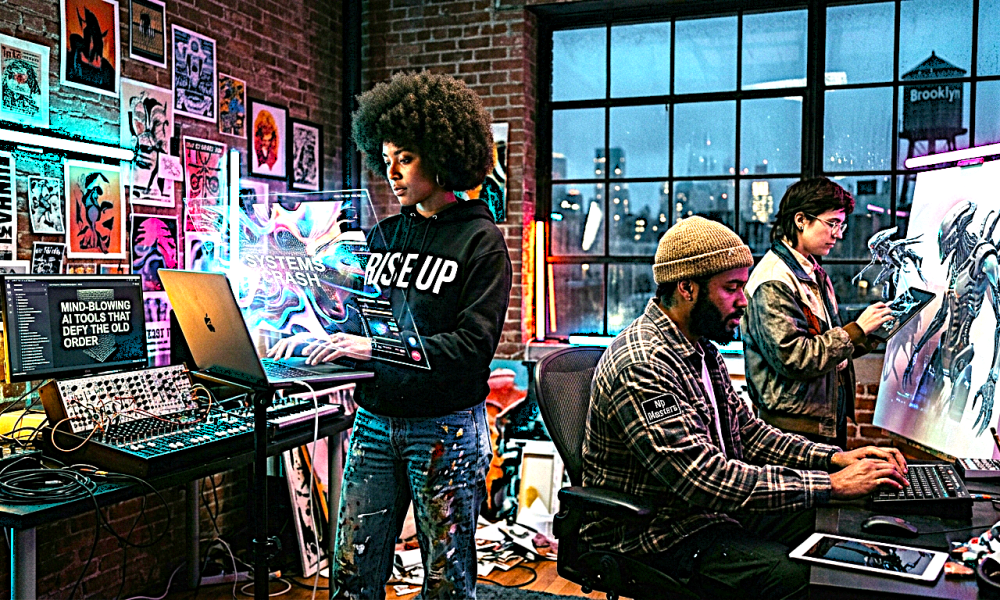
We are witnessing a moment where the creative class no longer waits for approval, opportunity, or funding. Instead, self-representing artists and independent creators are taking the reins, building their careers from the ground up through personal brands, community-driven storytelling, and a generation of AI tools tailored for artistic agency. What once required an entire production team, corporate budget, or institutional backing now happens on your laptop — sometimes even from a single prompt.
It’s never been easier, or more necessary, to be your own manager, producer, editor, and publisher. The choice is clear: adapt or get left behind. Luckily, the tools of adaptation are astonishingly capable, beautifully designed, and increasingly human in how they collaborate.
The Rise of the Self-Representing Artist
For the modern Self Representing artist, 2026 represents more than a new chapter—it signals an entire reinvention of what creative independence means. Gone are the days when visibility depended on a gallery’s approval, a grant committee’s deliberation, or the algorithmic whims of a corporate platform. Today’s Self Representing Artist is a strategist, digital craftsman, and storyteller who controls every aspect of their brand narrative.
The breakdown of legacy systems has, paradoxically, set artists free. Without institutions guarding access, creativity has moved directly into the hands of those who create. The AI Tools that define this shift are accessible, modular, and remarkably powerful.
Beyond Edge, for example, is revolutionizing local, offline production with its fully open-source video editor that runs natively on your own machine — no cloud dependency, no subscriptions, and absolute creative control. Its cutting-edge storytelling model allows users to sketch ideas, generate visual storyboards, and even produce short narrative films from a single text prompt. What used to take weeks of team coordination can now unfold in a weekend of inspired experimentation.
Meanwhile, Adobe, long criticized for its steep learning curve, has finally solved the dreaded “blank timeline problem.” Its latest generation of tools integrates adaptive scene building and automated narrative scaffolding—guiding creators from spark to structure without creative paralysis. The design philosophy is clear: give artists frictionless starts so their momentum never stalls.
The self-representing artist no longer operates in isolation; they operate in liberation. The more the world decentralizes, the more sustainable, personal, and authentic their creative practice becomes. Independence is no longer a fallback. It’s the new frontier.
Creative AI Tools That Feel Like True Collaborators
In this fast-evolving Self Representing Artist landscape, creative AI Tools have become the connective tissue between vision and realization—not replacing human intention, but extending it in astonishing ways. The best of these tools are no longer passive utilities; they feel like collaborative partners who understand flow, tone, and creative rhythm.
This year, Luma has emerged as a leader in conversational creativity. Its newest model functions more like a creative co-pilot than a software suite—one that responds to voice or text prompts with mood-sensitive adjustments, visual concepts, and dynamic pacing suggestions. Creators describe working with it as “having a dialogue with your imagination,” where the boundary between inner vision and tangible production nearly disappears.
Higgsfield has also made a bold leap forward with three new tools and a fully integrated audio suite designed for multi-sensory storytelling. The suite synchronizes sound design with motion cues, enabling independent filmmakers and multimedia artists to generate emotionally cohesive experiences without traditional post-production bottlenecks. What once required a sound engineer, editor, and motion designer now exists in a single, intuitive interface.
Then there’s Kling 3.0, which is redefining motion design with upgraded motion control systems that feel less like software sliders and more like direct creative choreography. In our tests, its real-time gesture recognition and scene comprehension allowed artists to produce polished motion sequences simply by describing emotional tempo or camera feeling—for example, “drift slowly upward with anticipation,” and the engine responds visually in seconds.
Even Beyond Edge’s storytelling model has inspired a wider movement toward locally run, privacy-first AI environments. Artists weary of Big Tech data harvesting finally have an open creative laboratory that lives on their own machines—a quiet revolution for personal sovereignty in digital art-making.
The Breakdown That Sparks a Self Representing Artist Reinvention
Theriault will tell you that this Self Representing Artists renaissance didn’t appear in a vacuum. It emerged from necessity. The economic contraction of global creative industries, the collapse of institutional patronage, and the automation of legacy production pipelines have forced creators to rethink the entire concept of sustainability.
Today’s filmmakers, musicians, and Self Representing Artists aren’t waiting for their next grant check or commission—they’re rewriting funding and distribution logic completely. Crowdfunding once served as a lifeline; now, AI-fueled micro-production allows creators to make and market faster than traditional funders can even process applications.
The same goes for art distribution. With physical galleries stagnating, digital storytelling and hybrid exhibition formats have taken center stage. A self-representing artist today can launch a global exhibition from their studio in Digby or Berlin, using embedded generative elements to make each viewer’s experience unique. This fundamental shift has not just democratized creative access; it has multiplied the reach and depth of what independent artistry can mean.
Rather than lament institutional decay, many creatives like Self Representing Artist Theriault see the massively creative AI Tools available as an opening—a dismantling of middlemen, gatekeepers, and restrictive norms. The cultural structures that once defined credibility are yielding to new forms of authenticity, where audience trust and digital storytelling-creating craftsmanship matter more than formal credentials or a political connection.
A Decentralized Future Fueled by Imagination and AI Tools
We’re entering an age of radical self-determination in art. Every creator, from illustrator to cinematographer to musician, now holds a full-stack studio’s AI Tools power in their hands. Creative AI tools and local-first software like Beyond Edge symbolize the philosophical heart of this transformation: autonomy, privacy, creativity, and collaboration seamlessly bound together.
It’s a moment where innovation feels communal again—not in corporate boardrooms but in the dialogue between artists, technologists, and independent thinkers pushing for better tools. The technology isn’t here to impose a method; it’s here to expand one’s freedom to experiment.
You finish reading about Higgsfield’s, Kling’s, Luma’s, or Adobe’s latest evolutions, and the immediate impulse isn’t to analyze—it’s to make something. That spark, that drive to create without constraint, is the pulse of 2026’s creative revolution.
So if the cultural systems seem to be falling apart, maybe that’s a gift. Maybe this is the era where the artists themselves rebuild them—open-source, self-funded, and more human than ever before.
Because right now, inspiration is infinite, tools are collaborative, and your next great project could begin as simply as a single conversation with your creative co-pilot.
About This Movement
This new creative wave signifies more than an upgrade in software or style; it’s a global correction toward authenticity. As self-representing artists like Theriault continue to redefine success and creative AI tools democratize production, the distinction between imagination and output continues to dissolve. The world isn’t waiting for art to be authorized — it’s waiting for it to be made.