
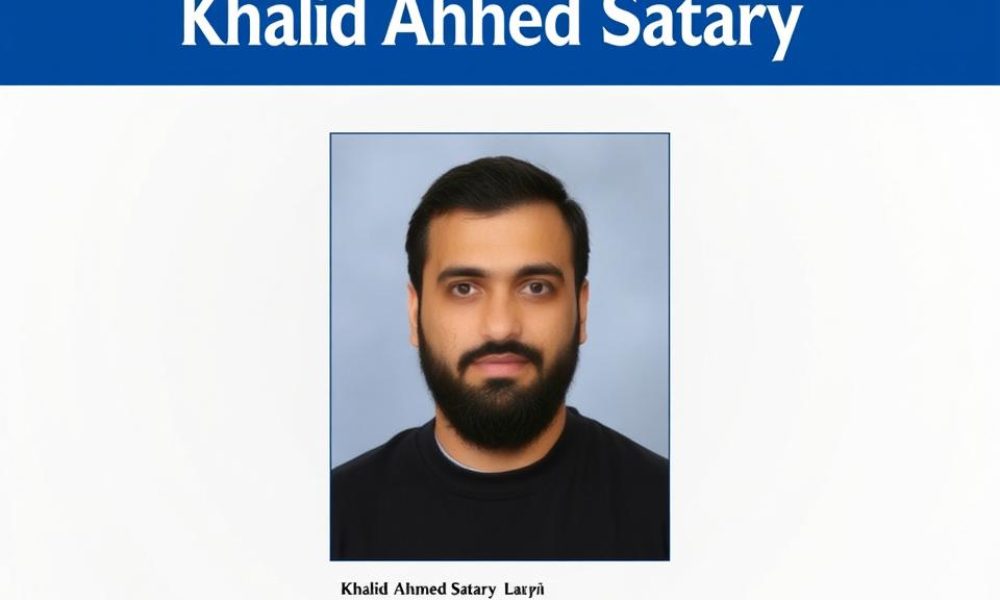
After seizing 16 bank accounts and restraining real estate connected to the accused laboratory executive, federal investigators continue to examine financial relationships, corporate records, international transfers, and potential intermediaries that could reveal how the fugitive supports himself outside the United States.
WASHINGTON, DC, July 14, 2026 — Federal authorities searching for Khalid Ahmed Satary are pursuing more than a wanted businessman, because the international manhunt also involves a continuing effort to identify, preserve, and recover wealth allegedly connected with a diagnostic laboratory network that billed Medicare more than $547 million.
Sixteen Bank Accounts Were Seized During the Initial Takedown
The Justice Department’s official account of the nationwide genetic-testing enforcement operation states that the government seized 16 bank accounts and restrained real estate connected to Satary when federal prosecutors announced the original criminal charges in September 2019.
Those actions demonstrated that investigators were following money alongside medical records, laboratory claims, telemarketing evidence, physician orders, corporate ownership documents, and alleged kickback payments associated with the healthcare fraud conspiracy described within the federal indictment.
A bank account seizure generally prevents account holders from withdrawing, transferring, spending, or concealing disputed funds while the government pursues judicial proceedings to determine whether the funds constitute criminal proceeds or property otherwise subject to forfeiture.
Restraining real estate serves a similar preservation function by preventing the sale, refinancing, transfer, or encumbrance of property before courts determine whether the government can establish the legal connection required for permanent forfeiture.
Neither action automatically establishes Satary’s guilt, because defendants and third parties retain rights to contest ownership, traceability, procedural compliance, innocent-owner status, and the government’s allegation that particular assets were involved in or derived from criminal activity.
The $547 Million Figure Does Not Equal Satary’s Personal Wealth
Federal prosecutors allege that Performance Laboratories in Oklahoma, Lazarus Services in Louisiana, and Clio Laboratories in Georgia collectively billed Medicare more than $547 million for cancer genetic testing between approximately 2016 and 2019.
That dramatic number represents claims allegedly submitted to Medicare rather than confirmed payments received by the laboratories, recoverable losses established at sentencing, or personal profit deposited directly into Satary’s individual accounts.
Healthcare fraud investigations distinguish carefully among amounts billed, claims approved, reimbursements paid, claims denied, funds recovered, operating expenses, payments distributed to marketers, and proceeds ultimately attributed to particular defendants.
The government must therefore reconstruct how much money Medicare actually transferred, where those payments traveled afterward, which individuals controlled the receiving accounts, and whether later expenditures or investments can be legally traced to disputed reimbursements.
Satary remains presumed innocent unless prosecutors prove the allegations beyond a reasonable doubt, while the financial seizure proceedings require their own evidence and legal analysis even when they arise from the same alleged healthcare conspiracy.
Medicare Payments Created the Starting Point
The financial investigation begins with Medicare reimbursement records, because every disputed laboratory payment identifies a claim, beneficiary, service date, billing code, ordering physician, testing company, reimbursement amount, and account receiving the government funds.
Investigators can place those incoming payments alongside outgoing transfers to employees, marketers, doctors, consultants, landlords, vendors, related companies, property sellers, credit card providers, and other recipients whose transactions may help explain how the laboratory network distributed its revenue.
Ordinary business expenses are not criminal merely because a company later becomes the subject of a healthcare fraud investigation, requiring forensic accountants to distinguish legitimate payroll, equipment, leases, taxes, and laboratory operations from payments allegedly advancing or concealing unlawful activity.
The analysis becomes particularly important when money from legitimate and allegedly fraudulent sources enters the same account, creating commingled balances that require investigators to apply recognized tracing methods rather than assume that every subsequent expenditure represents criminal proceeds.
Alleged Kickbacks Connected Revenue With Referrals
Federal authorities allege that Satary and his co-conspirators paid millions of dollars in kickbacks and bribes to doctors, patient recruiters, telemarketing organizations, and intermediaries whose referrals generated expensive cancer genetic tests billed through Satary’s laboratories.
Those alleged payments can provide investigators with a financial map connecting Medicare reimbursements to the people who supplied beneficiaries, biological samples, physician signatures, and documentation required before laboratories could submit claims for federal payment.
Contracts describing consulting, marketing, lead generation, administrative support, or management services may receive especially close scrutiny when compensation increases with the volume or value of Medicare-funded tests generated by the receiving party.
Investigators compare invoices, bank transfers, communications, claim dates, sample volumes, and physician orders to determine whether a payment purchased legitimate services or rewarded referrals prohibited under federal healthcare law.
Corporate Accounts Can Reveal Operational Control
Satary’s alleged ownership of several laboratories provided federal authorities with numerous corporate accounts, payroll systems, contracts, tax filings, vendor relationships, and records of authorized signatures that could show who directed important financial decisions throughout the testing network.
Formal corporate records may identify one manager or owner, while bank instructions, emails, account access, payment approvals, and witness testimony reveal that another individual exercised practical control over revenue and expenditures.
That distinction becomes especially important when investigators examine companies connected through relatives, business partners, management agreements, shared addresses, common employees, or intermediaries whose formal titles may not reflect actual authority.
Federal prosecutors must connect Satary personally to the challenged transactions through admissible evidence rather than relying exclusively on ownership, because executives cannot automatically be convicted for every payment made within companies they control.
Real Estate Can Preserve Alleged Proceeds
Real estate frequently becomes important within asset-recovery cases because property can preserve substantial value, generate rental income, secure loans, and hold wealth long after disputed business revenue has left the original bank account.
Investigators can examine purchase contracts, mortgage documents, closing records, beneficial owners, property managers, renovation expenses, tax payments, insurance policies, and transfers used to acquire or maintain real estate allegedly connected with fraud proceeds.
A property placed in another company’s or individual’s name may still be subject to investigation when financial records show that Satary or a controlled laboratory supplied the purchase price, maintained the property, or exercised continuing control.
Third parties can contest government claims by demonstrating legitimate ownership, fair-value purchases, secured interests, or lack of knowledge concerning alleged criminal activity, making real-estate restraint only the beginning of a potentially lengthy forfeiture dispute.
Seizure Does Not Guarantee Permanent Forfeiture
A seizure temporarily places disputed property under government control, while forfeiture is the subsequent legal process by which ownership can be permanently transferred after the government satisfies applicable statutory and evidentiary requirements.
Criminal forfeiture generally follows conviction and focuses upon property associated with the proven offenses, while civil forfeiture can proceed against assets under separate legal standards even when the owner has not yet been convicted.
Satary’s fugitive status complicates the criminal case because prosecutors cannot complete an ordinary trial while he remains outside custody, yet related asset proceedings may continue when courts possess jurisdiction over property or accounts located within the United States.
Claimants can challenge those proceedings, demand evidence, assert innocent ownership, and contest tracing calculations, ensuring that the government cannot simply retain every asset associated with an accused person without judicial review.
The Fugitive Investigation Requires Access to Money
Remaining outside federal custody requires dependable financial resources for housing, food, transportation, communications, healthcare, legal assistance, immigration matters, business activity, and ordinary personal expenses that continue regardless of a fugitive’s location.
The HHS Office of Inspector General’s current fugitive profile states that Satary is believed to be in Dubai, although authorities have not publicly identified a confirmed residence, employer, account, property, or financial sponsor supporting him there.
Dubai is a major international business and financial center where lawful companies, investors, professionals, and expatriates conduct legitimate activity, making Satary’s suspected presence insufficient by itself to establish concealment, money laundering, or improper assistance by any local institution.
Investigators must instead identify specific accounts, companies, payments, properties, cards, intermediaries, or business relationships that connect the wanted defendant to resources available after his alleged flight from the United States.
International Credit Cards Remain an Unconfirmed Theory
The proposed subtitle referred to international credit cards, yet no public FBI, Justice Department, or HHS-OIG material currently identifies any particular credit card issuer, account number, transaction, or cardholder arrangement allegedly used by Satary while abroad.
Credit-card activity could theoretically reveal merchant locations, travel patterns, recurring expenses, online purchases, hotels, transportation, medical services, and people making payments on behalf of another user.
However, responsible reporting cannot claim that investigators are tracking specific cards without authoritative evidence, because Satary may rely upon bank transfers, business accounts, cash, third-party payments, or other financial arrangements not publicly disclosed.
The accurate conclusion is that financial investigators commonly examine payment instruments during international fugitive cases, while Satary’s actual present-day method of accessing money remains confidential or unknown within the available public record.
Shell Companies Are Also Not Publicly Confirmed
The phrase “shell company” generally refers to a legal entity with limited independent operations or employees, although such companies can serve lawful purposes, including investment holdings, property ownership, financing, intellectual property, joint ventures, or corporate restructuring.
Shell entities become concerning when they conceal beneficial ownership, disguise payment purposes, hold criminal proceeds, create false invoices, or distance a wanted person from accounts and assets that the person continues to control.
Public federal materials identify companies Satary allegedly controlled during the laboratory conspiracy, but they do not disclose a verified network of overseas shell companies currently sustaining him as a fugitive.
Investigators may examine foreign corporate registries, ownership records, directors, shareholders, addresses, bank relationships, and related parties, yet those investigative possibilities should not be presented as established findings before authorities release supporting evidence.
Beneficial Ownership Is More Important Than Company Names
Financial investigators look beyond the name printed on corporate filings because the person who legally owns shares may differ from the individual who directs transactions, supplies funds, receives benefits, or makes strategic decisions.
Beneficial ownership analysis examines who ultimately controls a company or asset, even when formal ownership appears to be held by nominees, relatives, holding companies, trusts, partnerships, or professional service providers.
Repeated telephone numbers, email addresses, payment instructions, authorized signers, addresses, accountants, and business partners can connect apparently separate entities to a single underlying controller.
This evidence becomes particularly valuable when a fugitive uses a legitimate-looking company to receive consulting income, pay living expenses, hold property, or conduct transactions without placing the wanted person’s legal name prominently within public records.
International Wires Can Create Durable Evidence
Cross-border bank transfers produce records that identify sending and receiving institutions, amounts, dates, currencies, payment references, account holders, and intermediary banks involved in moving money between jurisdictions.
Even when a payment passes through several companies or countries, investigators can seek records through subpoenas, mutual legal assistance, financial intelligence cooperation, correspondent banking relationships, and voluntary compliance by regulated institutions.
A transfer alone does not prove criminality, because international businesspeople routinely send lawful payments for investments, services, family support, property, and commercial obligations.
The investigative significance depends upon whether the transfer connects with alleged fraud proceeds, a fugitive’s living expenses, hidden beneficial ownership, false documentation, or people knowingly assisting in the avoidance of federal court proceedings.
Financial Institutions Serve as Critical Gatekeepers
Banks and other regulated financial institutions maintain customer identification, beneficial ownership, transaction monitoring, recordkeeping, and suspicious-activity programs intended to identify unusual conduct and comply with applicable anti-money-laundering obligations.
Those systems can detect unexplained transfers, rapid movement through several accounts, activity inconsistent with a customer’s stated business, payments involving high-risk counterparties, or sudden international transactions following major criminal charges.
Financial institutions generally cannot publicly disclose suspicious activity reports or confidential investigative cooperation, so the absence of public information does not establish that Satary’s accounts or associates have escaped regulatory review.
Authorities may deliberately avoid revealing which institutions or transactions are under examination because premature disclosure could compromise surveillance, warn intermediaries, or encourage the movement of remaining assets.
Freezing Money Can Pressure a Fugitive Network
Removing access to known accounts can disrupt a fugitive’s ability to pay for travel, accommodation, advisers, documents, communications, or supporters, potentially forcing reliance upon less dependable and more visible financial relationships.
A person who loses direct access to wealth may ask relatives, former employees, business partners, or intermediaries to cover expenses, thereby creating additional witnesses and transaction records that could expose their present location.
Financial pressure can also create disputes among supporters when promised reimbursement fails to materialize, assets become unavailable, or participants fear that continued assistance could expose their own accounts and companies to investigation.
However, asset freezing does not guarantee immediate surrender, particularly when a defendant possesses undiscovered resources, lawful foreign income, supportive associates, or assets beyond the reach of existing American court orders.
The Sixteen Accounts May Represent Only Part of the Picture
The Justice Department publicly confirmed the seizure of 16 bank accounts in 2019, but the announcement did not identify every financial institution, account balance, beneficial owner, transaction history, or relationship associated with those assets.
Some accounts may have held corporate operating funds, payroll, reimbursements, reserves, or money claimed by third parties, while others may have contained proceeds prosecutors believed were traceable to the alleged healthcare conspiracy.
The total value seized was not publicly stated within the original announcement, preventing accurate claims about how much wealth the government recovered or how severely the seizure affected Satary’s overall resources.
Investigators may also have discovered additional accounts, properties, or assets during later years, but such developments should not be reported as fact unless supported by court filings or official statements.
Houston Activity Could Reveal Later Financial Channels
The FBI alleges that Satary conspired with Houston-based laboratories while prohibited from working within healthcare, creating potential financial evidence generated after the original sixteen-account seizure and September 2019 indictment.
If the latter laboratories paid Satary, his associates, or companies he controlled, those transactions could reveal newer accounts, intermediaries, communication channels, and business partners relevant to both the bond-violation case and international fugitive search.
The government must still prove that Satary knowingly participated in those operations, because similarity with his earlier laboratory activity does not automatically establish ownership, control, or criminal intent.
Nevertheless, post-indictment financial relationships may provide the strongest bridge between his documented American businesses and the resources that were potentially available when he disappeared in late 2022.
Former Associates Can Become Financial Witnesses
Accountants, bookkeepers, bankers, attorneys, laboratory employees, marketers, investors, property managers, and business partners may possess records explaining how money moved and who exercised practical control over particular transactions.
A witness might identify an overseas account, a company name, a payment instruction, a trusted intermediary, a travel expense, a property purchase, or an alias that appeared insignificant before Satary became a fugitive.
Human testimony becomes especially valuable when account records use generic payment descriptions or corporate names that conceal the true commercial purpose understood by the participants.
Defense attorneys can challenge witness credibility, motives, memory, and cooperation benefits, making corroboration through bank records, emails, contracts, invoices, and transaction timing essential for proving the government’s financial theory.
Asset Recovery Protects Taxpayer Interests
Medicare is funded through taxpayer contributions, beneficiary premiums, and public resources intended to provide legitimate healthcare for older Americans and people with qualifying disabilities.
When prosecutors allege that laboratories obtained payments through medically unnecessary testing and unlawful kickbacks, asset recovery becomes one mechanism for returning value or reducing losses if the government ultimately proves the criminal case.
Restitution focuses upon compensating victims for legally established losses, while forfeiture removes property involved in or derived from criminal conduct, creating related but distinct financial remedies.
Successful recovery can never fully reverse patient anxiety, privacy violations, administrative costs, or damage to public trust, yet preserving assets prevents defendants from dissipating wealth before courts determine appropriate consequences.
Real Estate and Luxury Assets Can Be Easier to Preserve
Cash moves quickly, while real estate, vehicles, jewelry, business interests, and other substantial assets are often easier to identify and restrain because ownership transfers create documentation, and the property cannot disappear as easily as an electronic balance.
Investigators can compare purchase dates with Medicare payments, laboratory revenue, corporate transfers, loan applications, and tax records to determine whether the acquisition was supported by legitimate income or allegedly unlawful proceeds.
A defendant may argue that assets came from prior earnings, lawful investments, family wealth, or independent business activity, thereby requiring the government to establish traceability rather than relying on timing and appearance alone.
Complex tracing disputes can involve expert testimony, accounting methodologies, competing claims, and extensive documentation, particularly when property was purchased with commingled funds from multiple sources.
The UAE Dimension Requires International Cooperation
Should investigators identify state-controlled assets within the United Arab Emirates, American authorities would generally need cooperation through local law, treaty mechanisms, diplomatic engagement, financial intelligence channels, or recognized judicial procedures.
A United States warrant does not automatically authorize agents to seize foreign property, freeze overseas accounts, or compel a local financial institution to transfer records without the involvement of the relevant country.
Authorities must provide sufficient legal documentation while respecting local ownership rules, privacy protections, evidentiary requirements, and procedures governing restraint, confiscation, extradition, or immigration enforcement.
That process can be time-consuming, especially when ownership passes through companies, nominees, trusts, mortgages, or third parties asserting legitimate interests unrelated to Satary’s alleged offenses.
Publicity Can Expose Previously Hidden Assets
The FBI’s decision to place Satary on its Most Wanted Fraudsters list has distributed his photograph, aliases, alleged offenses, reward details, and geographic connections to audiences who may recognize previously unexplained business or financial activity.
Recent Florida reporting examining Satary’s fugitive status and domestic connections renewed attention among former associates, property contacts, laboratory professionals, and financial service providers who may possess useful records.
A tip identifying a company, account, property, credit card, adviser, or recurring payment could give investigators the starting point required to connect present-day financial activity with Satary’s historical laboratory network.
Members of the public should preserve original records and report information privately through official channels rather than publishing accusations that could alert Satary, harm innocent parties, or compromise active investigative work.
The $150,000 Reward Changes the Financial Calculation
The FBI offers up to $150,000 for information leading to Satary’s arrest and conviction, creating a powerful incentive for people who understand his finances, companies, travel, residence, or supporting relationships.
An accountant or former business partner may possess information more valuable than a casual sighting, as financial records can identify recurring payments, property expenses, or corporate arrangements that sustain a fugitive over an extended period.
Reward eligibility depends on credibility, originality, lawful acquisition, verification, and the information’s direct contribution to arrest and conviction; speculation about hidden wealth will not automatically qualify.
Precise documentation showing who controls an account, who pays a property expense, or where a company sends money could nevertheless become decisive when combined with confidential intelligence already held by federal authorities.
Financial Isolation Can Produce Investigative Mistakes
A fugitive with shrinking access to funds may reuse an old associate, contact a known accountant, move money through a previously identified company, or seek assistance from someone unwilling to accept long-term legal risk.
Those decisions can create new communications, transfers, travel reservations, device records, and witnesses that can reveal the connection investigators need to locate the wanted person.
Financial pressure also makes fraudsters vulnerable to betrayal, as intermediaries who control money can demand additional compensation, misappropriate assets, or cooperate with law enforcement after relationships deteriorate.
The government’s objective is therefore not merely to confiscate wealth, but to disrupt the stable financial environment that allows a sophisticated defendant to remain comfortable and difficult to trace.
Cryptocurrency Has Not Been Publicly Connected to Satary
Digital assets frequently appear within discussions of hidden fugitive wealth, yet no authoritative public source currently identifies a cryptocurrency wallet, exchange account, blockchain transaction, or token holding connected with Satary.
Cryptocurrency can complicate tracing when users conceal wallet ownership, but many blockchains preserve permanent transaction histories that become useful once investigators link an address to a known individual, device, exchange, or payment.
Claims that Satary converted Medicare proceeds into digital currency would therefore be speculative without court filings, seizure announcements, forensic evidence, or official statements supporting that conclusion.
The same caution applies to gold, private lending, offshore trusts, and other frequently suggested stores of value, because plausible investigative possibilities cannot be transformed into published facts merely because Satary remains at large.
Lawful Asset Protection Differs From Concealment
International companies, trusts, real estate holdings, investment accounts, and privacy structures can serve lawful objectives when beneficial ownership is accurately disclosed, funds have legitimate origins, taxes are properly addressed, and court orders are fully respected.
In professional advisory work, Amicus International Consulting emphasizes that lawful cross-border planning requires documented sources of funds, transparent regulatory compliance, genuine commercial purposes, and structures that never conceal criminal proceeds or frustrate judicial enforcement.
Professional second citizenship and international relocation planning cannot lawfully be used to hide proceeds of fraud, defeat asset-freezing orders, disguise beneficial ownership, or help wanted defendants access money while avoiding federal prosecution.
The legal distinction depends on truthfulness, ownership transparency, source-of-funds documentation, and a legitimate purpose, rather than on the location of an account or the complexity of a corporate arrangement.
Satary’s Fugitive Status Does Not End Financial Litigation
The criminal prosecution cannot reach a final trial resolution while Satary remains absent, but courts and investigators can continue to preserve evidence, examine transactions, pursue related defendants, and litigate claims involving property within their jurisdiction.
Statutes governing fugitive defendants may also affect the ability to challenge certain civil forfeiture actions, although the application depends upon specific facts, procedures, notice, representation, and judicial findings rather than automatic punishment for remaining abroad.
Satary would retain constitutional rights and the ability to contest the government’s evidence if arrested, while third parties can protect legitimate ownership interests independently from his personal criminal defense.
The financial case, therefore, continues on several tracks involving criminal allegations, forfeiture, restitution, asset preservation, related investigations, and the international effort to determine which resources remain available to the wanted defendant.
The Public Record Still Leaves Major Questions
Federal authorities have not disclosed the balances held in the sixteen seized accounts, the value or location of the restrained real estate, the amount recovered for Medicare, or whether Satary maintained substantial additional assets beyond those targeted in 2019.
They have also not publicly confirmed the use of international credit cards, overseas shell companies, cryptocurrency, foreign trusts, nominee properties, or other specific mechanisms frequently associated with sophisticated financial fugitives.
Those omissions may reflect investigative confidentiality, incomplete evidence, foreign legal restrictions, or the practical difficulty of tracing assets controlled indirectly through trusted people and businesses.
Responsible reporting must therefore recognize both the importance of the financial investigation and the limits of information federal agencies have chosen to release publicly.
Final Analysis
The seizure of sixteen bank accounts and restraint of Satary-connected real estate demonstrated that federal investigators attacked the alleged healthcare fraud network financially at the same moment prosecutors announced the September 2019 criminal charges.
Those measures preserved disputed assets, disrupted access to laboratory revenue, and provided forensic accountants with a substantial collection of transaction records capable of linking Medicare reimbursements to marketers, physicians, companies, properties, and alleged kickback recipients.
The public record does not prove that Satary currently relies upon international credit cards or shell companies, meaning those possibilities must remain investigative theories rather than factual descriptions of his financial lifelines.
What can be stated confidently is that prolonged fugitive living requires money and that every payment, property expense, corporate transfer, or supporting relationship creates another opportunity for investigators to identify his current location.
For Medicare and American taxpayers, recovering assets represents an essential component of accountability because imprisonment alone cannot restore government money allegedly diverted through unnecessary testing and unlawful referral arrangements.
For financial institutions and professional advisers, the case demonstrates why beneficial ownership, source-of-funds verification, transaction monitoring, and careful examination of healthcare revenue remain indispensable within high-value international relationships.
For former associates, the renewed $150,000 FBI reward provides a strong incentive to disclose current accounts, companies, properties, communications, or intermediaries rather than remain connected to a fugitive financial network.
For Satary, every resource required to maintain an overseas life carries potential exposure because money must move, property must be maintained, services must be purchased, and trusted people must continue to accept the risks associated with his unresolved federal warrant.
The financial hunt may therefore become the most effective path toward ending the manhunt, because a wanted person can change names, appearances, and locations, while the recurring need for money continuously reconnects that hidden life with traceable institutions and human relationships.




