
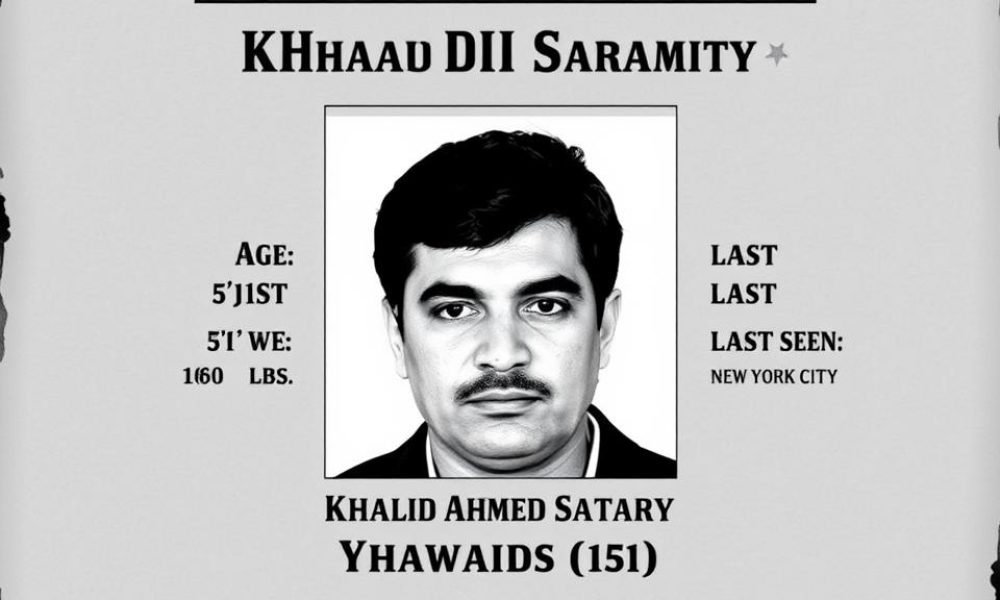
Federal prosecutors allege that the investigation into Khalid Ahmed Satary culminated in a sweeping indictment unsealed during September 2019, charging the laboratory executive with multiple federal felonies arising from an alleged nationwide conspiracy that billed Medicare more than $547 million for medically unnecessary cancer genetic testing.
WASHINGTON, DC, July 13, 2026 — For several years, federal investigators quietly assembled one of the largest healthcare fraud prosecutions in American history, collecting millions of pages of financial records, laboratory billing data, physician files, electronic communications, corporate documents, Medicare claims, and witness testimony before finally moving against Khalid Ahmed Satary and dozens of alleged co-conspirators. The investigation reached its first major public milestone on September 26, 2019, when federal prosecutors in Louisiana announced a sweeping indictment accusing Satary of helping direct a sophisticated genetic testing fraud network that allegedly generated more than $547 million in Medicare billing.
A Nationwide Investigation Years in the Making
The U.S. Department of Justice announcement describing the 2019 nationwide genetic testing enforcement action revealed that Satary’s indictment formed part of one of the largest coordinated healthcare fraud operations ever undertaken by the Department of Justice.
Rather than targeting a single fraudulent clinic or physician, investigators alleged that numerous laboratories, telemedicine providers, marketers, patient recruiters, physicians, and corporate executives had participated in interconnected schemes involving cancer genetic testing and other fraudulent healthcare billing practices throughout the United States.
The coordinated enforcement action involved dozens of defendants, multiple federal judicial districts, and allegations of more than $2.1 billion in fraudulent healthcare claims across several related investigations, making the Satary prosecution one component of a much broader national crackdown on genetic testing fraud.
Federal officials from the Federal Bureau of Investigation, the Department of Health and Human Services Office of Inspector General, the Internal Revenue Service Criminal Investigation Division, the Centers for Medicare & Medicaid Services, and numerous United States Attorney’s Offices worked together to reconstruct years of laboratory activity before presenting the evidence to a federal grand jury.
The resulting indictment reflected years of financial analysis, electronic evidence collection, witness interviews, laboratory inspections, subpoenaed business records, banking information, Medicare claims analysis, and forensic accounting intended to demonstrate how the alleged conspiracy operated from initial patient recruitment through final reimbursement.
Why Louisiana Became the Center of the Case
Although the alleged laboratory network stretched across several states, including Oklahoma and Georgia, federal prosecutors filed the principal indictment against Satary in the United States District Court for the Eastern District of Louisiana because one of the laboratories allegedly involved in the conspiracy, Lazarus Services, operated within that jurisdiction.
Federal prosecutors frequently select the district in which substantial portions of an alleged conspiracy occurred, in which important financial transactions took place, or in which significant evidence, witnesses, and corporate operations can most efficiently be presented before a federal grand jury.
Louisiana investigators, therefore, became responsible for coordinating evidence gathered from multiple states while working closely with national healthcare fraud investigators examining the broader genetic testing industry.
The choice of venue reflected procedural considerations established under federal criminal law rather than any suggestion that the alleged misconduct was limited to Louisiana alone.
The Grand Jury Returned Multiple Felony Charges
The federal grand jury charged Satary with several serious felony offenses, including conspiracy to commit healthcare fraud and wire fraud, healthcare fraud, conspiracy to violate the Anti-Kickback Statute, payment of illegal kickbacks, and money laundering, together with related financial offenses arising from the alleged operation of his diagnostic laboratory network.
Each charge addressed a different stage of the government’s theory concerning how the alleged scheme functioned from beginning to end.
Healthcare fraud allegations focused on claims submitted to Medicare that prosecutors contend were materially false because they involved medically unnecessary testing generated through unlawful referral practices.
Wire fraud allegations addressed the electronic communications used to transmit claims, financial information, and other data necessary to advance the alleged conspiracy across state lines.
Kickback charges examined whether payments were made to induce physicians and patient recruiters to generate federally reimbursed laboratory business.
Money-laundering allegations concerned the movement of proceeds that prosecutors contend originated from unlawful healthcare fraud.
Each count carries distinct legal elements that prosecutors must prove beyond a reasonable doubt before any conviction may be lawfully entered.
The Government’s Theory of the Conspiracy
According to the indictment, Satary allegedly owned and controlled Performance Laboratories, Lazarus Services, and Clio Laboratories, companies that collectively submitted approximately $547 million in Medicare claims involving cancer genetic testing between 2016 and 2019.
Federal prosecutors allege that telemarketers and patient recruiters first located Medicare beneficiaries, then obtained biological samples, and forwarded those materials to physicians whose medical relationships with the patients were frequently limited or nonexistent.
The laboratories allegedly processed the resulting genetic test results before submitting reimbursement claims to Medicare, while portions of the revenue allegedly flowed back through unlawful kickback arrangements that rewarded continued referrals.
Prosecutors contend that this commercial structure transformed legitimate molecular diagnostic technology into a high-volume reimbursement system driven primarily by financial incentives rather than individualized patient care.
Satary has not been convicted, and the indictment represents allegations that remain subject to proof in federal court.
Hundreds of Millions of Dollars in Claims
One of the most striking aspects of the indictment involved the extraordinary scale of the alleged Medicare billing.
Federal authorities allege that Satary’s laboratories submitted approximately $547 million in claims connected with cancer genetic testing during the charged conspiracy.
That figure represents the amount allegedly billed to Medicare rather than a judicial finding concerning payments ultimately received or money personally retained by Satary.
Healthcare fraud prosecutions routinely distinguish among billed amounts, approved reimbursements, actual payments, recovered funds, forfeited assets, and individual criminal proceeds because those categories may differ substantially.
Nevertheless, prosecutors regard the billing figure as powerful evidence of the alleged conspiracy’s unprecedented scope.
Federal Investigators Followed the Money
The indictment did not rely exclusively upon laboratory claims because financial investigators reconstructed how money allegedly flowed through numerous companies, bank accounts, consulting agreements, marketing contracts, and related business entities.
Forensic accountants compared Medicare reimbursements with outgoing transfers, payroll records, property purchases, corporate ownership documents, tax filings, banking activity, and communications discussing laboratory operations.
Federal investigators also examined alleged kickback payments directed toward physicians, patient recruiters, telemarketing companies, and intermediaries responsible for producing beneficiary referrals and laboratory orders.
Those financial records were an essential component of the government’s money-laundering allegations because prosecutors contend that the movement of proceeds reflected efforts to conceal or distribute revenue originating from healthcare fraud.
Following the money allowed investigators to identify relationships that ordinary laboratory billing records alone might never have revealed.
Simultaneous Enforcement Across the United States
The Satary indictment formed part of a coordinated national operation announced simultaneously across numerous federal judicial districts.
Federal agents executed search warrants, conducted interviews, seized evidence, restrained assets, and arrested defendants throughout the country in what the Department of Justice described as one of the largest healthcare fraud enforcement actions ever undertaken.
The coordinated timing prevented many suspects from receiving advance warning that investigators had completed years of evidence collection.
By acting simultaneously, authorities reduced opportunities for documents to disappear, electronic evidence to be destroyed, financial assets to be transferred, or witnesses to coordinate explanations before arrests occurred.
Large federal conspiracies frequently require this type of synchronized enforcement because participants often operate across multiple jurisdictions using interconnected companies and shared financial infrastructure.
Asset Seizures Accompanied the Criminal Charges
The Justice Department announced that investigators seized sixteen bank accounts and restrained multiple real estate properties connected with Satary when the indictment became public.
Those actions sought to preserve assets that prosecutors believe may represent proceeds of the alleged fraud or property otherwise subject to federal forfeiture proceedings.
Asset restraint does not establish criminal liability because defendants retain the right to challenge seizures, ownership claims, tracing calculations, and forfeiture allegations during judicial proceedings.
Nevertheless, the financial enforcement measures demonstrated that investigators viewed the case as extending well beyond disputed laboratory billing practices into the broader movement and preservation of allegedly unlawful proceeds.
Financial recovery remains an important objective in major healthcare fraud prosecutions because restitution and forfeiture can help reduce taxpayer losses if criminal allegations are ultimately proven.
Satary Was Released Pending Trial
Despite the seriousness of the indictment, Satary was initially released on bond under conditions imposed by the federal court while the criminal case proceeded through pretrial litigation.
Federal judges evaluating pretrial release must balance constitutional protections, statutory detention standards, flight risk, community safety, and the available evidence when determining whether a defendant should remain in custody before trial.
Release pending trial does not reflect a determination regarding guilt or innocence because every criminal defendant remains presumed innocent until proven guilty beyond a reasonable doubt.
Court-imposed conditions frequently include travel restrictions, reporting obligations, employment limitations, passport surrender, financial monitoring, or other requirements intended to ensure the defendant’s appearance at future proceedings.
The later history of Satary’s case would dramatically change after prosecutors alleged he violated those conditions.
The Indictment Became a Fugitive Investigation
Federal authorities allege that Satary ultimately failed to appear for a required court proceeding during December 2022, leading the court to issue a federal arrest warrant.
That alleged failure transformed the prosecution from a traditional white-collar criminal case into an international fugitive investigation involving the FBI and the Department of Health and Human Services Office of Inspector General.
Today, the FBI’s official Most Wanted Fraudsters profile for Khalid Ahmed Satary identifies him as a fugitive while offering a reward of up to $150,000 for information leading to his arrest and conviction.
Authorities have publicly identified Dubai as one possible location linked to the ongoing investigation, although no official source has confirmed his current residence.
His disappearance delayed judicial resolution but did not eliminate the indictment or the evidence already collected during years of investigation.
Why the Indictment Still Matters
The 2019 indictment remains the foundation of every subsequent development involving Satary.
Without the grand jury’s formal charges, there would be no federal arrest warrant, no fugitive investigation, no Most Wanted designation, and no continuing international effort to locate the laboratory executive.
The indictment also established the government’s legal theory regarding ownership of the laboratories, the alleged kickback structure, the Medicare billing process, and the financial flows supporting the money-laundering allegations.
Every future court proceeding will ultimately trace back to the evidence first presented before the grand jury in 2019.
Although years have passed since those original charges, prosecutors continue to rely on the same underlying laboratory records, financial documents, witness testimony, electronic communications, and Medicare claims assembled during the initial investigation.
Lessons for the Healthcare Industry
The Satary indictment demonstrated that healthcare fraud investigations increasingly focus upon complete commercial ecosystems rather than isolated fraudulent claims.
Federal investigators examined laboratories, physicians, marketers, telemedicine providers, patient recruiters, financial institutions, billing systems, and corporate ownership together rather than treating each participant independently.
Healthcare organizations, therefore, face growing expectations to implement meaningful compliance programs that can identify suspicious referral arrangements before they escalate into nationwide criminal investigations.
Independent compliance review, documentation of medical necessity, careful monitoring of marketing relationships, and transparent financial practices remain among the most important safeguards against the types of allegations described in the Satary prosecution.
Organizations that ignore unusually rapid growth, concentrated referral sources, or compensation linked to Medicare business risk attracting regulatory attention, even when many individual transactions appear legitimate in isolation.
International Business and Lawful Compliance
International business operations, laboratory ownership, cross-border investment, and global corporate structures remain entirely lawful when supported by transparent ownership, legitimate commercial activity, truthful reporting, and compliance with applicable regulations.
In professional advisory practice, Amicus International Consulting emphasizes that lawful international corporate planning depends on documented beneficial ownership, regulatory compliance, and legitimate commercial purposes, rather than on the concealment of criminal proceeds or the obstruction of law-enforcement investigations.
Professional international business structuring and second citizenship planning cannot lawfully be used to avoid criminal prosecution, conceal proceeds of healthcare fraud, frustrate federal arrest warrants, or interfere with judicial proceedings pending before American courts.
Final Analysis
The September 2019 indictment represented the moment federal investigators publicly revealed years of work examining what prosecutors describe as one of the largest cancer genetic testing fraud conspiracies ever charged against the Medicare program.
By alleging approximately $547 million in Medicare billing involving laboratories owned by Khalid Ahmed Satary, the indictment transformed a complex healthcare investigation into a nationally significant white-collar criminal prosecution.
The grand jury’s decision established the legal foundation for every subsequent development, including asset seizures, pretrial litigation, Satary’s later alleged flight, the federal arrest warrant, and his eventual addition to the FBI’s Most Wanted Fraudsters list.
Although Satary remains presumed innocent until proven guilty in court, the 2019 indictment continues to serve as the cornerstone of one of the most consequential healthcare fraud cases currently pending in the United States federal criminal justice system.




