
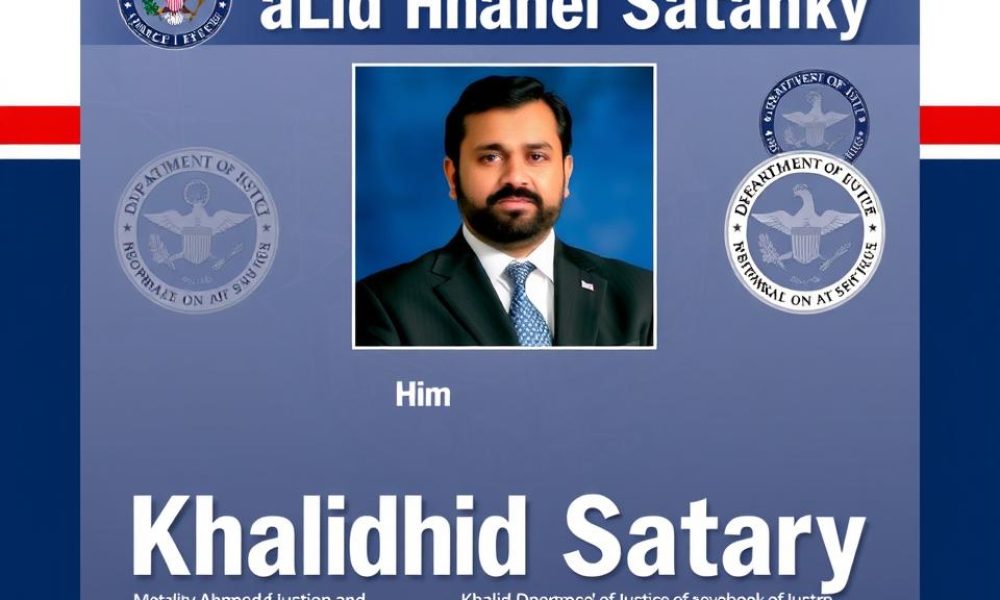
While released under court conditions prohibiting him from working within the healthcare industry, federal investigators allege that Khalid Ahmed Satary secretly conspired with Houston-based laboratories to submit additional fraudulent genetic-testing claims to Medicare, ultimately triggering a federal warrant for violating his pretrial release.
WASHINGTON, DC, July 14, 2026 — Khalid Ahmed Satary was already awaiting trial in one of the largest alleged genetic-testing fraud cases ever charged against the Medicare program when federal investigators say he violated the conditions of his release by returning to the same healthcare industry that prosecutors had accused him of exploiting for hundreds of millions of dollars.
A Second Alleged Fraud Developed After the First Indictment
The FBI’s official wanted notice for Khalid Ahmed Satary states that, after his September 2019 indictment, the laboratory executive was released on bond with conditions specifically prohibiting him from working in the healthcare field while the original federal prosecution proceeded in the Eastern District of Louisiana.
Those restrictions were intended to prevent Satary from returning to an industry where prosecutors alleged he had already controlled several diagnostic laboratories that collectively billed Medicare more than $547 million for expensive cancer genetic tests generated through deceptive marketing, medically questionable orders, kickbacks, and bribes.
Federal authorities now allege that Satary ignored that prohibition and conspired with Houston-based laboratories to continue submitting fraudulent genetic-testing claims to Medicare, extending the government’s concerns beyond his earlier companies in Georgia, Oklahoma, and Louisiana into another major American healthcare market.
The public record does not establish that Satary personally owned the Houston laboratories, publicly managed their employees, or appeared as their disclosed executive, making the strongest accurate conclusion that investigators allege he secretly worked with those facilities while legally forbidden from participating in healthcare operations.
Pretrial Release Was a Privilege Governed by Strict Conditions
Federal defendants are generally presumed innocent and may receive pretrial release when a court determines that enforceable conditions can reasonably address flight risk, public safety, witness interference, evidence preservation, and the defendant’s ability to appear for every required judicial proceeding.
A court may restrict employment, travel, financial transactions, communications, business ownership, professional activity, passport access, contact with alleged co-conspirators, or involvement within industries connected to the pending charges, depending upon the risks demonstrated by prosecutors and the defendant’s circumstances.
Satary’s restriction against healthcare work directly addressed the alleged environment surrounding his prosecution, because the original indictment accused him of using diagnostic laboratories, patient recruiters, telemarketing organizations, telemedicine companies, and physicians to generate enormous volumes of Medicare-funded cancer genetic testing.
Preventing additional healthcare activity, therefore, served both protective and evidentiary purposes, reducing the possibility that Satary could generate new claims, influence witnesses, access sensitive beneficiary information, move money through medical companies, or reproduce the commercial structure described in the original indictment.
The Original Case Already Involved Extraordinary Allegations
Federal prosecutors alleged that Satary owned Performance Laboratories in Oklahoma, Lazarus Services in Louisiana, and Clio Laboratories in Georgia, three diagnostic facilities that collectively submitted more than $547 million in Medicare claims between approximately 2016 and 2019.
The government contends that telemarketers and patient recruiters obtained Medicare beneficiary information and cheek-swab samples before arranging doctors’ orders through telemedicine physicians who frequently lacked genuine treatment relationships with the patients whose genetic material entered the laboratory system.
Investigators further allege that Satary paid millions of dollars in illegal kickbacks and bribes to doctors and patient recruiters, creating financial incentives to produce additional samples and medical orders regardless of whether the resulting genetic panels were genuinely necessary for individual patient care.
Those allegations remain unproven against Satary, who retains the presumption of innocence, yet their magnitude explains why a federal judge would impose restrictions designed to separate him from healthcare businesses while prosecutors prepared their evidence and defense attorneys challenged the government’s case.
Houston Offered Another Large Laboratory Market
Houston contains one of America’s largest concentrations of hospitals, clinics, laboratories, medical professionals, healthcare entrepreneurs, telemedicine companies, billing services, and related businesses, creating a legitimate medical economy capable of supporting advanced testing while also attracting federal scrutiny when suspicious claims emerge.
According to investigators, Satary’s alleged Houston activity involved laboratories submitting fraudulent genetic-testing claims to Medicare, suggesting that the business model under examination may have resembled the earlier combination of beneficiary recruitment, physician authorization, laboratory processing, electronic billing, and federal reimbursement.
The FBI has not publicly identified every Houston laboratory involved, every participant who allegedly worked with Satary, the total claim amount attributed to that conduct, or the precise financial arrangements linking the fugitive defendant to those facilities.
Responsible reporting must therefore avoid attaching unsupported company names or amounts to the Houston allegations while recognizing that the FBI considers the suspected conduct sufficiently serious to be prominently included in Satary’s current Most Wanted Fraudsters profile.
Secret Participation Could Avoid Formal Ownership Records
A person prohibited from healthcare employment would not necessarily appear within obvious corporate filings, laboratory licenses, payroll systems, public websites, or executive directories, because informal influence can be exercised through consultants, intermediaries, relatives, nominees, management companies, financial partners, or trusted associates.
Investigators examining such conduct would compare communications, payment records, account access, business instructions, referral arrangements, laboratory claim patterns, meetings, travel, employment decisions, contracts, and testimony from insiders who can describe who actually directed key operations.
Formal ownership and operational control are not always identical, because one individual may appear on government records while another person supplies financing, negotiates referral agreements, directs employees, controls revenue, or makes strategic decisions behind the scenes.
The government must nevertheless prove Satary’s knowing involvement through admissible evidence, rather than on assumptions arising from his prior ownership of a laboratory, since a prior indictment does not automatically establish responsibility for every subsequent healthcare company or disputed Medicare claim.
Genetic Testing Remained a Highly Profitable Billing Opportunity
Cancer genetic testing can provide legitimate medical value when qualified professionals identify hereditary risk, document clinical necessity, obtain informed consent, interpret complex findings, and integrate results into meaningful screening, prevention, counseling, or treatment decisions.
The alleged fraud model exploited the discrepancy between the inexpensive cheek swab used to collect genetic material and the substantial Medicare reimbursement associated with sophisticated laboratory panels, which federal authorities say could generate approximately $10,000 to $20,000 per sample.
A laboratory processing hundreds or thousands of marketing-generated samples could therefore create enormous billing volume, particularly when physician orders were supplied through remote arrangements, and beneficiaries believed the testing represented a fully covered preventive service.
Federal investigators allege that Satary’s original laboratories engaged in deceptive marketing campaigns, illegal referral payments, and medically unnecessary testing, making any suspected return to genetic laboratory operations especially concerning while those specific allegations remained pending before the Louisiana federal court.
Bond Conditions Depend Upon Complete Honesty
A defendant released before trial must accurately report employment, travel, residence, financial changes, contacts, and other matters required by the court or supervising pretrial services officers, because judicial supervision depends upon reliable information rather than constant physical surveillance.
Secret participation within prohibited business activity can undermine the entire release arrangement by demonstrating that restrictions cannot function when a defendant conceals relationships, uses intermediaries, or provides incomplete information concerning the conduct a court specifically ordered him to avoid.
Federal judges can respond to violations by modifying conditions, ordering more intensive monitoring, revoking release, issuing arrest warrants, or detaining the defendant pending trial when evidence shows that less restrictive measures cannot ensure compliance.
Satary’s case escalated beyond an ordinary compliance dispute because a federal warrant was ultimately issued for a pretrial release violation, while investigators now describe him as an international fugitive who failed to return for a scheduled court appearance.
The November 2022 Warrant Marked a Critical Turning Point
The FBI states that a federal arrest warrant was issued on November 23, 2022, through the United States District Court for the Eastern District of Louisiana after authorities alleged that Satary violated the conditions governing his release.
The HHS Office of Inspector General separately reports that Satary failed to appear for a December 12, 2022, court date and was declared a fugitive, creating a timeline in which the bond violation and subsequent absence transformed a large healthcare prosecution into an international manhunt.
The warrant did not resolve the original allegations or prove the suspected Houston activity, because both matters still require adjudication through ordinary federal procedures after Satary is located, arrested, represented by counsel, and brought before the court.
His disappearance nevertheless changed the practical character of the case by interrupting hearings, delaying trial preparation, increasing concerns about flight, and requiring investigators to redirect resources toward travel, financial, immigration, communication, and overseas-location analysis.
Dubai Became a Possible Destination
Federal authorities have publicly identified Dubai as one possible location associated with Satary, although no official source has disclosed a confirmed residence, current employer, property holdings, corporate position, or recent sighting that would establish exactly where he lives.
Dubai’s global aviation links, international business environment, large expatriate population, real estate market, and financial services sector make it a plausible location for many international entrepreneurs, but those lawful characteristics should not be interpreted as evidence that the city knowingly shelters wanted defendants.
American law-enforcement agents cannot independently arrest a fugitive in another sovereign country; they must cooperate with local police, immigration agencies, prosecutors, courts, and diplomatic officials before any detention, deportation, extradition, or other lawful return mechanism can proceed.
International movement may delay a prosecution, yet it does not invalidate the Louisiana indictment, erase the pretrial release warrant, eliminate laboratory records, or prevent investigators from preserving evidence related to both the original laboratories and the later Houston allegations.
The Houston Allegations Could Affect Future Detention
Should Satary be captured, prosecutors would almost certainly emphasize the alleged Houston conduct and his disappearance when arguing that no future release conditions could reasonably ensure compliance, appearance, or protection against additional prohibited activity.
A judge could consider whether Satary allegedly returned to healthcare despite an explicit restriction, whether he concealed that involvement, whether new Medicare claims were submitted, and whether his later failure to appear demonstrated that earlier judicial trust had been misplaced.
Satary would retain the right to challenge those allegations, dispute the government’s evidence, explain his conduct, and argue that any Houston relationships were lawful, misunderstood, unrelated to healthcare operations, or inaccurately attributed to him.
The court would evaluate evidence and statutory detention factors rather than relying solely on the FBI’s public wanted notice, because fugitive publicity cannot substitute for the evidentiary procedures required at an actual federal hearing.
The Alleged Conduct May Create Additional Criminal Exposure
Violating pretrial conditions can result in consequences separate from the underlying indictment, while new fraudulent Medicare submissions could support additional healthcare fraud, wire fraud, kickback, conspiracy, obstruction, or money-laundering charges when legally sufficient evidence exists.
The public FBI notice does not specify every additional count prosecutors may pursue, and it would be improper to predict formal charges before the Justice Department files them through an indictment, information, or other recognized procedure.
However, evidence that a defendant continued substantially similar conduct while awaiting trial could become relevant to prosecutorial strategy, sentencing arguments, obstruction analysis, forfeiture efforts, and the government’s assessment of the defendant’s leadership and intent.
The latter conduct could also provide investigators with new witnesses, communications, bank records, laboratory claims, contracts, and cooperating participants whose evidence may illuminate both the Houston activity and Satary’s understanding of the original genetic-testing business model.
Medicare Claims Preserve a Durable Electronic Record
Every submitted genetic-testing claim can preserve beneficiary identifiers, service dates, billing codes, ordering physicians, laboratory information, reimbursement requests, payment outcomes, and related records that can survive long after the laboratory ceases operations or a defendant leaves the country.
Investigators can compare Houston claims against patterns associated with Performance Laboratories, Lazarus Services, and Clio Laboratories, examining whether the same marketers, physicians, testing panels, billing strategies, consultants, bank accounts, or communication methods appeared within both periods.
Repeated structures can become powerful evidence when they demonstrate shared personnel, copied documents, identical referral arrangements, or financial relationships that connect supposedly independent companies with a defendant legally prohibited from participating in healthcare.
Defendants may counter that similar billing patterns arise naturally within the same industry, requiring prosecutors to support any claimed connection through direct communications, payments, witness testimony, account control, contracts, and evidence of actual decision-making authority.
Insiders May Explain the Alleged Houston Operation
Laboratory employees, owners, marketers, billing specialists, physicians, accountants, consultants, and investors can provide essential context because financial records show money moving without always revealing who negotiated the arrangement or why particular instructions were followed.
An insider may explain whether Satary attended meetings, selected marketers, directed claims, controlled accounts, supplied physician relationships, approved payments, reviewed testing volume, or operated through another person whose name appeared within formal company records.
Cooperating witnesses can possess incentives to reduce their own exposure, making corroboration through emails, messages, bank transfers, recorded conversations, contracts, and Medicare data particularly important when prosecutors present their testimony.
The prolonged period as a fugitive may complicate memory, yet electronic records and contemporaneous business communications can preserve details more reliably than recollections formed years after disputed events.
The Case Demonstrates the Limits of Industry Bans
Employment restrictions can protect the public only when defendants comply honestly, and regulated businesses conduct meaningful due diligence before accepting investors, consultants, managers, referral partners, or advisers connected to pending healthcare fraud cases.
A prohibited executive can potentially remain influential without receiving a conventional paycheck, particularly when compensation flows through another company, payments are delayed, ownership is concealed, or trusted associates formally hold positions while following undisclosed instructions.
Laboratories should verify beneficial ownership, consulting relationships, funding sources, management authority, referral arrangements, exclusion status, pending charges, and the actual responsibilities of individuals influencing federally reimbursed operations.
Failure to investigate hidden control can expose legitimate employees and investors to criminal, civil, regulatory, and reputational consequences when a supposedly independent adviser is later accused of directing prohibited healthcare activity.
Houston Laboratories Faced Their Own Compliance Responsibilities
Any laboratory working with Medicare beneficiaries must ensure that tests are medically necessary, physician orders arise through legitimate relationships, compensation complies with federal law, ownership is transparent, and claims accurately represent services actually delivered.
Companies cannot safely rely upon another person’s industry experience without examining whether that individual is legally permitted to participate, whether referral strategies involve kickbacks, and whether rapid revenue growth reflects genuine clinical demand or questionable marketing arrangements.
Compliance officers require access to contracts, bank records, beneficial ownership, marketer payments, ordering patterns, beneficiary complaints, and communications, together with genuine authority to stop billing when executives or investors resist independent review.
The allegations surrounding Satary’s bond violation demonstrate how an established fraud defendant can pose heightened risks to every new business partner, especially when the proposed work closely resembles conduct already described in a major federal indictment.
Public Reporting Renewed Attention on the Bond Violation
Recent South Florida reporting on Satary’s addition to the FBI’s Most Wanted Fraudsters list highlighted an allegation that he worked with Houston laboratories while released under conditions barring him from healthcare employment.
The coverage also emphasized his ties to Houston, Atlanta, Delray Beach, Dubai, Jordan, and the Israel-Palestine region, broadening public recognition among communities, industries, and former associates who may possess relevant information about his current identity or location.
A useful tip could include a current address, telephone number, email account, employer, vehicle, financial relationship, travel record, property interest, company connection, or individual knowingly assisting Satary while the federal warrant remains outstanding.
Members of the public should avoid confrontation and report credible information through official channels, allowing trained agents and international partners to verify identity, preserve evidence, and coordinate any lawful enforcement action safely.
The FBI Reward Increased the Pressure
The FBI is offering up to $150,000 for information leading to Satary’s arrest and conviction, creating a substantial incentive for former employees, laboratory partners, marketers, financial contacts, relatives, landlords, overseas associates, or others possessing original and verifiable information.
Reward payment is not automatic because investigators must determine whether the submitted intelligence is accurate, lawfully obtained, independently corroborated, and sufficiently important to contribute directly to Satary’s arrest and eventual conviction.
Someone involved in the Houston laboratories may understand aliases, communication channels, financial intermediaries, travel patterns, or international contacts that emerged after the original Louisiana indictment and before Satary disappeared from court supervision.
Even historical information can be valuable when it provides the missing connection between Satary’s American laboratory activity and a present overseas business, address, device, account, associate, or identity that is unknown to investigators.
Continued Fraud Could Influence Eventual Sentencing
Federal sentencing judges may consider relevant conduct, financial loss, leadership, sophistication, obstruction, violation of judicial trust, and continued criminal activity when calculating an advisory guideline range after convictions have been obtained.
If prosecutors ultimately prove that Satary resumed healthcare fraud while prohibited from the industry, that conduct could strengthen arguments that the original alleged scheme reflected deliberate and continuing behavior rather than an isolated compliance failure within several laboratories.
Flight could also affect sentencing through obstruction-related findings, although Satary would retain the right to contest whether his absence was willful, whether the government accurately described his movements, and whether particular enhancements legally apply.
No sentence can be imposed until he is arrested and convicted, making current discussions of penalty necessarily contingent on future proceedings that have been delayed since his failure to appear in December 2022.
The Houston Allegation Does Not Prove Every Laboratory Claim Was Fraudulent
Laboratories can submit valid genetic testing claims even when a consultant, owner, marketer, or business associate later becomes accused of misconduct, because each reimbursement request must be evaluated on its own medical and documentary circumstances.
The government must establish which Houston claims were fraudulent, how they were generated, what Satary allegedly did, who knowingly participated, and whether submitted services lacked medical necessity, lawful referrals, accurate representations, or legitimate physician authorization.
Patients whose tests were clinically appropriate should not assume that their results are invalid solely because investigators examine the business relationships surrounding a laboratory, although they may wish to discuss findings with qualified treating professionals.
Likewise, employees who performed technical laboratory duties without knowledge of the alleged fraud should not be treated as conspirators merely because they worked within an organization that was later subjected to federal scrutiny.
Lawful Healthcare Investment Requires Full Transparency
Healthcare laboratories can receive international investment, management advice, administrative support, and growth capital lawfully when beneficial ownership is disclosed, funds have legitimate origins, compensation is commercially reasonable, and every participant satisfies applicable regulatory requirements.
In professional advisory work, Amicus International Consulting emphasizes that legitimate cross-border structures require accurate ownership records, documented funding, independent compliance, and complete separation from healthcare fraud proceeds, concealed management, judicial violations, or attempts to obstruct enforcement.
Professional international relocation and second citizenship planning cannot lawfully be used to defeat pretrial restrictions, hide indicted defendants, disguise prohibited business involvement, or prevent authorities from tracing Medicare funds and executing federal warrants.
Lawful privacy protects legitimate personal and commercial interests, while secret participation becomes legally dangerous when it is designed to evade a court order or to continue conduct that substantially resembles an alleged fraud already pending before a federal judge.
The Bond Violation Became More Than a Procedural Matter
A missed reporting requirement or a technical misunderstanding may sometimes be corrected through modified supervision, but the FBI describes Satary’s alleged violation as renewed participation in fraudulent genetic testing claims despite a clear prohibition on healthcare work.
That accusation transforms the bond dispute into a continuation of the central public harm identified within the original indictment, because Medicare beneficiaries, physician orders, genetic samples, laboratory claims, and federal reimbursements allegedly remained part of the later activity.
The allegation also suggests that the original prosecution did not immediately dismantle every commercial relationship, business method, or source of expertise that could recreate the disputed testing pipeline through different laboratories and participants.
For investigators, the Houston activity may therefore provide evidence about how the alleged model could migrate between companies even after federal authorities seized accounts, restrained property, announced charges, and imposed court restrictions upon a principal defendant.
Final Analysis
Federal authorities allege that Khalid Ahmed Satary violated his pretrial release by conspiring with Houston-based laboratories to submit fraudulent genetic-testing claims to Medicare after a judge prohibited him from working within the healthcare industry.
The public record does not establish that he formally owned those laboratories or specify the full amount allegedly billed through them, requiring careful distinction between confirmed court conditions and unresolved allegations concerning his hidden operational role.
If proven, the alleged conduct would demonstrate that Satary returned to the same general industry and reimbursement model that underpinned his original $547 million laboratory prosecution, while benefiting from the liberty granted by federal pretrial release.
The government must still establish which companies participated, which claims were fraudulent, how Satary exercised control, what payments or communications connected him to the operation, and whether every challenged act occurred knowingly and intentionally.
For the federal court, the alleged violation represents a profound breach of judicial trust, because employment restrictions are designed to prevent precisely the continuation of conduct associated with pending criminal charges.
For Medicare, the Houston allegations illustrate how suspected-fraud models can migrate from one laboratory network to another when marketers, physicians, executives, billing specialists, and financial intermediaries remain available after an initial enforcement action.
For legitimate healthcare businesses, the case serves as a warning that beneficial ownership, consulting authority, funding sources, referral relationships, and executive backgrounds must be subject to meaningful examination before any person is permitted to influence federally reimbursed operations.
For Satary, the alleged bond violation and subsequent disappearance have made an already serious healthcare fraud prosecution considerably more difficult, potentially affecting future detention and sentencing arguments, as well as the government’s interpretation of his intent.
Until he is apprehended, Satary remains presumed innocent, but the Louisiana indictment, allegations from the Houston laboratory, an outstanding warrant, an international search, and a $150,000 FBI reward ensure that the consequences of his broken bond remain active rather than forgotten.




