
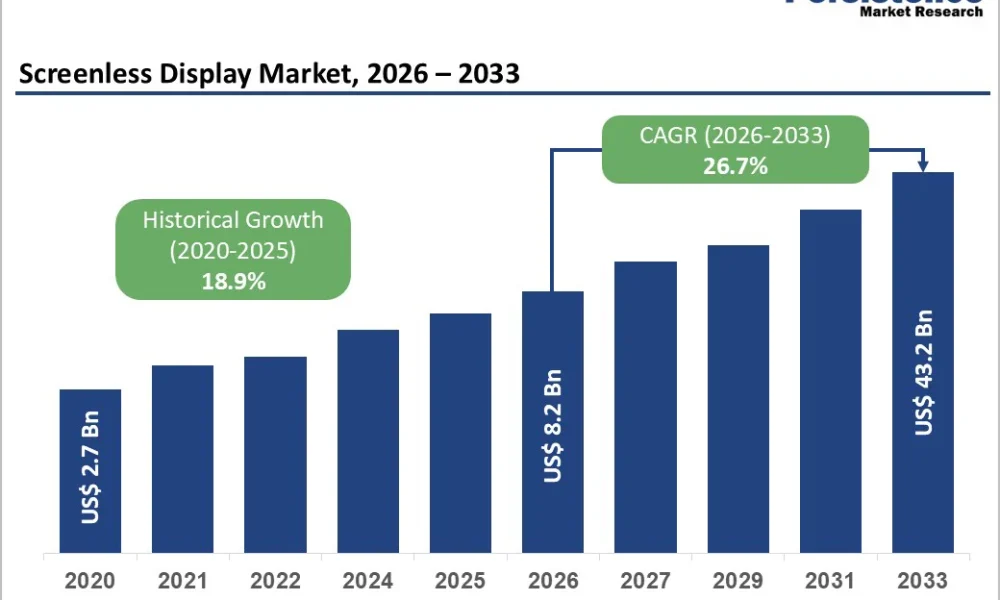
The global Screenless Display Market is entering an accelerated innovation cycle, projected to grow from US$ 8.2 billion in 2026 to US$ 43.2 billion by 2033, registering a remarkable CAGR of 26.7% between 2026 and 2033. Historically, the market expanded at a CAGR of 18.9% from 2020 to 2025, highlighting strong early adoption and increasing commercialization momentum.
This exceptional growth trajectory reflects the convergence of augmented reality (AR), virtual reality (VR), holographic projection systems, micro-LED miniaturization, AI-driven visualization, and spatial computing applications. Screenless displays are redefining digital interaction by eliminating traditional physical screens and enabling immersive, contextual, and real-time information delivery across consumer, enterprise, automotive, healthcare, and defense environments.
As spatial computing becomes mainstream, screenless display technologies are emerging as foundational infrastructure for next-generation human-machine interaction.
Market Overview and Growth Outlook
Key Market Metrics
- Market Size (2026E): US$ 8.2 Bn
- Forecast Value (2033F): US$ 43.2 Bn
- Projected CAGR (2026–2033): 26.7%
- Historical CAGR (2020–2025): 18.9%
The shift toward immersive and context-aware computing experiences is transforming digital ecosystems. Enterprises are investing heavily in screenless technologies to improve productivity, safety, visualization precision, and user engagement.
Several structural drivers support sustained expansion:
- Rapid AR/VR ecosystem development
- Falling optical component costs
- Growth in automotive HUD systems
- Smart city infrastructure investments
- AI-powered visualization and adaptive content delivery
Market Dynamics
Driver: Technological Miniaturization and Component Cost Reduction
Breakthroughs in optical engineering, holographic projection, waveguide materials, and micro-LED development have significantly reduced device size and improved energy efficiency.
Over the past three years:
- Optical component costs have declined by 15–20% annually.
- Waveguide manufacturing scalability has improved.
- Holographic projection systems have moved from lab prototypes to commercial deployment.
The unveiling of full-windshield holographic displays at CES 2025, particularly by Hyundai Mobis, validated mass-market readiness for automotive applications.
These advancements allow seamless integration into:
- Smart glasses
- Automotive windshields
- Industrial equipment
- Surgical visualization platforms
Driver: Integration of Augmented Reality and AI-Powered Visualization
Screenless display infrastructure is central to AR and VR ecosystems. Leading technology firms such as Microsoft, Google, and Apple are investing heavily in spatial computing platforms that depend on immersive projection systems.
In healthcare:
- Surgeons manipulate 3D anatomical models without physical interfaces.
- Medical trainees using immersive AR simulations show 25–35% higher skill acquisition rates.
- AI-driven visualization adapts in real time to user behavior and environmental context.
Enterprise deployments across manufacturing and logistics demonstrate productivity improvements of 20–40% using AR-enabled screenless workflows.
Driver: Government Digital Transformation and Smart Cities
Asia Pacific governments are creating favorable policy environments for immersive technologies.
China’s Digital China initiative promotes AI, 5G, and immersive interface infrastructure. India’s AVGC-XR draft policy provides fiscal incentives for AR/VR and holographic projects, reimbursing up to 35% of qualified production expenditures.
Singapore’s Smart Nation and Japan’s Society 5.0 frameworks also emphasize immersive technologies.
Smart city investments across Asia Pacific are expected to exceed US$ 2 trillion by 2030, with screenless displays increasingly deployed in:
- Transportation management
- Urban visualization
- Public information systems
- Industrial automation
Restraint: High Development and Implementation Costs
Despite falling component costs, full system deployments remain capital intensive:
- Enterprise solutions range from US$ 50,000 to US$ 500,000+.
- Specialized waveguide materials remain supply constrained.
- Calibration and maintenance complexity increases total cost of ownership.
SMEs and budget-constrained institutions may delay adoption until cost structures further decline.
Key Market Opportunities
Healthcare Precision Visualization
Healthcare represents one of the most promising commercial opportunities. Companies like RealView Imaging Ltd. are deploying interactive holographic visualization systems for surgical planning and intraoperative support.
Hospitals adopting 3D holographic imaging report:
- Improved surgical precision
- Reduced complication rates
- Faster decision-making
Medical schools are integrating immersive 3D anatomical visualization platforms for advanced clinical training.
As precision medicine advances, real-time 3D visualization will become standard practice in operating rooms and diagnostic centers.
Automotive and Transportation Transformation
The automotive sector is the fastest-growing end-use segment.
Hyundai Mobis introduced the first full-windshield holographic display, eliminating traditional dashboards.
Luxury OEMs such as BMW and Mercedes-Benz are investing heavily in advanced heads-up displays (HUDs).
Key adoption drivers:
- ADAS regulatory mandates
- Autonomous vehicle development
- Enhanced driver safety requirements
- Premium in-vehicle user experience demand
Commercial vehicles and aerospace sectors also require advanced visualization for mission-critical decision-making.
Elevate your business strategy with comprehensive market data. Request a sample report now: https://www.persistencemarketresearch.com/samples/9110
Category-Wise Analysis
Product Type Insights
Visual Image Screenless Displays – 61.3% Market Share (2026)
This segment includes holographic projections, laser-scanned imagery, and light-field displays.
Its dominance reflects:
- Commercial maturity
- Broad enterprise adoption
- Lower complexity compared to retinal projection technologies
Emerging technologies such as virtual retinal displays (VRD) represent the fastest-growing product category, projecting images directly onto the retina for enhanced immersion.
End-User Insights
Consumer Electronics – 33.1% Market Share (2026)
Growth is driven by:
- AR-enabled smart glasses
- Immersive gaming platforms
- Social media AR filters
- Wearable visual systems
Companies such as Sony Corporation and Magic Leap, Inc. are pushing innovation boundaries in wearable AR devices.
Automotive & Transportation – Fastest Growing Segment
The integration of full-windshield holography and intelligent HUD systems is redefining vehicle interiors.
Defense and aerospace sectors are similarly accelerating adoption for mission planning and tactical awareness.
Regional Insights
North America – 30.2% Market Share (2026)
North America leads global commercialization due to:
- Concentration of tech giants
- Strong venture capital ecosystem
- U.S. military procurement contracts
- Advanced healthcare infrastructure
Companies like NVIDIA and Intel support high-performance processing needed for real-time visualization.
U.S. Army IVAS contracts provide manufacturing scale benefits, reducing system costs across civilian markets.
East Asia – 20.3% Market Share and Fastest Growth
China leads East Asia through Digital China initiatives and large-scale 5G deployment.
High consumer tech adoption in Japan and South Korea further accelerates demand for AR wearables and immersive entertainment systems.
Manufacturing capabilities in China support cost-effective production of optical components and holographic systems.
Europe – 24.5% Market Share
European leadership in automotive innovation drives strong regional demand.
The partnership between ZEISS and tesa for holographically functionalized films demonstrates Europe’s strategic positioning in advanced windshield display systems.
Industrial and healthcare deployments continue expanding across Germany, France, and the UK.
Competitive Landscape
The Screenless Display Market is moderately consolidated with innovation-driven competition.
Key companies include:
- Microsoft
- Magic Leap, Inc.
- RealView Imaging Ltd.
- Avegant
- Synaptics Incorporated
- Holoxica Ltd.
- EON Reality
- Leia Inc.
- Sightful
Strategic collaborations, micro-LED innovation, AI integration, and cloud-based visualization services remain primary competitive differentiators.
Future Outlook
By 2033, screenless display technologies will underpin the broader spatial computing ecosystem. As 5G connectivity, edge computing, AI, and holographic optics converge, physical screens may become secondary interfaces in many enterprise and consumer environments.
Expected long-term developments include:
- Fully immersive AR workplaces
- Holographic telepresence systems
- AI-adaptive automotive interiors
- 3D surgical visualization standardization
- Smart city holographic public displays
With a projected valuation of US$ 43.2 billion by 2033, the Screenless Display Market stands at the forefront of digital interface transformation.
Conclusion
The global Screenless Display Market is undergoing transformative expansion, driven by AR/VR integration, AI-powered visualization, holographic innovation, and government digital transformation initiatives.
From US$ 8.2 billion in 2026 to US$ 43.2 billion by 2033, growing at 26.7% CAGR, the industry is redefining how digital information is accessed and experienced.
As industries eliminate traditional screens and embrace immersive spatial computing environments, screenless display technologies will become foundational to next-generation enterprise systems, automotive platforms, healthcare visualization, and consumer electronics worldwide.
Related Reports:




