
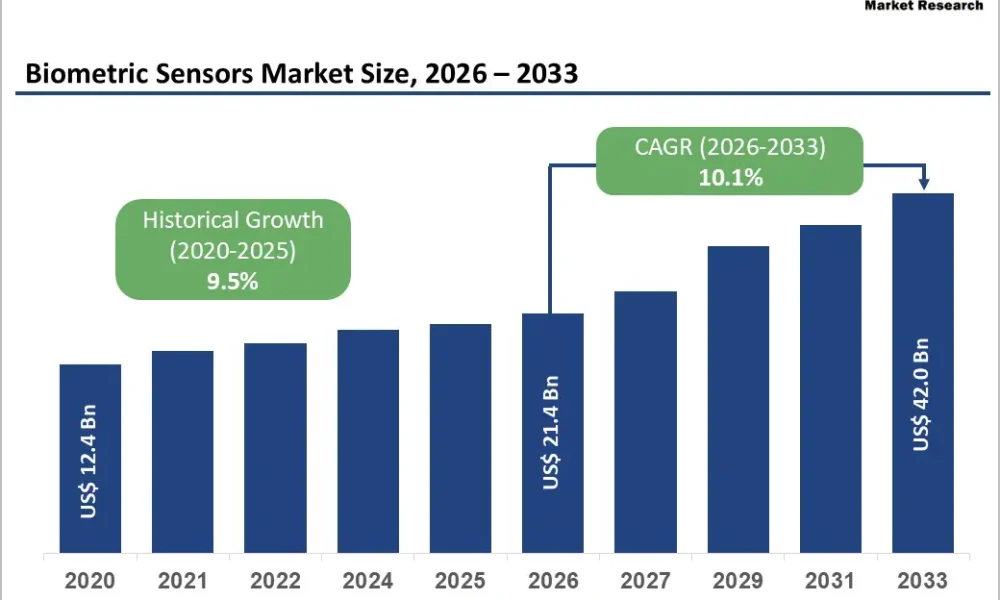
The global Biometric Sensors Market is poised for sustained expansion, projected to grow from US$ 21.4 billion in 2026 to US$ 42.0 billion by 2033, registering a CAGR of 10.1% between 2026 and 2033. The market previously expanded at a CAGR of 9.5% from 2020 to 2025, reflecting steady integration across consumer electronics, government identity systems, and financial services.
Rising cybersecurity threats, expanding national ID programs, rapid smartphone penetration, and AI-powered authentication technologies are fundamentally reshaping digital identity infrastructure worldwide.
According to the Identity Theft Resource Center (ITRC), reported U.S. data compromises surged from 1,801 in 2022 to 3,205 in 2023, underscoring the urgent need for stronger authentication mechanisms.
Market Overview
Key Market Metrics
- Market Size (2026E): US$ 21.4 Billion
- Forecast Value (2033F): US$ 42.0 Billion
- Projected CAGR (2026–2033): 10.1%
- Historical CAGR (2020–2025): 9.5%
Biometric sensors leverage unique physiological and behavioral characteristics such as fingerprints, facial patterns, iris recognition, and voice authentication to enable secure, non-transferable identity verification.
The shift away from password-based systems toward multi-factor biometric authentication is now a global trend across government, banking, healthcare, retail, and enterprise environments.
Market Dynamics
Driver: Rising Security Threats and Identity Theft
Escalating cybercrime and identity fraud are primary catalysts for biometric adoption. With 13.5% of digital account openings suspected to involve fraud, organizations are deploying biometric solutions to mitigate unauthorized access risks.
Biometric sensors offer:
- Non-replicable authentication
- Multi-factor verification
- Reduced credential theft risks
- Strong auditability and non-repudiation
As fraud attempts grow globally, financial institutions and enterprises are prioritizing biometric security layers.
Driver: Government Initiatives and Regulatory Mandates
Large-scale government biometric identification programs significantly accelerate demand.
India’s Unique Identification Authority of India manages the Aadhaar program, which has enrolled over 1.3 billion citizens—forming the world’s largest biometric identity database.
The European Union’s Entry/Exit System (EES), operational from October 2025, mandates biometric registration—including fingerprints and facial scans—for non-EU travelers.
Such initiatives drive procurement of:
- Fingerprint scanners
- Facial recognition systems
- Iris sensors
- Border control authentication platforms
Government modernization projects remain among the largest revenue generators in the biometric sensors market.
Restraint: Privacy Regulations and Compliance Complexity
Stringent data protection laws limit adoption in certain jurisdictions.
The European Union’s General Data Protection Regulation (GDPR) classifies biometric data as sensitive personal information under Article 9, requiring explicit consent and strict compliance protocols.
Organizations must implement:
- Encrypted storage
- Secure processing environments
- Regular audits
- Transparent data policies
Compliance costs increase implementation complexity, particularly for SMEs.
Restraint: Spoofing and Presentation Attacks
Biometric systems remain vulnerable to presentation attacks involving:
- Silicone fingerprint replicas
- 3D-printed masks
- AI-driven deepfake videos
Research indicates over 80% of fingerprint scanners can be compromised using fabricated replicas, while spoofing attempts have increased by 50% since 2022.
This vulnerability necessitates continuous advancement in:
- Liveness detection
- Anti-spoofing AI algorithms
- Multi-modal authentication
Key Market Opportunities
AI and Machine Learning Integration
The integration of artificial intelligence into biometric authentication presents transformative growth potential.
AI-powered multimodal systems combining fingerprint, facial, and voice recognition demonstrate up to 80% reduction in error rates compared to single-modality systems.
Machine learning enables:
- Continuous adaptive learning
- Behavioral analytics
- Fraud pattern detection
- Reduced false acceptance and rejection rates
Financial institutions, healthcare providers, and government agencies increasingly adopt AI-powered biometric-as-a-service platforms.
Expansion into Emerging Technologies
Biometric integration is expanding into adjacent industries:
- Automotive driver monitoring systems
- IoT device authentication
- Smart city surveillance
- Wearable health devices
In 2024, Rheinmetall partnered with Dermalog to develop driver-monitoring biometric tools. Meanwhile, Infineon supports automotive-grade biometric chips.
Healthcare adoption is also accelerating for patient identification and secure medical record management.
Category-Wise Analysis
Sensor Type Insights
Optical Sensors – 52.8% Market Share (2025)
Optical fingerprint sensors dominate due to:
- High-resolution imaging
- Cost-effective production
- Compact integration in smartphones and laptops
- Proven scalability
Companies such as Qualcomm Technologies and Synaptics Incorporated lead innovation in optical and ultrasonic fingerprint solutions.
Scan Type Insights
Facial Scanning – Fastest Growing Modality
Facial recognition benefits from:
- Non-contact verification
- Rapid authentication speeds
- Enhanced computer vision and 3D sensing
- Deployment across airports, retail, and law enforcement
Facial recognition systems are implemented in more than 20 U.S. airports and expanding globally.
Thermal facial recognition gained momentum post-pandemic, supporting contactless authentication environments.
Application Insights
Payment & Fintech – Fastest Growing Segment
Biometric authentication in financial services supports:
- Mobile banking logins
- Digital KYC processes
- Biometric ATMs
- UPI-based authentication in India
- Wallet-based facial and fingerprint approvals
With biometric banking adoption exceeding 85% in select European markets, fintech ecosystems are rapidly scaling secure biometric-enabled transactions.
End-User Insights
Government & Defence – Dominant Segment
Governments deploy multimodal biometric systems for:
- National ID programs
- Border security
- Criminal investigation
- Public safety monitoring
Companies such as Thales, IDEMIA, and NEC Corporation provide integrated biometric platforms for large-scale deployments.
Elevate your business strategy with comprehensive market data. Request a sample report now: https://www.persistencemarketresearch.com/samples/33611
Regional Insights
North America – 32% Market Share
North America leads due to:
- Advanced digital infrastructure
- Strong fintech ecosystem
- Federal security programs
- State-level privacy frameworks
Illinois’ Biometric Information Privacy Act (BIPA) significantly influences compliance strategies.
The FBI’s Next Generation Identification system further strengthens biometric integration in federal operations.
Healthcare providers are increasingly deploying biometric systems for patient verification and record security.
Europe – Strong Regulatory-Driven Adoption
Europe’s biometric expansion is tied to border modernization and digital identity initiatives.
The Entry/Exit System rollout across 29 Schengen states mandates fingerprint and facial biometric collection for travelers.
European vendors emphasize privacy-centric design, ethical AI deployment, and GDPR-compliant biometric platforms.
Biometric payment adoption in Europe grew 45% in 2023, reflecting consumer trust in secure authentication systems.
Asia Pacific – Fastest Growing Region
Asia Pacific is projected to expand at a 12.8% CAGR from 2026 to 2033.
China leads with extensive facial recognition camera networks supporting smart city ecosystems.
India’s Aadhaar program remains a cornerstone of digital identity infrastructure, managed by the Unique Identification Authority of India.
Japan and South Korea are accelerating biometric integration in banking, transportation, and defense.
The region’s large population base and fintech expansion create scalable demand for biometric sensors.
Competitive Landscape
The Biometric Sensors Market is moderately concentrated, with established technology leaders dominating through proprietary algorithms and integrated platforms.
Key companies include:
- IDEMIA
- HID Global Corporation
- Fujitsu
- NEC Corporation
- Suprema Inc.
- Goodix Technology
- Fingerprint Cards AB
- Aware Inc.
Competition increasingly revolves around:
- AI-driven multimodal authentication
- Anti-spoofing technology
- Cloud-based biometric platforms
- Regulatory compliance expertise
Future Outlook
The biometric sensors market will continue evolving alongside digital identity ecosystems, fintech transformation, and smart infrastructure expansion.
Key future trends include:
- Biometric authentication embedded in IoT ecosystems
- Automotive cabin personalization via iris and facial recognition
- Privacy-preserving biometric encryption methods
- Edge AI-enabled biometric processing
- Biometric-as-a-Service (BaaS) cloud platforms
As governments and enterprises prioritize secure digital identity frameworks, biometric sensors will become central to cybersecurity, financial inclusion, and border modernization strategies.
Conclusion
The global Biometric Sensors Market is set to grow from US$ 21.4 billion in 2026 to US$ 42.0 billion by 2033, expanding at a CAGR of 10.1%.
Rising identity fraud, government digital identity programs, AI-powered authentication systems, and expanding fintech ecosystems are fueling steady adoption across regions.
While privacy regulations and spoofing risks pose challenges, technological advancements in AI, liveness detection, and multimodal systems are strengthening reliability and market confidence.
Biometric sensors are no longer optional security enhancements—they are becoming foundational infrastructure for the global digital economy.
Related Reports:




