Definition
Sanitizers and disinfectants for food contact surfaces are chemical formulations specifically engineered to eliminate or reduce pathogenic microorganisms on surfaces that come into direct contact with food products. These include equipment, countertops, cutting tools, and processing lines in food manufacturing and handling facilities.
Key types of sanitizers and disinfectants include:
- Chlorine Compounds: Cost-effective, broad-spectrum agents widely used in industrial settings.
- Quaternary Ammonium Compounds (Quats): Highly effective, low-toxicity solutions suitable for frequent use.
- Hydrogen Peroxide & Peracetic Acid Formulations: Eco-friendly alternatives with strong antimicrobial properties.
- Other Specialty Compounds: Including enzyme-based cleaners, plant-derived antimicrobials, and bio-based disinfectants.
Applications span across multiple sectors:
- Dairy Products: Requires stringent sanitation to prevent Listeria and other pathogens.
- Meat & Poultry: High contamination risk necessitates robust surface cleaning protocols.
- Fish & Seafood: Sensitive to spoilage, demanding frequent disinfectant use.
- Fruits & Vegetables: Reduces microbial load during washing and handling.
- Processed Foods: Ensures hygiene and compliance with food safety regulations.
These products must meet strict regulatory requirements, ensuring they are non-toxic to consumers while effectively controlling microbial contamination.
Market Size
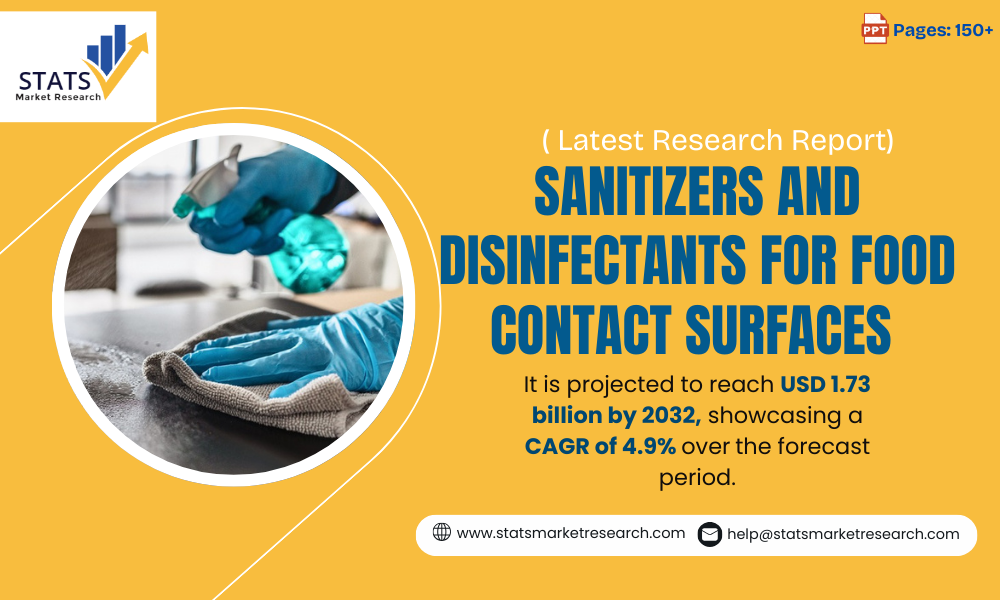
Global sanitizers and disinfectants for food contact surfaces market was valued at USD 1.21 billion in 2024 and is projected to reach USD 1.73 billion by 2032, growing at a CAGR of 4.9% during the forecast period.
Download FREE Sample of this Report @ https://www.statsmarketresearch.com/download-free-sample/8060146/global-sanitizers-disinfectants-for-food-contact-surfaces-forecast-market
Key insights:
- Chlorine-based sanitizers dominate the market, holding over 35% revenue share in 2024 due to affordability and broad efficacy.
- Rising consumer awareness of foodborne illnesses, coupled with expanding food processing industries, is driving demand.
- Post-pandemic hygiene standards have increased sanitization frequency by 30-50%, creating sustained growth opportunities for disinfectant suppliers.
- Major players such as Ecolab, Stepan Company, BASF, and Evonik Industries are investing in advanced formulations that balance efficacy, safety, and environmental compliance.
Historical trends highlight strong adoption in North America and Europe, while Asia-Pacific exhibits accelerated growth due to expanding food processing sectors and regulatory compliance enforcement.
Recent Developments in the Sanitizers and Disinfectants for Food Contact Surfaces Market
The market for sanitizers and disinfectants for food contact surfaces is rapidly evolving, driven by heightened food safety regulations and consumer demand for cleaner products. One major trend is the development of eco-friendly and non-toxic formulations that are effective against a broad spectrum of pathogens while being safe for both human health and the environment. This includes the use of plant-based and biodegradable ingredients. There is also a strong focus on creating ready-to-use products, such as pre-moistened wipes and single-use sprays, which simplify the sanitization process and reduce the risk of misuse. Furthermore, advancements in nanotechnology and the use of specialized coatings are enabling the creation of long-lasting, antimicrobial surfaces that can provide continuous protection against germs, which is a significant step forward in proactive food safety.
Major Distribution Channels for Sanitizers and Disinfectants for Food Contact Surfaces
The distribution of sanitizers and disinfectants for food contact surfaces is a predominantly business-to-business (B2B) model. The primary customers are food processing plants, restaurants, and other foodservice establishments, which are subject to stringent health and safety regulations. These businesses typically procure products through specialized distributors that cater to the food and hospitality industries. Key players in this market, like Ecolab and Diversey, often have direct sales forces to serve large corporate clients with custom solutions and comprehensive hygiene programs. While industrial and institutional channels dominate, there is also a significant market for consumer products available through hypermarkets, supermarkets, and online platforms, catering to the growing home and small business segment. The distribution network is highly specialized to ensure products meet specific regulatory requirements and efficacy standards for food safety.
Market Dynamics (Drivers, Restraints, Opportunities, and Challenges)
Drivers
Increasing Food Safety Regulations
- Stringent regulatory frameworks, including EU Biocidal Products Regulation (BPR) and US FDA/EPA mandates, are boosting demand.
- Over 600 million cases of foodborne illnesses occur annually, nearly half linked to improper sanitation.
- Food processing compliance spending in North America is expected to grow at 6.2% annually through 2027, driving consistent demand.
Impact of COVID-19 Pandemic
- Disinfection protocols became mandatory operational standards, with post-pandemic frequency remaining significantly higher than pre-2020 levels.
- Facilities increasingly adopt EPA-approved, hospital-grade disinfectants, contributing to a 9.3% CAGR in expenditure for food processing disinfection.
Technological Advancements in Formulation Chemistry
- Quaternary ammonium compounds (quats) now hold 42% market share due to enhanced antimicrobial efficacy and safety.
- Stabilized hydrogen peroxide and bio-based disinfectants offer longer potency and reduced toxicity, encouraging upgrades from older chemical formulations.
Restraints
High Operational Costs
- Premium disinfectants cost 40-60% more than conventional products, pressuring SMEs with low profit margins (4-7%).
- Labor accounts for 65% of sanitation program costs, with trained staff commanding 15-20% wage premiums.
Regulatory Complexity
- Divergent approval processes across regions slow market penetration:
- EU BPR: 3-5 years, ~€300,000 per product.
- US EPA: Extensive toxicology and documentation requirements.
- Multi-jurisdiction compliance demands 200-300 additional staff hours annually, increasing operational burden.
Opportunities
Green Chemistry Innovations
- Enzyme-based and plant-derived antimicrobials represent a $2.8 billion growth opportunity by 2030.
- Bio-based disinfectants offer comparable microbial kill rates while being environmentally sustainable.
- Example: A citrus-extract disinfectant achieved 8% market share within two years, certified biodegradable with 5-log bacterial reduction.
Automated Sanitation Systems
- Growth of fogging and clean-in-place (CIP) systems creates demand for formulation-specific disinfectants.
- These products command 25-35% price premiums while delivering measurable efficiency improvements.
- The automated sanitation equipment market is projected to grow at 12.4% CAGR through 2028, benefiting compatible chemical suppliers.
Challenges
Emerging Microbial Resistance
- Certain Listeria strains exhibit 60% higher survival against common quats, necessitating frequent product reformulations.
- R&D cycles have accelerated from 3-5 years to 18-24 months, creating resource pressures for manufacturers.
Workforce Shortages
- Over 45% of food facilities report challenges filling sanitation roles.
- High turnover (>30%) results in knowledge gaps, inconsistent cleaning protocols, and operational vulnerabilities.
Regional Analysis
North America
- High adoption due to stringent FDA/EPA regulations and advanced food processing infrastructure.
- Ecolab and Stepan Company dominate the market, supporting compliance through innovative solutions.
Europe
- Strong growth driven by EU food safety regulations and emphasis on green, bio-based products.
- Companies leverage vertical integration to maintain cost-effective compliance and product innovation.
Asia-Pacific
- Rapidly expanding food processing industry fuels market growth.
- Japan, China, and India prioritize hygiene compliance and eco-friendly sanitizers.
Latin America & Middle East
- Adoption is slower due to fragmented regulatory enforcement and limited access to premium formulations.
- Growth potential exists in urban centers with modern food processing facilities.
Get the Complete Report & TOC @ https://www.statsmarketresearch.com/global-sanitizers-disinfectants-for-food-contact-surfaces-forecast-market-8060146
Competitor Analysis
Key players compete via innovation, geographic expansion, and sustainable product offerings:
- Ecolab Inc. (U.S.): Dominates with ~18% market share; broad portfolio and strong food processor relationships.
- BASF SE (Germany): Vertical integration strengthens high-efficacy formulations; 6-8% growth in sanitation division.
- Evonik Industries (Germany): Specializes in next-gen chemical formulations for industrial applications.
- Stepan Company (U.S.): Leading quaternary ammonium segment in North America.
- KAO Corporation (Japan): Holds 25% of Japan’s disinfectant market for food surfaces.
- Pilot Chemical (U.S.) & Kersia Group (France): Innovators in plant-based, organic facility-focused sanitizers.
- Solvay SA (Belgium), Kemin Industries (U.S.), Christeyns Food Hygiene (Belgium), Nerta (France), Thatcher Company (U.S.): Regional and niche players contributing to market diversification.
Global Sanitizers and Disinfectants for Food Contact Surfaces: Market Segmentation Analysis
This report provides a deep insight into the global Sanitizers and Disinfectants for Food Contact Surfaces market, covering all essential aspects, including macro-level market trends, micro-level segmentation, competitive landscape, development trends, niche opportunities, SWOT analysis, and value chain assessment.
It enables stakeholders to evaluate competitive positioning, identify growth potential, and formulate market strategies. This report is indispensable for industry players, investors, researchers, consultants, and business strategists seeking actionable insights into the market.
Market Segmentation (by Application)
- Dairy Products
- Meat & Poultry
- Fish & Seafood
- Fruits & Vegetables
- Processed Foods
Market Segmentation (by Type)
- Chlorine Compounds
- Quaternary Ammonium Compounds
- Hydrogen Peroxide & Peracetic Acid
- Others
Key Company
- Ecolab Inc. (U.S.)
- BASF SE (Germany)
- Evonik Industries (Germany)
- Stepan Company (U.S.)
- KAO Corporation (Japan)
- Pilot Chemical (U.S.)
- Kersia Group (France)
- Solvay SA (Belgium)
- Kemin Industries (U.S.)
- Christeyns Food Hygiene (Belgium)
- Nerta (France)
- Thatcher Company (U.S.)
Geographic Segmentation
- North America
- Europe
- Asia-Pacific
- Latin America
- Middle East & Africa
FAQ
Q1: What is the current market size of the Sanitizers and Disinfectants for Food Contact Surfaces market?
A1: The market was valued at USD 1.21 billion in 2024 and is projected to reach USD 1.73 billion by 2032, growing at a CAGR of 4.9%.
Q2: Which are the key companies operating in this market?
A2: Key players include Ecolab, BASF, Evonik, Stepan Company, KAO Corporation, Pilot Chemical, Kersia Group, Solvay SA, Kemin Industries, Christeyns Food Hygiene, Nerta, and Thatcher Company.
Q3: What are the key growth drivers in this market?
A3: Growth is driven by stringent food safety regulations, rising consumer awareness, post-pandemic hygiene practices, and innovations in antimicrobial formulations.
Q4: Which regions dominate the market?
A4: North America, Europe, and Asia-Pacific dominate due to stringent regulatory frameworks and expanding food processing industries.
Q5: What are the emerging trends in this market?
A5: Emerging trends include bio-based disinfectants, enzyme-based cleaners, automated sanitation systems, and multi-purpose formulations for industrial and organic food applications.
About Us
☎️ International: +1 (332) 2424 294
📄 Website: www.statsmarketresearch.com
Join us on LinkedIn:- https://www.linkedin.com/company/statsmarketresearch




