
Definition
DFN (Dual Flat No-leads) and QFN (Quad Flat No-leads) packages are advanced surface-mount semiconductor packaging technologies designed for space-constrained electronic applications. These leadless packages provide multiple advantages over traditional leaded packages, including:
- Smaller PCB footprint, enabling higher density integration.
- Improved thermal performance, allowing efficient heat dissipation for high-frequency or power-sensitive devices.
- Low profile, which supports compact and wearable device designs.
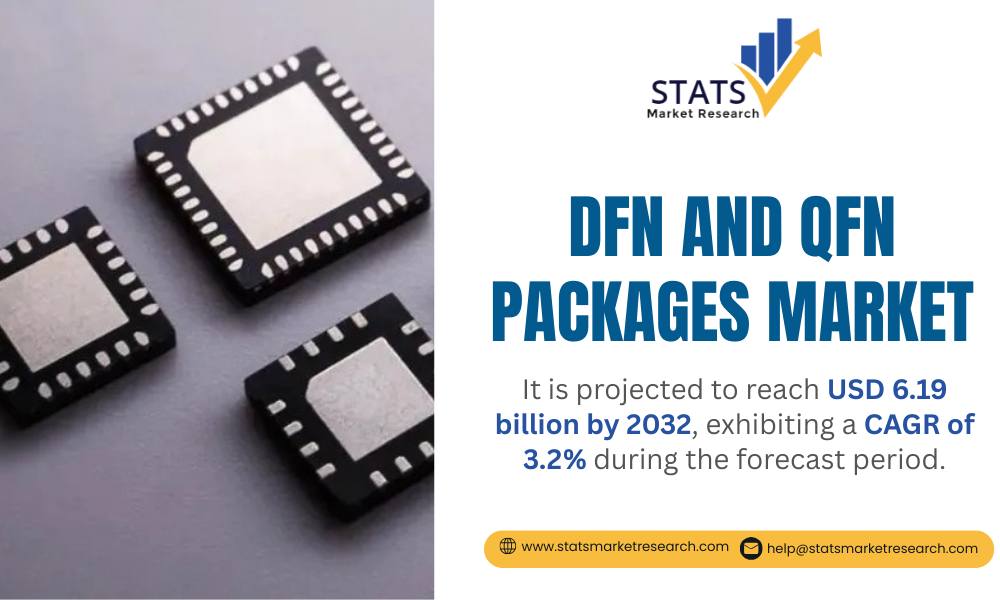
QFN packages typically feature a square or rectangular plastic-encapsulated body with exposed pads on the underside for enhanced heat conduction, making them suitable for RF applications and high-frequency circuits.
DFN packages are preferred in miniaturized consumer electronics and wearable devices due to their reliability, compactness, and compatibility with modern manufacturing processes.
Applications of DFN/QFN packages include:
- Consumer electronics: smartphones, wearables, tablets.
- Automotive electronics: ADAS modules, power management ICs, infotainment systems.
- Industrial equipment: compact controllers and IoT devices.
- Communication devices: RF front-end modules, 5G components.
- Medical electronics: portable devices and diagnostic instruments.
The growing adoption of DFN/QFN packages is primarily driven by demand for miniaturization, higher efficiency, and cost-effectiveness in modern electronics.
Market Size
Global DFN and QFN packages market was valued at USD 4.93 billion in 2023 and is projected to grow from USD 5.12 billion in 2025 to USD 6.19 billion by 2030, exhibiting a CAGR of 3.2%.
Download FREE Sample of this Report @ https://www.statsmarketresearch.com/download-free-sample/8059799/global-dfn-qfn-packages-forecast-market
Key insights include:
- QFN packages dominate due to their cost-effectiveness, compact design, and superior thermal performance for high-frequency applications.
- Consumer electronics lead the adoption, with over 1.2 billion smartphones shipped globally in 2023, many of which utilize DFN/QFN packages in power management and RF modules.
- Automotive electronics are becoming a major driver, as modern vehicles increasingly integrate hundreds of semiconductor devices.
- Market growth is also fueled by the rollout of 5G infrastructure, wearable technology, and industrial automation.
- Industry leaders such as ASE Group, Amkor Technology, JCET, and Powertech Technology are driving innovation to reduce package dimensions while improving thermal and electrical performance.
Historically, adoption was concentrated in Asia-Pacific, followed by North America and Europe, driven by semiconductor manufacturing hubs and electronics production centers.
Recent Developments in the DFN and QFN Packages Market
The DFN (Dual Flat No-lead) and QFN (Quad Flat No-lead) packages market is in constant flux, driven by the demand for smaller, more powerful, and cost-effective electronic devices. A major recent development is the push for enhanced thermal performance, with manufacturers designing packages with larger exposed pads and advanced substrate materials to improve heat dissipation, which is critical for high-power applications in automotive and industrial electronics. There is also a strong trend towards miniaturization and higher pin counts, with the development of dual-row micro lead frame (DRMLF) packages that allow for more connections in a smaller footprint. Additionally, the industry is focusing on improving reliability for demanding environments, such as those found in automotive and aerospace applications, by using advanced materials and refining manufacturing processes to reduce solder joint fatigue.
Major Distribution Channels for DFN and QFN Packages
The distribution of DFN and QFN packages operates within a highly specialized business-to-business (B2B) ecosystem. The primary customers are Original Equipment Manufacturers (OEMs), Original Design Manufacturers (ODMs), and Electronics Manufacturing Services (EMS) providers in key sectors like consumer electronics, automotive, industrial, and telecommunications. Consequently, the main distribution channel is direct sales from major semiconductor manufacturers and packaging companies like Amkor Technology and ASE Group. These companies often work directly with their clients to provide custom-designed packaging solutions. However, a significant portion of the market is also served through a network of specialized electronics component distributors and supply chain partners who provide a wide range of products to a broader customer base, including small and medium-sized enterprises.
Market Dynamics (Drivers, Restraints, Opportunities, and Challenges)
Drivers
Rising Demand for Miniaturized Electronics
- DFN/QFN packages provide up to 70% space savings compared to traditional leaded packages.
- Smartphones, wearables, and tablets increasingly adopt these packages for compact power management ICs and RF modules.
- Wearable devices rely on DFN packages for footprint efficiency, thermal reliability, and high-density integration.
Automotive Semiconductor Growth
- The automotive semiconductor market is projected to grow at 6.7% CAGR through 2030.
- DFN/QFN packages are preferred in ADAS, infotainment, and electrification systems, especially for AEC-Q100 Grade 1 automotive-grade components.
- Moisture-resistant QFN variants support under-the-hood applications, providing reliability in harsh operating conditions.
Restraints
Thermal Management Challenges
- Compact form factor limits heat dissipation, with thermal resistance ranging from 20–50°C/W.
- High-power applications (>5W) often require larger package types with better thermal paths.
- Manufacturers mitigate this with thermal pad designs and optimized PCB layouts, but limitations persist.
Opportunities
Emerging 5G Infrastructure
- 5G RF front-end modules leverage QFN packages for high-frequency performance and compact design.
- The telecom sector plans to deploy 7 million 5G base stations by 2025, increasing demand for QFN packages.
- Advanced packaging innovations are emerging to support mmWave bands, improving RF shielding and signal isolation.
Challenges
Precision Placement and Assembly Complexity
- DFN/QFN packages have pad pitches as small as 0.4mm, requiring high-precision placement and inspection equipment.
- Contract manufacturers report 2–3x higher yield losses compared to leaded packages due to soldering defects.
- Solutions include improved stencil designs and reflow profiles, but the learning curve is steep.
Regional Analysis
Asia-Pacific
- Dominates the market with semiconductor manufacturing hubs in Taiwan, China, and South Korea.
- High adoption in consumer electronics, automotive, and 5G applications.
North America
- Driven by automotive semiconductor innovation, industrial electronics, and defense applications.
- ASE, Amkor, and other players maintain R&D and production facilities to support local demand.
Europe
- Focused on automotive-grade applications and industrial electronics.
- Specialized QFN variants for automotive and telecom segments are increasingly deployed.
Rest of the World
- Latin America and Middle East show nascent adoption, primarily in industrial electronics and telecom sectors.
- Growth potential exists as electronics manufacturing expands in emerging regions.
Get the Complete Report & TOC @ https://www.statsmarketresearch.com/global-dfn-qfn-packages-forecast-market-8059799
Competitor Analysis
The market is highly competitive, with key players focusing on innovation, cost efficiency, and global expansion:
- ASE Group (Taiwan): 18% market share, leading in advanced packaging and micro-QFN solutions.
- Amkor Technology (U.S.): 15% share, strong R&D and panel-level packaging innovations.
- JCET (China) & Powertech Technology (Taiwan): Over 22% combined share, cost-effective mid-market solutions.
- UTAC Group & ChipMOS Technologies: Specialty niche providers, automotive-grade and high-density consumer electronics focus.
Innovation Trends:
- ASE introduced micro-QFN with 0.35mm pad pitch.
- Amkor invests in panel-level packaging for cost-sensitive applications.
Global DFN and QFN Packages: Market Segmentation Analysis
This report provides a deep insight into the global DFN and QFN Packages market, covering macro-level trends, micro-level segmentation, competitive landscape, development trends, niche markets, SWOT analysis, and value chain assessment.
The analysis enables stakeholders to evaluate competitive positioning, identify growth potential, and formulate market strategies. It is a must-read for industry players, investors, researchers, consultants, and business strategists exploring the DFN/QFN packages market.
Market Segmentation (by Application)
- Automotive Electronics
- Consumer Electronics
- Industrial Equipment
- Communication Devices
- Medical Electronics
Market Segmentation (by Type)
- QFN Packages
- QFN16L, QFN20L, QFN32L, QFN48L, QFN64L, QFN80L
- DFN Packages
- DFN2L, DFN4L, DFN6L, DFN8L, DFN10L, DFN12L, DFN16L
Key Company
- ASE Group (Taiwan)
- Amkor Technology (U.S.)
- JCET (China)
- Powertech Technology Inc (Taiwan)
- Tongfu Microelectronics (China)
- Tianshui Huatian Technology (China)
- UTAC Group (Singapore)
- OSE CORP (Taiwan)
- ChipMOS Technologies (Taiwan)
- King Yuan Electronics (Taiwan)
- SFA (Taiwan)
- China Chippacking (China)
- Chizhou HISEMI Electronics Technology (China)
- Forehope Electronic (Ningbo) Co., Ltd (China)
- Wuxi Huarun Anseng Technology (China)
Geographic Segmentation
- North America
- Europe
- Asia-Pacific
- Latin America
- Middle East & Africa
FAQ
Q1: What is the current market size of the DFN and QFN Packages market?
A1: The market was valued at USD 4.93 billion in 2023 and is projected to reach USD 6.19 billion by 2030, with a CAGR of 3.2%.
Q2: Which are the key companies operating in this market?
A2: Key players include ASE Group, Amkor Technology, JCET, Powertech Technology, UTAC Group, ChipMOS Technologies, Tongfu Microelectronics, and OSE CORP.
Q3: What are the key growth drivers in this market?
A3: Growth is driven by miniaturization of electronics, automotive semiconductor expansion, and 5G infrastructure deployment.
Q4: Which regions dominate the DFN and QFN Packages market?
A4: Asia-Pacific, North America, and Europe dominate due to semiconductor manufacturing hubs, electronics production, and automotive adoption.
Q5: What are the emerging trends in this market?
A5: Emerging trends include micro-QFN packages with smaller pad pitches, panel-level packaging, RF-optimized QFN designs, and advanced automotive-grade solutions.
About Us
☎️ International: +1 (332) 2424 294
📄 Website: www.statsmarketresearch.com
Join us on LinkedIn:- https://www.linkedin.com/company/statsmarketresearch




