
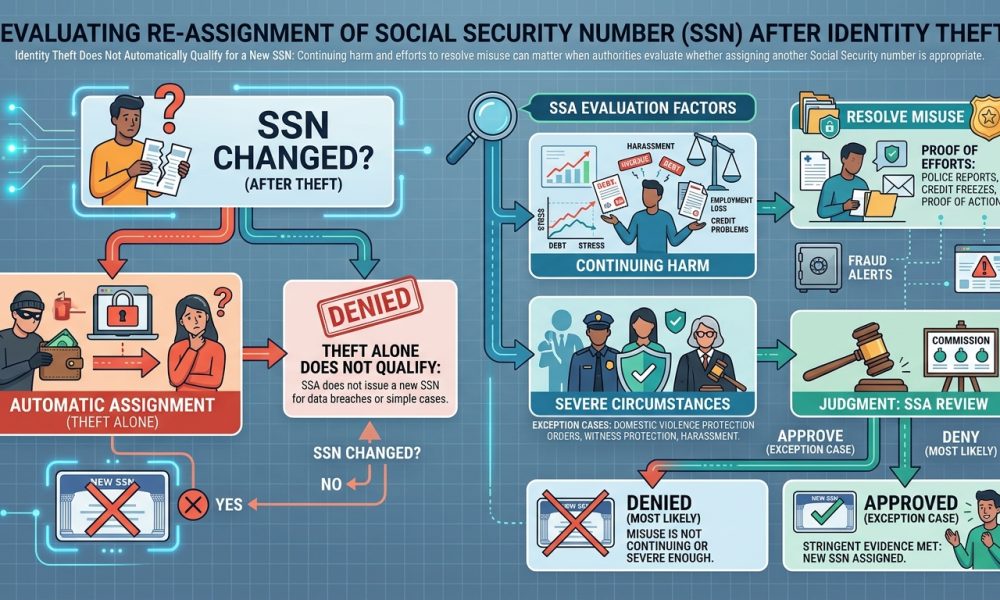
Harassment, abuse, and threats to life can raise distinct documentation questions for people seeking Protection through Social Security procedures.
Washington, DC, October 20, 2026 — People experiencing harassment, abuse, or threats to their lives may ask the Social Security Administration to consider assigning a different Social Security number, but the request requires individual assessment and evidence supporting the circumstances.
For survivors, the process raises questions beyond completing an Application, including how to safely obtain identifying documents, explain the threat, arrange confidential communications, and maintain access to employment, benefits, and other essential services during any transition.
Social Security recognizes personal danger as a distinct reason to consider another number, so applicants should not assume they must first experience financial identity theft or go through a credit dispute process before explaining their safety concerns.
The practical challenge is to establish the relevant circumstances while understanding what reassignment can accomplish, because a different number may support Protection without automatically restricting every source of personal Information or eliminating the need for broader safety planning.
Safety Concerns Have Their Own Eligibility Basis
Social Security’s public guidance lists harassment, abuse, domestic violence, and life endangerment among the circumstances that may support another number, distinguishing these situations from requests based solely on personal preference or a general desire for privacy.
The agency also recognizes ongoing identity theft problems under a separate category, so an applicant facing threats should explain those threats directly rather than assuming eligibility depends on first documenting fraudulent loans, disputed accounts, or damaged credit.
When circumstances overlap, such as an abusive person also misusing financial Information, an applicant can describe both issues accurately while asking the representative which evidence applies to the safety request and which problems require additional attention elsewhere.
That distinction helps keep the assessment focused on the actual circumstances, especially when someone’s immediate concern is personal danger rather than a financial loss that a bank or credit reporting company would ordinarily address.
Supporting Evidence Can Come From Several Sources
The Social Security Administration’s guidance for domestic violence victims identifies third-party evidence describing the nature and extent of abuse, including Information from police or medical personnel, restraining orders, and letters from people familiar with the circumstances.
Its examples also include shelters, counselors, relatives, and friends, indicating that applicants should discuss the evidence available in their case rather than assume only one type of official document can adequately explain the situation.
A supporting account is most useful when its author distinguishes what they personally observed from Information reported by someone else, allowing the agency to understand the basis of the statement without requiring speculation or unsupported conclusions.
Applicants should ask what additional Information is needed if the available records are incomplete, since understanding the specific evidentiary gap is more useful than repeatedly submitting the same material without knowing which question remains unanswered during review.
A Clear Account Can Explain a Complicated History
Harassment or abuse may involve a sequence of incidents rather than a single, easily summarized event, so a concise chronology can explain how the circumstances developed and why the applicant believes Protection remains necessary at the time of the request.
That chronology can identify approximate dates, relevant organizations, and the documents associated with particular events, while clearly marking uncertain details instead of presenting an estimate as an exact fact that the available records do not establish.
Preparing an account should help the applicant communicate accurately rather than pressure them to repeat every distressing detail, and an advocate can help organize Information. Hence, the discussion remains focused on what the agency needs to assess.
The applicant should also distinguish earlier incidents from current circumstances, allowing the representative to understand both the Background and the present concern without assuming that a change in residence or relationship status has necessarily resolved the underlying risk.
Obtaining Documents Can Raise Safety Questions
Someone who has left an unsafe household may lack immediate access to Identification, birth records, or other personal papers, creating a practical obstacle to discuss with the agency before the person tries to retrieve them.
A survivor should not assume they must return to an unsafe location to complete the request; instead, they can ask the issuing Authority, an advocate, or a lawyer about ways to obtain replacement records.
Before ordering documents, consider where confirmations and deliveries will arrive, especially if an existing mailing address or shared account could reveal that the person has begun seeking assistance or updating identifying Information.
These questions concern the safe management of an Application rather than its underlying merits, and explaining them early can help the applicant make practical arrangements before Social Security requests sensitive records or generates correspondence.
Identity Verification Remains Part of the Process
Social Security requires applicants seeking another number to establish identity, age, and citizenship or immigration status, along with evidence relevant to the request. Hence, documentation of danger and documentation of the applicant’s identity serve different purposes during assessment.
A record describing abuse does not necessarily establish every identifying fact the agency must verify, just as a passport or other accepted identity document does not by itself explain the circumstances supporting the request for another number.
Applicants should confirm which documents are acceptable and whether originals or certified copies are required, rather than assuming a photograph, ordinary photocopy, or document accepted by another organization will meet Social Security’s requirements.
When records show different names or other discrepancies, identifying the issue before the appointment can help the applicant ask what connecting evidence is needed and avoid discovering the problem only after an incomplete submission delays review.
Safe Communication Deserves Attention Before an Appointment
Social Security directs people requesting another number to arrange an appointment, creating an opportunity to ask about the required evidence and explain communication concerns before assuming ordinary telephone messages or correspondence suit their circumstances.
An applicant can ask how appointment notices, document requests and decisions will be communicated, then identify any restrictions involving shared devices, monitored accounts or addresses where another person might receive Information intended only for the applicant.
An advocate helping with these arrangements should confirm the applicant’s desired assistance. What Information may be shared, particularly when several service providers are involved, and each maintains its own records and communication procedures. Check these arrangements with the organization handling the Information, because an applicant’s preference for confidentiality does not mean every office uses the same contact practices or can provide every requested communication option.
Name Changes Require Separate Coordination
For people who also expect to change their legal names, Social Security’s domestic violence publication advises completing that change before applying for another number, making the order of the two processes an important question to discuss early.
A legal name change and assignment of another number remain separate decisions, so approval in one process should not be interpreted as proof that the other has been completed or that its requirements no longer apply.
Someone concerned about public exposure through a name change proceeding can ask a qualified lawyer or the relevant court about available confidentiality procedures, because the scope of Protection depends on the jurisdiction and the circumstances of the Application.
The practical goal is to coordinate the records and procedures involved while avoiding assumptions about secrecy, automatic notification or shared eligibility rules that could leave the applicant with inconsistent documents or an incomplete understanding of what has been protected.
Requests Involving Children Need Individual Review
When a request includes children, supporting records must address their circumstances and the adult’s Authority to act, rather than assuming a parent’s Application automatically establishes eligibility or provides sufficient documentation for every child.
Social Security’s publication identifies custody documentation and records establishing children’s citizenship, ages, and identities as relevant evidence, so it’s important to ask which documents are needed before submitting multiple family applications together for review.
The broader subject of family Identification appears in Amicus International Consulting’s article on Mexico’s children’s passports and parental photographs. However, passport documentation remains separate from the Authority, evidence, and eligibility questions governing requests for different Social Security numbers.
Families can organize each child’s records separately and seek legal advice on custody questions, especially when existing orders or disputed arrangements require clarification that an Application to Social Security cannot independently resolve for the adults involved.
Other Privacy Measures Address Different Information
A different Social Security number addresses one identifier. In contrast, an address confidentiality program or a court restriction addresses other Information, so it’s important to understand each measure’s purpose and limitations before treating them as interchangeable.
Associated Press reporting on Tennessee’s Safe at Home program described a substitute address service for eligible victims, illustrating a separate approach to limiting public disclosure that does not itself determine whether Social Security will assign another number.
A survivor considering several protections can ask which records each measure covers, which organizations must receive separate notice,, and whether any exceptions affect the intended use, rather than assuming participationautomatically changes all existing informatioy.
These questions are especially useful when different agencies or service providers are involved, because a Protection accepted for one transaction may require additional review elsewhere and may not extend to records already held by another organization.
Existing Records Continue After Reassignment
Social Security’s handbook explains that old and new numbers remain linked within its records to ensure proper crediting of earnings, preserving an important administrative connection even when the agency approves a different number for the individual.
That internal connection should not be confused with unrestricted public access. Still, it means reassignment cannot be described as removing every official relationship between the person’s earlier records and their current identifying Information.
The agency also warns that existing financial, employment, and other records may remain under previous Information, so coordination is necessary when an applicant needs continued access to legitimate accounts, benefits, or services after the change.
Before proceeding, an applicant can discuss how essential transactions will be handled and which organizations require updates, helping identify foreseeable difficulties without assuming that those administrative questions outweigh the safety concerns supporting consideration of the request.
Support Can Help Without Guaranteeing an Outcome
A survivor advocate can help organize Information and identify practical questions. At the same time, a qualified lawyer may assist with court records, custody, or other legal matters that arise alongside the Social Security Application and require separate advice.
The role of assistance is to clarify the circumstances and available options, not to promise approval or suggest that an applicant must exaggerate events to meet criteria the agency will assess through its own procedures.
Applicants should be cautious about assurances that another number guarantees complete anonymity or removes every earlier record, because those claims overlook both the limits of reassignment and the independent systems that continue maintaining Information about the individual.
If the agency requests further evidence, the applicant can ask what remains unresolved and what documentation could address it, so any follow-up responds directly to the identified issue instead of relying on broad or repetitive submissions.
Protection Depends on More Than the Number
A different Social Security number may help as part of a broader safety plan. Still, the decision should reflect the person’s circumstances, the evidence available, and the practical consequences of changing an identifier used across essential services.
Do not delay immediate Protection and access to support while an administrative request is pending, especially when the applicant needs help with safe housing, legal proceedings, or other matters that require attention independent of Social Security’s review.
If reassignment is approved, checking the resulting documents and following the agency’s instructions can help manage the transition, while reviewing communication arrangements remains important whenever additional organizations must receive updated Information or supporting records afterward.
The central question is whether the evidence supports a different number under Social Security’s criteria, with the applicant understanding that the measure can contribute to Protection while leaving other safety needs and administrative responsibilities to be addressed separately.




