
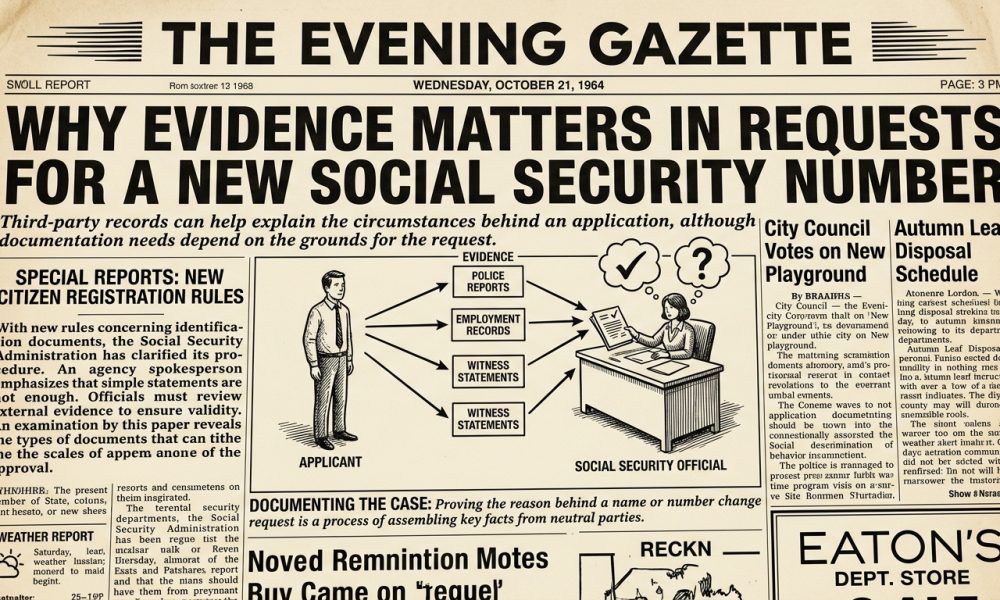
Third-party records can help explain the circumstances behind an Application, but required documentation depends on the grounds for the request.
Washington, DC, October 20, 2026 — Requests for a different Social Security number depend on more than an applicant’s preference for a replacement identifier, because the Social Security Administration must assess whether the circumstances meet its criteria and whether the supporting evidence establishes the relevant facts.
That assessment involves separate questions about who the applicant is and why another number may be appropriate, so it matters to distinguish identity documents from records describing harassment, ongoing identity theft problems, or another recognized basis for consideration.
For applicants, the practical challenge is to present an accurate account supported by relevant material, rather than assume that submitting more paperwork automatically strengthens a request or that one official document establishes every fact the agency needs.
Understanding each record’s purpose can make preparation more effective, especially when the Application involves sensitive Information, inconsistent documents, or circumstances that developed over time and require explanation beyond the details in a standard Application form.
The Grounds for the Request Determine What Matters
The Social Security Administration’s guidance on requesting another number identifies limited circumstances for consideration, including persistent identity theft problems, harassment or danger, certain numbering conflicts, and qualifying religious or cultural objections, each of which raises different evidentiary questions.
A request involving unresolved misuse of an existing number requires a different explanation than a request involving threats to personal safety, even when both applicants understandably worry about how their identifying Information could be used against them.
Applicants should therefore start by describing the actual problem and asking which documents apply, rather than selecting a category because it seems easier to explain or resembles an example from an online discussion.
When several issues overlap, organizing them separately can help the representative understand their relationship while preserving the distinction between facts supporting reassignment and other problems that may require assistance from a bank, court, or another government agency.
Identity Documents Answer a Separate Question
Social Security requires evidence establishing identity, age, and citizenship or immigration status when assessing a request for another number, along with Information supporting the reason for the request, so these documentary requirements serve related but different functions.
A passport may help establish who an applicant is without showing that harassment occurred, while a letter describing threats may explain the circumstances without meeting the agency’s requirements to identify the individual named in the Application.
Recognizing that distinction can prevent avoidable omissions, particularly when someone assumes that a detailed police report or extensive correspondence removes the need to provide the personal documentation ordinarily required to establish the applicant’s identity and relevant status.
Before an appointment, applicants can ask which documents address each requirement and identify anything unavailable, allowing the agency to explain acceptable evidence rather than leaving the person to infer that one document must serve every purpose.
Third Party Records Can Provide Independent Context
For requests involving harassment, abuse, or life endangerment, SocialSecurity’ss domestic violence publication identifies evidence from police or medical personnel, restraining orders, and letters from shelters, counselors, relatives, friends, or others familiar with the circumstances.
These examples show that relevant Information can come from several sources. However, a record’s usefulness depends on what it establishes, not simply on whether its author holds an official position or knows the applicant personally.
A practical way to prepare supporting statements is to identify how the writer knows the circumstances and distinguish direct observations from Information reported by another person, helping the reader understand the basis and limits of the account.
Applicants should seek accurate descriptions rather than predetermined language, because a statement that clearly explains relevant events is more useful than a document repeating broad conclusions without identifying the facts on which those conclusions are based.
Safety Evidence Should Describe the Circumstances Clearly
Harassment and abuse may involve repeated incidents, changing patterns,, or several organizations, sog a short chronologycan connectg individual records andexplaing why the applicant believes the circumstances supportconsideringf another Social Security number.
The chronology can identify dates where known, describe uncertainty where necessary, and connect events with available documents, without turning an approximate recollection into an exact claim the supporting material does not establish or independently confirm.
A survivor who lacks particular records can discuss the difficulty with the agency, whose publication states it will help obtain needed additional evidence, rather than assume an incomplete collection automatically prevents meaningful consideration.
Document preparation should also account for personal safety, and someone unable to retrieve papers safely can ask an advocate, lawyer, or issuing Authority about alternatives before attempting to obtain material from an unsafe location or person.
Identity Theft Evidence Must Explain Continuing Problems
For identity theft requests, Social Security considers whether the individual has tried to address problems caused by misuse but still faces disadvantages tied to the original number, making the sequence of events relevant to the assessment.
A notice showing that Information was exposed can document the original disclosure. Still, it does not necessarily establish that misuse occurred, what corrective steps followed, or which problems remain unresolved when the person seeks another number.
Applicants can distinguish these stages by organizing records of the incident, correspondence describing recovery efforts, and later evidence of continuing difficulties, and by explaining what each item contributes rather than expecting the representative to reconstruct the entire history.
Successful corrections should also be included in an accurate account, because acknowledging what has been resolved helps identify the remaining issue and avoids presenting every earlier problem as though it continues unchanged at the time of review.
Financial Correspondence Can Document Recovery Efforts
The Federal Trade Commission advises people disputing inaccurate credit Information to contact both the credit reporting company and the business supplying the Information, and to preserve supporting documents and records of what they submitted during the correction process.
Those records can help an applicant describe efforts to address misuse, especially when a response explains whether Information was corrected, remained disputed, or required additional documentation before the organization could complete its investigation of the reported problem.
A later credit report or account notice can provide additional context. Still, the applicant should explain the specific discrepancy rather than assume an unfamiliar entry establishes its cause or proves every recovery effort failed.
Keeping records for recovery purposes does not mean submitting every document to Social Security, and asking which items are relevant can reduce unnecessary disclosure while ensuring the material needed for assessment is available.
Other Eligibility Categories Require Different Explanations
Social Security also recognizes problems involving similar numbers assigned within a family or situations where more than one person is assigned or uses the same number, so applicants should describe the specific conflict and its consequences.
A numerical resemblance alone does not explain the difficulty, so records of actual confusion are more informative than simply presenting two numbers and expecting the agency to infer that the situation warrants reassignment to a different identifier.
For religious or cultural objections to particular digits, the agency’s published guidance calls for written documentation from a religious group with which the number holder has an established relationship, reflecting a distinct requirement within that eligibility category.
Applicants relying on that provision should ask how the requirement applies to their circumstances, rather than assuming a personal preference, an informal explanation, or documentation prepared for another purpose will necessarily meet the agency’s requirements.
Originals and Certified Copies Have Different Status
Social Security’s operating instructions distinguish acceptable original records and properly certified copies from uncertified photocopies and notarized copies when evaluating evidence of age, identity, citizenship, or lawful status, making a document’s form important.
A document can contain accurate Information yet still be unacceptable in the form submitted, so applicants should verify requirements before paying for certification or assuming a scanned Image will serve the same purpose as an authorized copy.
The agency also evaluates whether a document is appropriate for the fact being established, meaning that Authenticity alone does not make every official record suitable evidence of identity, age, or another required element of the Application.
Applicants should preserve records in their issued condition and ask about questionable copies, because adding annotations, altering Information, or trying to repair apparent discrepancies themselves can raise further questions that the applicant should instead clarify with the issuer.
Inconsistent Records Need Explanation and Careful Review
Differences in names, dates, or other identifying details can arise for several reasons, and applicants should identify them openly rather than assume that the agency will overlook the discrepancy or automatically understand the relationship between the records.
In April 2024, Associated Press reporting on William Woods’ stolen identity described how he was wrongly jailed after challenging financial activity under his name, illustrating the serious consequences that can follow when institutions misinterpret conflicting identity Information.
The broader lesson is to examine evidence carefully. However, that case does not establish that every Application involving identity concerns or a request for another number requires a particular document or investigative method.
An applicant facing discrepancies can ask which connecting records or corrections are needed, preserve the original documents, and get clarification from the issuing organization rather than create an explanation unsupported by the available Information or official record.
Family Applications Require Records for Each Person
When a request includes children, Social Security’s domestic violence guidance identifies custody documentation and evidence of children’s citizenship, ages, and identities among the relevant records, requiring attention to each child rather than reliance solely on the adult’s Application.
A parent’s documents may establish the adult’s identity without answering every question about a child. In contrast, a custody record may establish Authority without independently demonstrating the circumstances that support a different number for that family member.
The importance of distinguishing family document functions also appears in Amicus International Consulting’s article on Mexico’s children’s passports and parental photographs, a related subject that remains separate from Social Security’s evidence requirements and decisions about assigning another number.
Families preparing several applications can organize records separately and identify which questions apply to each person, helping prevent one individual’s circumstances from being treated as evidence that everyone in the household necessarily qualifies for the same administrative action.
Sensitive Information Requires Thoughtful Handling
Applications involving abuse, threats, or financial misuse can contain highly personal material, so it makes sense to ask how documents should be submitted and what Information is necessary before distributing a complete collection to several organizations or representatives.
An applicant can maintain an inventory of submitted records and confirm where correspondence will arrive, particularly when a shared address, account or device could expose communications to someone who should not receive Information about the request.
These practical precautions should be coordinated with the receiving organization rather than assumed, because different agencies and advisers maintain their own procedures and may need clarification about safe contact arrangements before they can respond appropriately to the applicant.
A representative assisting with preparation can help organize materials and identify unanswered questions, but should not promise that withholding relevant facts, providing standardized statements, or submitting a particular volume of paperwork will guarantee the desired outcome.
Evidence Supports a Decision Without Guaranteeing Approval
Social Security directs applicants seeking another number to schedule an appointment, where a representative assesses the circumstances and explains the potential advantages and disadvantages. Hence, preparing documents supports that review without replacing the agency’s responsibility to determine eligibility.
If additional material is requested, asking which fact remains unestablished can make follow-up more effective, allowing the applicant to address a specific gap instead of repeatedly submitting documents that do not answer the outstanding question.
Applicants should also understand that a different number does not erase earlier records, and Social Security maintains links between old and new numbers for proper earnings credit. At the same time, other organizations may require separate updates after reassignment.
Evidence matters because it connects an applicant’s explanation to facts the agency can evaluate, allowing the request to be considered on its actual grounds while preserving accuracy, realistic expectations, and an understanding of the responsibilities that remain after any decision.




