
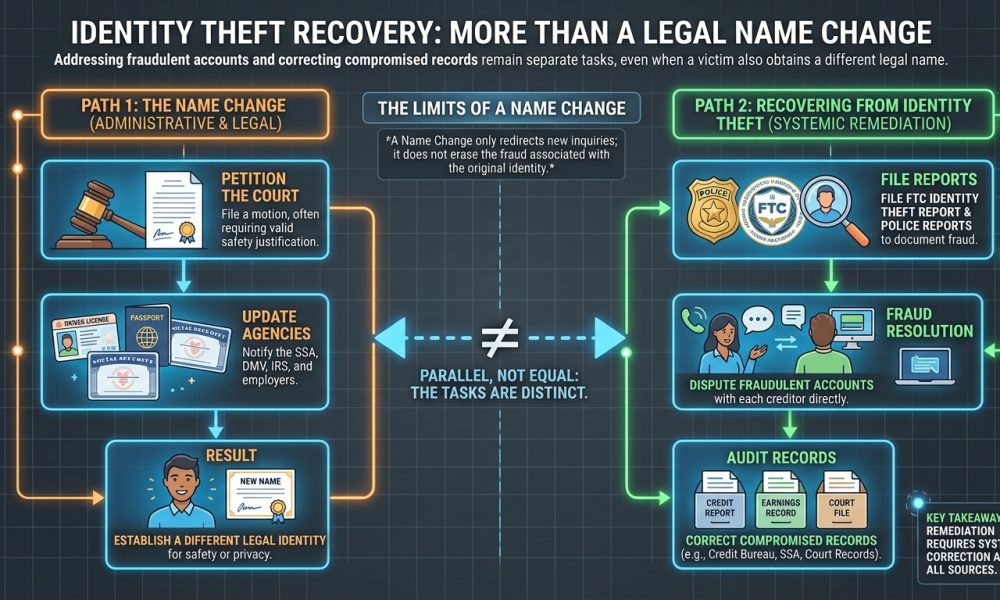
Addressing fraudulent accounts and correcting compromised records remain separate tasks, even when a victim also obtains a different legal name.
Washington, DC, October 20, 2026 — A legal name change can serve an important personal purpose. Still, it does not automatically close fraudulent accounts, reverse unauthorized transactions, or correct records created when someone else misused theindividual’ss identifying Information.
For identity theft victims, that distinction matters because financial institutions, government agencies, and other organizations maintain separate systems, each of which may require notification, supporting evidence, and follow-up before investigating or resolving a problem.
Changing a name also leaves other identifying Information potentially exposed, including account credentials, Social Security numbers, and previously collected personal details, meaning someone responsible for earlier misuse may retain Information that could support additional fraudulent activity.
Recovery therefore requires attention to the specific harm, treating a name change as a separate administrative process rather than evidence that compromised accounts are secure or that every affected organization has corrected inaccurate records.
A New Name Does Not Close an Existing Account
An account opened fraudulently under a person’s former name can remain in an institution’s records after a legal name change, so the victim must identify the account and explain the misuse through the organization’s designated recovery procedures.
The same distinction applies when an existing legitimate account has been compromised, because updating its customer name does not necessarily revoke unauthorized access, replace exposed credentials, or resolve transactions that the account holder did not authorize.
Consumers should explain both issues when they occur together, making clear whether they are requesting a legal name update, reporting identity theft,t or seeking correction of particular transactions, instead of expecting one service request to accomplish everything.
Keeping those requests identifiable can make follow-up more effective, especially when different departments handle customer Information, account security, and fraud investigations and need separate documentation before completing their parts of the recovery process.
The First Priority Is Identifying the Misuse
Identity theft can involve new credit accounts, access to existing accounts, employment Information, tax filing, or medical records, so it’s important to establish what actually happened before deciding which notifications and corrective steps are necessary.
An unfamiliar bill or unexpected account message should prompt verification through a trusted contact channel. At the same time, the consumer avoids assuming every unusual communication is genuine or that every unfamiliar business name necessarily indicates identity theft.
A practical incident record can distinguish confirmed unauthorized activity from questions still under investigation, helping the individual explain what they know without presenting an uncertain suspicion as a fact when contacting an institution or public agency.
That distinction also helps prioritize action, because an account currently accessible to an unauthorized person presents a different immediate problem from an older reporting error that requires documentation and correction but does not involve continuing account access.
Contacting the Affected Institution Begins the Response
The Federal Trade Commission’s guidance on recovering from identity theft advises contacting the fraud departments of affected companies, asking about closing or freezing compromised accounts and changing relevant credentials, while also reporting the theft and reviewing credit Information.
Consumers should use contact details obtained independently from an official website, account statement,, or other trusted source, because a messageofferingr recovery assistance may itself be an attempt to obtain additional identifying or financial Information.
During the conversation, ask what action has been taken and what remains outstanding to distinguish an immediate security measure from a completed investigation, and to avoid mistakenly assuming that restricting access also resolves every disputed charge or associated record.
When an institution replaces an account or payment credential, the consumer can ask how to manage legitimate payments and services, reducing disruption without assuming all existing arrangements will automatically transfer to the replacement Information
Digital Account Security Requires Its Own Work
A legal name change does not remove someone from an email account they can already access. Hence, controlling communications is especially important when email is used to receive account alerts, password resets, and other sensitive recovery Information.
The Federal Trade Commission recommends changing compromised passwords, signing out of other devices, enabling available two-factor Authentication, and checking recovery contact Information, with extra attention to email forwarding rules that could keep exposing messages after access appears restored.
Consumers should follow the provider’s recovery instructions and review whether unauthorized changes remain, rather than assume that changing a visible display name or successfully signing in proves that every method of continued access has been removed.
When several services depend on the same email address, documenting which accounts you’ve secured can help organize your response, while ensuring sensitive recovery correspondence isn’t routinely delivered to an account whose security remains uncertain.
Credit Reports Need Separate Review
Credit reporting companies associate Information with consumers through several identifying details, and Experian explains that a legal name change does not ordinarily create a new credit file or remove earlier account Information from credit score calculations.
Consumers should therefore review their reports for unfamiliar accounts and inaccurate details even after updating their names, identify which reporting companies show the problem, and avoid assuming the same Information appears identically in every report.
A related point appears in Investopedia’s explanation of marriage and credit history, which notes that changing a name does not erase the existing financial record, reinforcing the distinction between updating Identification and correcting Information attributable to fraud or error.
The aim is to preserve an accurate history while removing Information that doesn’t belong, since losing legitimate payment records wouldn’t necessarily improve the consumer’s position and could make later verification of their financial experience more difficult.
Disputes Must Address the Particular Error
The Federal Trade Commission advises consumers disputing inaccurate credit Information to contact both the reporting company and the business that supplied it, explain the specific error, and retain copies of the supporting material and correspondence submitted.
A focused dispute identifies the account or entry, explains why it is incorrect, and states the requested correction, giving the recipient a clearer basis for review than a general statement that the consumer has recently changed names.
Identity theft blocking is a separate remedy described by the Consumer Financial Protection Bureau, requiring an identity theft report, proof of identity, and Identification of the affected Information, rather than merely a request to remove unfavorable credit entries.
Consumers should use the procedure appropriate to the facts and provide truthful Information, because a genuine identity theft claim differs from a disagreement over a legitimate account and should not be used to conceal accurate financial history.
Protective Measures Do Not Replace Corrections
A credit freeze restricts access by prospective creditors and can make it harder to open fraudulent new accounts. At the same time, a fraud alert requires additional identity verification and protects against different risks than correcting Information already reported.
Federal consumer guidance explains that the three nationwide credit reporting companies offer freezes at no cost, and an initial fraud alert can be placed through one company, which must notify the other two.
Neither measure should be interpreted as a completed investigation of existing accounts, so a victim may still need to pursue disputes, contact affected businesses, or address misuse involving records outside the ordinary consumer credit reporting system.
Keeping Protection and correction separate helps consumers accurately evaluate progress, especially when an older fraudulent account is discovered after safeguards were established. Its appearance does not necessarily mean someone opened a new account afterward.
Tax and Employment Records Require Targeted Attention
Identity theft involving tax returns or reported wages raises questions that a legal name change cannot resolve on its own, because the relevant agencies must review specific filings, notices, or earnings Information rather than update the person’s current identifying details.
The Internal Revenue Service directs affected individuals to follow verified notices, maintain communication records, and continue meeting filing and payment responsibilities. At the same time, an Identity Protection PIN provides an additional safeguard against unauthorized use of taxpayer Information.
Employment misuse may require Social Security assistance when someone else’s earnings appear associated with the victim, so explain the discrepancy instead of assuming that correcting a name will also correct the underlying wage record.
Consumers unsure about an unfamiliar tax document can seek guidance from the responsible agency or a qualified tax professional, especially when an incorrect response could create additional discrepancies alongside the original misuse the person is trying to resolve.
Medical Identity Theft Can Affect More Than Billing
Medical identity theft can involve unauthorized treatment, prescriptions, or insurance claims, and the Federal Trade Commission warns that another person’s health Information may become mixed with the victim’s records, potentially affecting care or access to insurance benefits.
If someone receives an unfamiliar medical bill or explanation of benefits, they should contact the relevant provider or insurer through a verified channel and ask for Information needed to determine whether the entry reflects legitimate care, a billing mistake, or unauthorized activity.
Updating the patient’s legal name does not establish that the underlying clinical or insurance Information is accurate, so the person should identify the disputed records and ask the organization how to request review and appropriate correction.
Because several providers or administrators may hold related Information, tracking who you’ve contacted can help you avoid assuming that correcting one bill means every affected medical record or insurance claim has also been reviewed.
Documenting Recovery Helps Explain What Remains
A concise chronology can record when you discovered the misuse, which organizations you contacted, what evidence you submitted, and what responses followed, helping you distinguish resolved issues from matters that still require action or clarification.
That record becomes particularly useful when the person also changes names, because older correspondence may identify the former name. At the same time, later applications and communications use the current one, creating an additional need to explain continuity accurately.
Appropriate evidence of the legal change can support that explanation. Still, it should be provided through the recipient’s accepted procedure rather than distributed indiscriminately whenever an organization asks a question about an earlier transaction or account.
After receiving a correction notice, check the relevant statement or report to confirm the result appears as expected, and describe any remaining discrepancy precisely instead of reopening the entire history without identifying the unresolved issue.
Family Members May Need Individual Recovery Plans
When identity theft affects more than one family member, each person’s accounts and records need attention, since a parent’s name change, fraud report, or account restriction does not show that every related individual’s Information has been secured or corrected.
The broader importance of family documentation appears in Amicus International Consulting’s article on Mexico’s children’s passports and parental photographs. However, travel Identification serves a different purpose from establishing which family member owns an account or is affected by fraudulent activity.
Parents assisting children can ask the receiving organization what Authority and documentation are required, keeping each child’s records separate so evidence about one person isn’t mistakenly treated as proof of circumstances affecting everyone in the household.
Similar names, shared addresses, and overlapping contact Information can require explanation. Still, those connections should not be accepted as sufficient proof that an unfamiliar account belongs to the individual whose Information appears in the disputed record.
A Name Change Can Accompany Recovery Without Replacing It
A victim may have valid personal or safety reasons to seek another legal name. Still, the decision should be understood alongside the practical work needed to secure accounts, correct inaccurate Information, and preserve access to legitimate services.
Another Social Security number is also an exceptional and separate matter, with the agency considering limited grounds for reassignment rather than treating a name change or a report of identity theft as automatic eligibility for a different number.
Consumers should be cautious of services that promise complete erasure of earlier records, especially when they substitute changed identifiers for truthful disputes or claim that established financial obligations disappear without the appropriate legal or administrative process.
Effective recovery depends on resolving the misuse and confirming the results, allowing someone who changes names to move forward with accurate records and stronger account Protection while recognizing the specific problems that still need attention.




