
The global rotary solenoids market is entering a strong growth phase as industries rapidly shift toward automation, robotics, and advanced motion-control systems. Rotary solenoids are electromechanical devices that convert electrical energy into controlled rotational motion. Their compact size, rapid response, and reliability make them essential components in modern industrial machinery, robotics systems, automotive assemblies, and aerospace applications.
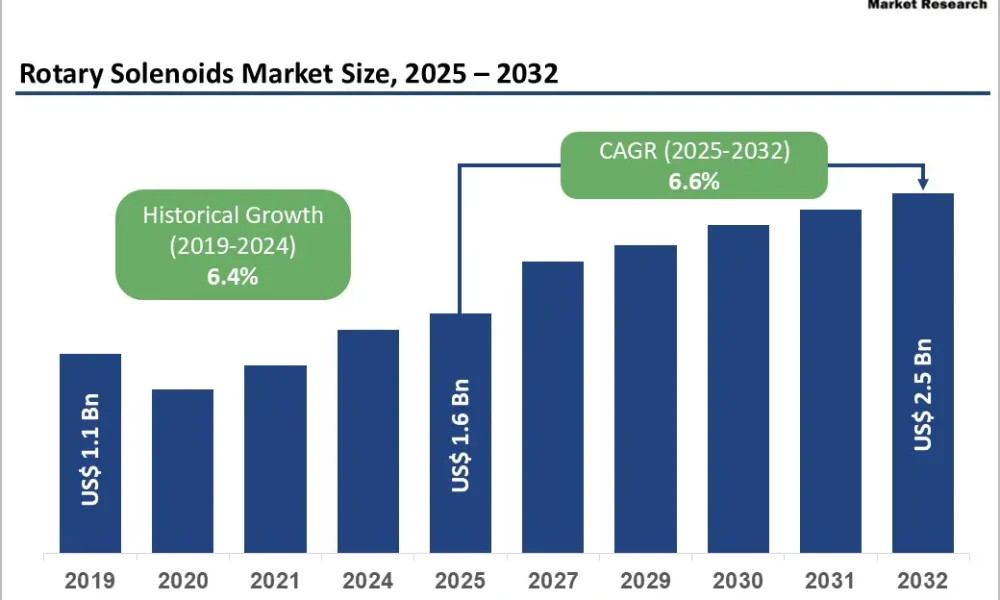
According to industry projections, the global rotary solenoids market is expected to reach US$2.5 billion by 2032, growing from US$1.6 billion in 2025 at a CAGR of 6.6% during 2025–2032. This steady expansion is being driven by the rising demand for precise electromechanical actuation, increasing deployment of collaborative robots, and growing integration of smart manufacturing technologies.
The adoption of rotary solenoids is particularly increasing across sectors such as automotive, packaging, electronics manufacturing, aerospace, and medical devices, where precise motion control is critical. The rapid growth of Industry 4.0 technologies, including Industrial Internet of Things (IIoT), predictive maintenance, and smart factory architectures, is also fueling demand for compact, energy-efficient rotary actuators.
As manufacturers increasingly replace traditional pneumatic or mechanical actuators with electric alternatives, rotary solenoids are becoming an essential part of modern automated production systems.
Industrial Automation Revolution Driving Market Growth
One of the most significant growth drivers for the rotary solenoids market is the global industrial automation revolution. Manufacturers are rapidly transforming production systems using advanced technologies such as artificial intelligence, machine learning, IIoT, and edge computing.
Modern factories rely heavily on precise and reliable motion control systems to maintain production efficiency. Rotary solenoids provide high-speed rotational motion with minimal mechanical complexity, making them ideal for automated manufacturing processes.
Industries such as automotive manufacturing, electronics assembly, and packaging are increasingly replacing manual or pneumatic systems with electrically actuated solutions. Rotary solenoids offer several advantages:
- Compact design
- Fast response time
- High reliability
- Low maintenance requirements
- Energy efficiency
These characteristics make them well suited for high-cycle operations in automated production lines.
Another key driver is the increasing deployment of collaborative robots (cobots) and autonomous mobile robots (AMRs). These robotic systems require actuators capable of delivering accurate torque, repeatable motion, and fast response. Rotary solenoids are widely used in robotic joints, grippers, and end-effectors to enable precise manipulation tasks.
The rise of modular and reconfigurable manufacturing systems further increases demand for compact solenoid solutions that can easily integrate into flexible production environments.
Robotics Expansion and Smart Manufacturing
The global surge in robotics adoption is significantly boosting the rotary solenoids market. Manufacturing facilities, logistics hubs, and healthcare systems are deploying robots to improve productivity, reduce labor costs, and increase operational efficiency.
Robots rely on precise electromechanical actuation systems to perform tasks such as:
- Pick-and-place operations
- Assembly processes
- Quality inspection
- Packaging and sorting
Rotary solenoids are particularly valuable because they can provide fast and repeatable rotational motion in small spaces. This is critical in robotic arms and miniature mechanical systems.
In addition, miniaturized rotary solenoids are enabling new applications in:
- Medical robotics
- Surgical instruments
- Laboratory automation
- Consumer electronics
Integration with smart controllers and embedded sensors allows rotary solenoids to support real-time adaptive motion control, making them compatible with advanced Industry 4.0 architectures.
Market Challenges: Cost and Supply Chain Complexity
Despite strong growth prospects, the rotary solenoids market faces several challenges related to cost pressures and supply chain disruptions.
The production of rotary solenoids relies heavily on raw materials such as:
- Copper
- Steel
- Rare-earth magnets
Fluctuating commodity prices have significantly increased manufacturing costs in recent years. High-performance solenoids require precision machining, specialized winding techniques, and strict quality standards, which further increases production expenses.
Advanced variants such as servo rotary solenoids and miniaturized actuators also involve higher research and development costs, longer product development cycles, and greater capital investment.
Supply chain complexity has also become a major concern. The global semiconductor shortage and disruptions in electronic component supply have affected actuator manufacturing. Many rotary solenoid systems depend on integrated drivers, control electronics, and sensors, making them vulnerable to component shortages.
Geopolitical tensions, trade restrictions, and logistics disruptions continue to complicate global sourcing strategies. Smaller manufacturers often struggle to maintain stable supply chains due to limited supplier networks and weaker bargaining power.
Elevate your business strategy with comprehensive market data. Request a sample report now: https://www.persistencemarketresearch.com/samples/29887
Emerging Opportunities in Asia Pacific
Asia Pacific is emerging as the fastest-growing regional market for rotary solenoids. Rapid industrialization, expanding electronics manufacturing, and government-backed automation initiatives are driving significant demand.
Countries such as China, Japan, South Korea, and India are investing heavily in advanced manufacturing technologies, robotics adoption, and smart factory infrastructure.
The region’s manufacturing hubs—particularly in electronics and automotive production—require high volumes of compact electromechanical components. Rotary solenoids are widely used in:
- Smartphone assembly equipment
- Automotive manufacturing lines
- Packaging machinery
- Medical device production
The increasing shift toward electric vehicle production across Asia is also driving new applications for rotary solenoids in battery systems, thermal management units, and vehicle control mechanisms.
India is becoming an important growth market as foreign direct investment continues to increase in the manufacturing sector. Government initiatives promoting industrial automation and domestic production are encouraging companies to adopt advanced actuator technologies.
Localization of supply chains is another major trend shaping the regional market. Many global manufacturers are establishing production facilities in Asia Pacific to reduce costs, shorten lead times, and mitigate geopolitical risks.
Product Type Analysis
DC Rotary Solenoids
DC rotary solenoids dominate the market, accounting for approximately 46% of total revenue in 2025. Their widespread adoption is driven by their affordability, simplicity, and ease of integration.
These solenoids are widely used in:
- Automotive locking systems
- Industrial valve actuation
- Conveyor sorting equipment
- Packaging machinery
Their ability to deliver rapid switching and consistent performance makes them suitable for high-cycle industrial environments.
Servo Rotary Solenoids
Servo rotary solenoids represent the fastest-growing product segment. These advanced actuators provide higher precision, improved dynamic response, and better compatibility with digital control systems.
They are increasingly used in:
- Collaborative robotics
- Aerospace systems
- Medical imaging equipment
- Minimally invasive surgical tools
As industries demand greater accuracy and motion control capabilities, servo rotary solenoids are gaining traction despite their higher cost.
Application Insights
Automotive Industry
The automotive sector accounts for more than 29% of total demand, making it the largest application segment. Rotary solenoids play an important role in several vehicle systems, including:
- Electronic steering column locks
- Automatic transmission selectors
- Battery cooling valves
- Climate control systems
- Active grille shutters
The transition toward electric vehicles (EVs) and advanced driver assistance systems (ADAS) is increasing the need for reliable electromechanical actuators.
Robotics and Automation
Robotics represents the fastest-growing application segment. Rotary solenoids are widely used in robotic arms and end-effectors for precise positioning and repeatable motion.
Their compact size and fast response make them ideal for space-constrained robotic systems, including medical robots and collaborative manufacturing equipment.
Consumer Electronics and Medical Devices
Miniaturized rotary solenoids are also gaining popularity in consumer electronics and healthcare technologies. They are used in:
- Smartphone camera modules
- Haptic feedback systems
- Infusion pumps
- Diagnostic devices
- Surgical instruments
These applications require highly accurate motion control and long operational lifecycles.
End-User Industry Analysis
Aerospace
The aerospace sector accounts for approximately 15% of total market revenue, making it the largest end-user segment.
Rotary solenoids are used in several critical aviation and space applications, including:
- Fuel valve actuation
- Landing gear locking systems
- Satellite antenna positioning
- Cabin management systems
High reliability and strict certification requirements drive demand for advanced solenoid technologies.
Packaging Industry
The packaging sector is emerging as the fastest-growing end-user industry. Automation in packaging processes is increasing rapidly as companies aim to improve productivity and reduce labor costs.
Rotary solenoids are widely used in:
- Filling machines
- Bottle capping systems
- Labeling equipment
- Sealing mechanisms
Food, beverage, and pharmaceutical industries rely on automated packaging lines that require precise and durable actuation components.
Regional Market Insights
North America
North America leads the global rotary solenoids market, accounting for approximately 31% of total revenue. The region’s advanced industrial infrastructure and high robotics adoption rates support strong demand.
The United States is a major hub for smart manufacturing and automation technologies. Companies are increasingly deploying robotics and AI-driven systems in production lines, creating strong demand for high-performance actuators.
Reshoring initiatives and domestic manufacturing investments are also strengthening local supply chains for electromechanical components.
Europe
Europe remains a major market due to its strong engineering base and advanced manufacturing sector. Countries such as Germany, France, Italy, and the United Kingdom are leading adopters of precision automation technologies.
Strict environmental regulations and energy-efficiency standards are encouraging manufacturers to adopt energy-efficient actuator solutions.
Asia Pacific
Asia Pacific is the fastest-growing region, driven by rapid industrial expansion and rising automation investments. Manufacturing hubs in China, Japan, and South Korea are major consumers of rotary solenoids for electronics assembly and robotics systems.
India is also emerging as a key growth market due to increasing automation in automotive production and packaging industries.
Competitive Landscape
The global rotary solenoids market is moderately fragmented, with several international and regional manufacturers competing through innovation, product differentiation, and strategic partnerships.
Key companies operating in the market include:
- Johnson Electric
- Magnet Schultz
- TAKANO
- RAM Company
- Geeplus
- Kendrion
- Shindengen Electric Manufacturing
- Brandstrom Instruments
- Kuhnke
- indeas GmbH
- NSF Controls
- DACO Instruments
These companies are focusing on miniaturized designs, energy-efficient products, and IoT-enabled actuator systems to strengthen their market positions.
Strategic collaborations with robotics integrators, industrial automation providers, and OEM manufacturers are also becoming a key competitive strategy.
Recent Industry Developments
Several important product innovations were introduced recently:
- October 2024: Geeplus launched a space-qualified bistable rotary solenoid with low outgassing characteristics designed for aerospace and satellite applications.
- July 2024: Magnetic Sensor Systems introduced the R-09-150 series of compact rotary solenoids featuring 18 winding configurations to support customized torque and duty cycle requirements.
These innovations highlight the growing focus on precision engineering, compact designs, and application-specific actuator solutions.
Future Outlook
The rotary solenoids market is expected to maintain steady growth over the next decade as industries continue to adopt advanced automation technologies.
Key trends shaping the future include:
- Increasing robotics adoption across manufacturing and logistics
- Miniaturization of electromechanical components
- Integration of smart sensors and IoT connectivity
- Growth of electric vehicles and autonomous systems
- Expansion of aerospace and space exploration programs
As smart factories become the global standard for production, rotary solenoids will remain a critical component in enabling precise, reliable, and energy-efficient motion control.
With continuous technological innovation and expanding industrial applications, the market is set to reach US$2.5 billion by 2032, reinforcing the importance of rotary solenoids in the future of advanced manufacturing and automation.
Related Reports:




