
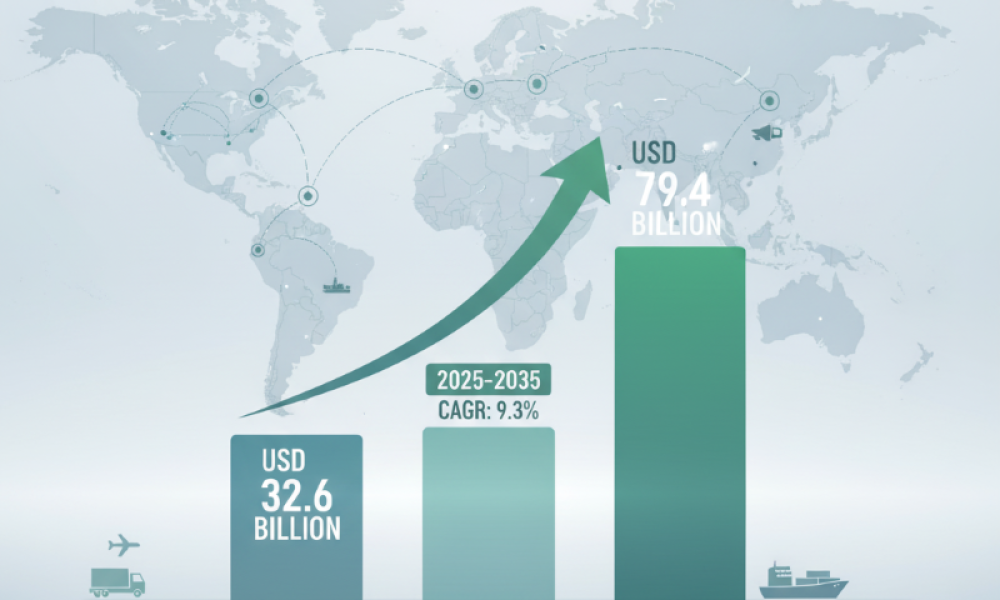
The global freight transport management market is undergoing a significant transformation, driven by the rising complexities of global trade, increasing supply chain demands, and technological advancements. Estimated to be valued at USD 32.6 billion in 2025, the market is projected to reach an impressive USD 79.4 billion by 2035, expanding at a compound annual growth rate (CAGR) of 9.3% over the next decade. The rapid evolution of freight management is being propelled by advancements in digital platforms, real-time tracking, and route optimization technologies that are redefining logistics operations across the globe.
Unlock detailed analytics – Request your personalized report now! https://www.futuremarketinsights.com/reports/sample/rep-gb-26042
Key Growth Drivers
Globalization, coupled with the expansion of e-commerce and international trade, is at the forefront of this market’s evolution. The need for streamlined freight operations has never been more pressing, as companies across industries look to improve efficiency, reduce costs, and increase visibility within their supply chains. Technological innovations, such as cloud-based platforms and AI-powered route optimization, are empowering freight service providers to manage increasingly complex networks more effectively. As companies seek to adapt to rising fuel costs and fluctuating demand, the shift towards structured transport management systems has become a strategic necessity.
By 2030, the market is expected to surpass USD 60 billion, underscoring the crucial role of digital freight platforms in ensuring sustainability and operational efficiency. In fact, companies that fail to adopt these technologies may face declining returns, as the competitive pressure intensifies.
Segmental Insights and Key Developments
Among the various segments within the freight transport management market, solutions are expected to maintain dominance, accounting for approximately 61.5% of the market share by 2025. This segment encompasses comprehensive transport management software suites that facilitate everything from route planning and freight auditing to load optimization and carrier management. By offering centralized control and enhanced data visibility, these solutions help reduce operational bottlenecks, mitigate risks, and improve delivery outcomes.
In terms of deployment models, the on-premises segment continues to hold a significant share due to longstanding infrastructure and data security priorities among large enterprises. However, cloud-based solutions are increasingly gaining traction, particularly as organizations seek scalable, flexible platforms that integrate seamlessly with existing IT infrastructure.
The road freight segment is expected to remain the leader in freight transport management, capturing a substantial 36.9% share of the market. As the backbone of last-mile delivery and regional distribution, road freight is seeing a surge in digital adoption, driven by the increasing need for vehicle tracking, fleet scheduling, and regulatory compliance in an increasingly congested global trade landscape.
Competitive Landscape
The freight transport management market is highly competitive, with key players leveraging technology to maintain an edge in the market. Major technology giants, including Oracle Corporation, SAP SE, and IBM Corporation, are spearheading innovations in integrated software solutions that provide end-to-end visibility, predictive analytics, and automation in freight management processes. These companies are focusing on cloud compatibility and AI-driven functionalities to cater to enterprises of all sizes, offering scalability and improved decision-making capabilities.
In addition to tech providers, logistics giants such as DB Schenker and CEVA Logistics are integrating freight management solutions into their operations, not only for internal efficiency but also as value-added services for their clients. Smaller companies like Korber AG and Infor are carving out niches by providing specialized solutions that integrate seamlessly with other supply chain components like warehouse management and industry-specific ERP systems.
Key Regional Markets
The freight transport management market is experiencing growth across several regions, with North America, Asia-Pacific, and Europe leading the charge. China and India are witnessing particularly strong growth, driven by their rapidly expanding manufacturing sectors and booming e-commerce markets. China is expected to lead the market with a CAGR of 12.6%, followed closely by India at 11.6%, as both countries are significantly investing in smart logistics and digital supply chain infrastructure.
Germany is anticipated to experience a CAGR of 10.7%, driven by its precision manufacturing and automotive logistics sectors, while the United States lags behind at 7.9%, as enterprise rollouts and advanced analytics take precedence over broader market adoption.
Download Brochure for Full Insights: https://www.futuremarketinsights.com/reports/brochure/rep-gb-26042
Challenges and Future Outlook
Despite the promising growth trajectory, challenges such as infrastructure bottlenecks, fuel price volatility, and cross-border compliance issues continue to pose obstacles to market expansion. These challenges are most pronounced in emerging markets, where logistics infrastructure is still developing and regulatory environments remain fragmented. However, technological advancements in predictive analytics, automation, and multimodal logistics will continue to address these hurdles, driving further adoption of digital freight management solutions.
Looking ahead, the market’s future remains optimistic, with continued investments in automation, sustainability, and predictive analytics set to consolidate the value of freight transport management systems. As companies worldwide increasingly rely on these solutions to navigate complex global supply chains, the market is poised for long-term growth, with the next decade promising significant opportunities for both established players and new entrants.
About Future Market Insights (FMI)
Future Market Insights, Inc. (ESOMAR certified, recipient of the Stevie Award, and a member of the Greater New York Chamber of Commerce) offers profound insights into the driving factors that are boosting demand in the market. FMI stands as the leading global provider of market intelligence, advisory services, consulting, and events for the Packaging, Food and Beverage, Consumer Technology, Healthcare, Industrial, and Chemicals markets. With a vast team of over 400 analysts worldwide, FMI provides global, regional, and local expertise on diverse domains and industry trends across more than 110 countries.



