
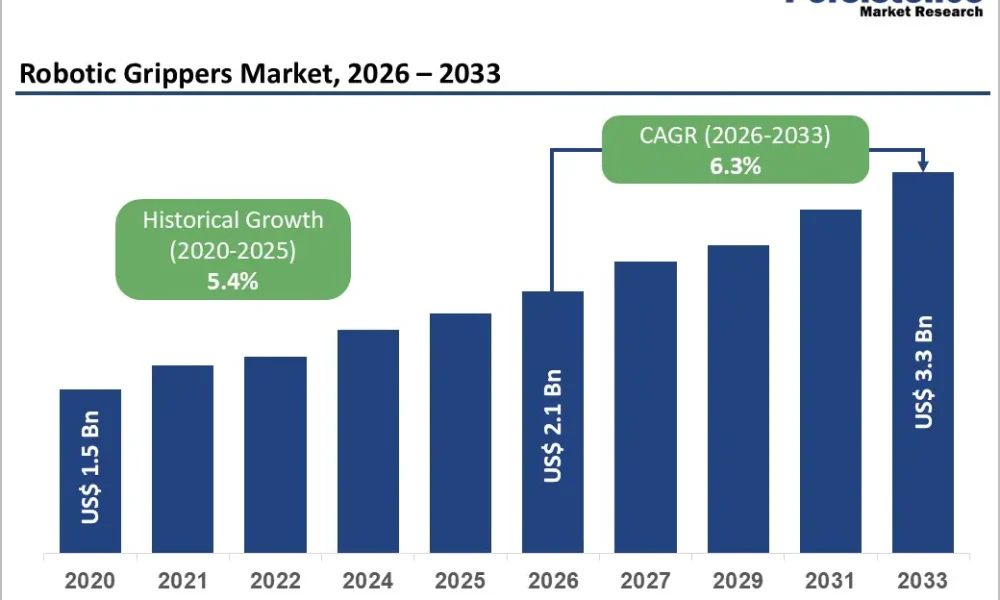
The global robotic grippers market is witnessing steady expansion as industries increasingly integrate automation technologies into manufacturing, logistics, and packaging operations. Robotic grippers are essential end-of-arm tooling (EOAT) devices attached to robotic arms, enabling robots to grasp, manipulate, and transport objects during automated processes. These grippers play a critical role in precision manufacturing, assembly lines, pick-and-place operations, and automated material handling systems. According to industry estimates, the global robotic grippers market is expected to reach US$2.1 billion in 2026 and grow to approximately US$3.3 billion by 2033, registering a CAGR of 6.3% during the forecast period from 2026 to 2033. The increasing adoption of industrial automation across sectors such as automotive manufacturing, semiconductor fabrication, consumer electronics production, and food packaging is a major factor driving market growth.
Several macroeconomic and technological factors are accelerating the adoption of robotic grippers worldwide. Large-scale semiconductor investments, including CHIPS Act funding exceeding US$500 billion in the United States, are driving demand for highly precise robotic systems used in chip manufacturing. Similarly, the European semiconductor market has experienced strong growth, with expansion exceeding 12% in recent years, further increasing the need for robotic handling technologies. The rise of B2B e-commerce and automated logistics systems is another major driver. With global B2B e-commerce gross merchandise value projected to grow from US$9.8 trillion to over US$36 trillion between 2017 and 2026, warehouses and fulfillment centers are increasingly adopting robotic automation solutions. In terms of market segmentation, mechanical grippers remain the dominant product segment due to their durability, cost efficiency, and wide industrial compatibility. Geographically, Asia-Pacific leads the robotic grippers market, supported by strong manufacturing activity, rapid automation adoption, and significant investments in robotics across China, Japan, and South Korea.
𝐆𝐞𝐭 𝐚 𝐒𝐚𝐦𝐩𝐥𝐞 𝐏𝐃𝐅 𝐁𝐫𝐨𝐜𝐡𝐮𝐫𝐞 𝐨𝐟 𝐭𝐡𝐞 𝐑𝐞𝐩𝐨𝐫𝐭: https://www.persistencemarketresearch.com/samples/36127
Key Highlights from the Report
• The robotic grippers market is projected to grow at a CAGR of 6.3% between 2026 and 2033.
• Global market value is expected to increase from US$2.1 billion in 2026 to US$3.3 billion by 2033.
• Industrial automation across automotive, semiconductor, and packaging sectors is driving market demand.
• Semiconductor investments under the CHIPS Act are boosting demand for precision robotic handling systems.
• Mechanical grippers dominate the market due to reliability and cost-effective operation.
• Asia-Pacific leads the market due to strong manufacturing output and robotics adoption.
Market Segmentation
The robotic grippers market can be segmented based on product type, application, end-user industry, and technology. Each segment reflects the increasing complexity and specialization of robotic automation solutions used in modern manufacturing and logistics environments.
Based on product type, the market includes mechanical grippers, vacuum grippers, magnetic grippers, adhesive grippers, and soft grippers. Mechanical grippers represent the largest share of the market due to their versatility and ability to handle a wide variety of objects. These grippers typically use mechanical fingers or jaws to grasp objects and are widely used in assembly lines and pick-and-place operations. Vacuum grippers are commonly used in packaging, electronics manufacturing, and material handling applications where delicate or flat objects need to be lifted without physical pressure. Magnetic grippers are used primarily in metalworking industries where ferromagnetic materials are handled. Soft grippers, a relatively newer innovation, are designed using flexible materials that allow robots to handle fragile or irregularly shaped items, making them particularly useful in food processing and pharmaceutical applications.
In terms of application, robotic grippers are widely used for pick-and-place operations, machine tending, assembly, packaging, palletizing, and inspection processes. Pick-and-place applications account for a substantial share of the market because robotic arms equipped with grippers can perform repetitive material handling tasks with speed and accuracy. Assembly applications in automotive and electronics industries also require advanced grippers capable of manipulating small components with high precision. Packaging and palletizing applications are increasingly adopting robotic grippers in logistics centers, where automated systems improve efficiency and reduce manual labor requirements.
From an end-user industry perspective, the robotic grippers market serves automotive manufacturing, electronics and semiconductor industries, food and beverage processing, pharmaceuticals, logistics and warehousing, and consumer goods manufacturing. The automotive sector remains one of the largest adopters of robotic grippers due to extensive use of industrial robots in assembly lines. Semiconductor and electronics manufacturers rely on robotic grippers for delicate wafer handling and microcomponent assembly. In the food and beverage industry, specialized grippers are used to handle fragile food items and ensure hygiene compliance. Logistics and warehousing operations are also adopting robotic grippers as part of automated sorting and packaging systems.
𝐎𝐧𝐞 𝐂𝐥𝐢𝐜𝐤 → 𝐘𝐨𝐮𝐫 𝐂𝐮𝐬𝐭𝐨𝐦 𝐌𝐚𝐫𝐤𝐞𝐭 𝐕𝐢𝐞𝐰: https://www.persistencemarketresearch.com/request-customization/36127
Regional Insights
Regional trends in the robotic grippers market reflect variations in industrial automation adoption, manufacturing output, and technological investments. Asia-Pacific dominates the global market due to the region’s strong manufacturing base and extensive use of industrial robotics. Countries such as China, Japan, and South Korea are among the largest users of industrial robots worldwide. China, in particular, has been investing heavily in smart manufacturing initiatives and robotics technology as part of its broader industrial modernization strategies. Japan and South Korea also maintain strong robotics ecosystems supported by advanced engineering capabilities and large-scale electronics manufacturing.
North America represents another significant market for robotic grippers, driven by rapid adoption of automation in manufacturing and logistics sectors. The United States is witnessing increased deployment of robotic systems in automotive production, semiconductor fabrication plants, and warehouse automation. Investments under the CHIPS and Science Act aimed at strengthening domestic semiconductor manufacturing are expected to further boost demand for high-precision robotic grippers used in chip production processes.
Europe is also experiencing steady growth in the robotic grippers market due to increasing automation in automotive manufacturing and industrial production. Countries such as Germany, Italy, and France have long-standing industrial robotics industries that continue to invest in advanced automation technologies. The region’s strong focus on Industry 4.0 and smart manufacturing is encouraging companies to adopt sophisticated robotic systems capable of performing complex tasks with minimal human intervention.
The Middle East and Africa and Latin America are emerging markets where robotic automation adoption is gradually increasing. Growing investments in industrial development, logistics infrastructure, and manufacturing modernization are encouraging companies in these regions to adopt robotic solutions, including advanced grippers.
Market Drivers
One of the primary drivers of the robotic grippers market is the rapid expansion of industrial automation across global manufacturing sectors. Industries are increasingly integrating robotic systems into production processes to improve efficiency, reduce operational costs, and enhance product quality. Robotic grippers enable robots to perform complex handling tasks with high precision, making them essential components in automated manufacturing lines. The automotive industry, for instance, relies heavily on robotic grippers for assembly operations, welding processes, and component handling.
Another important driver is the rapid expansion of semiconductor manufacturing worldwide. With global demand for semiconductors increasing significantly, governments and private companies are investing heavily in chip fabrication facilities. Semiconductor manufacturing requires extremely precise robotic handling systems capable of manipulating delicate wafers and microcomponents. Robotic grippers designed for high precision and contamination control are therefore becoming essential tools in semiconductor fabrication plants.
The growth of e-commerce and automated logistics is also contributing to increased demand for robotic grippers. Modern warehouses and distribution centers rely on robotic automation systems for order fulfillment, sorting, and packaging. Robotic grippers allow automated systems to pick and place items quickly and accurately, improving operational efficiency in high-volume logistics environments.
Market Restraints
Despite strong growth prospects, the robotic grippers market faces several challenges that could limit its expansion. One of the key restraints is the high cost associated with advanced robotic systems, including specialized grippers designed for complex industrial tasks. Small and medium-sized enterprises (SMEs) may find it difficult to invest in sophisticated robotic automation systems due to budget constraints.
Another challenge is the technical complexity involved in designing and integrating robotic grippers with industrial robots and automation systems. Each industrial application may require customized gripper designs to handle specific objects, materials, or environmental conditions. Developing such customized solutions often involves additional engineering efforts and increased implementation costs.
Workforce concerns and lack of skilled personnel capable of operating advanced robotics systems can also hinder market growth. Although automation improves productivity, companies must invest in training programs to ensure workers can effectively manage and maintain robotic systems.
Market Opportunities
The robotic grippers market presents several promising opportunities as automation technologies continue to evolve. One of the most significant opportunities lies in the development of soft robotics and adaptive gripper technologies. These advanced grippers use flexible materials and sensors to handle delicate objects, making them suitable for applications such as food processing, agriculture, and healthcare.
Another opportunity arises from the increasing adoption of collaborative robots (cobots). Unlike traditional industrial robots that operate in isolated environments, cobots are designed to work alongside human workers. Robotic grippers designed for collaborative applications must be lightweight, safe, and adaptable, creating new opportunities for manufacturers to develop innovative products.
The integration of artificial intelligence (AI) and machine vision systems with robotic grippers is also expected to create new growth avenues. AI-powered robotic systems can analyze objects in real time, allowing grippers to adjust their grip strength and positioning automatically. Such capabilities improve flexibility and expand the range of tasks robots can perform in manufacturing and logistics operations.
𝐆𝐞𝐭 𝐈𝐧𝐬𝐭𝐚𝐧𝐭 𝐀𝐜𝐜𝐞𝐬𝐬 𝐓𝐨𝐝𝐚𝐲—𝐌𝐚𝐤𝐞 𝐒𝐦𝐚𝐫𝐭𝐞𝐫 𝐃𝐞𝐜𝐢𝐬𝐢𝐨𝐧𝐬 : https://www.persistencemarketresearch.com/checkout/36127
Company Insights
Key companies operating in the global robotic grippers market include:
• SCHUNK GmbH & Co. KG
• Festo AG & Co. KG
• SMC Corporation
• Zimmer Group
• OnRobot A/S
• Robotiq Inc.
• Piab AB
• DESTACO (Dover Corporation)
• Soft Robotics Inc.
• ATI Industrial Automation
Recent developments in the market include the introduction of AI-enabled robotic grippers capable of adaptive gripping and real-time object recognition, improving automation flexibility in manufacturing environments. Additionally, several companies are launching advanced soft gripper technologies designed for delicate handling applications in food processing and pharmaceutical industries, expanding the range of industries adopting robotic automation solutions.
Conclusion
The robotic grippers market is poised for steady growth as industries continue to adopt advanced automation technologies to improve productivity and operational efficiency. Increasing investments in semiconductor manufacturing, rapid expansion of e-commerce logistics, and growing adoption of robotics in automotive and electronics industries are key factors driving market demand. While challenges such as high implementation costs and technical complexity remain, ongoing technological innovations in soft robotics, AI integration, and collaborative robotics are expected to create new opportunities for market expansion. As manufacturing ecosystems evolve toward greater automation and precision, robotic grippers will remain essential components supporting the next generation of intelligent industrial systems.




