
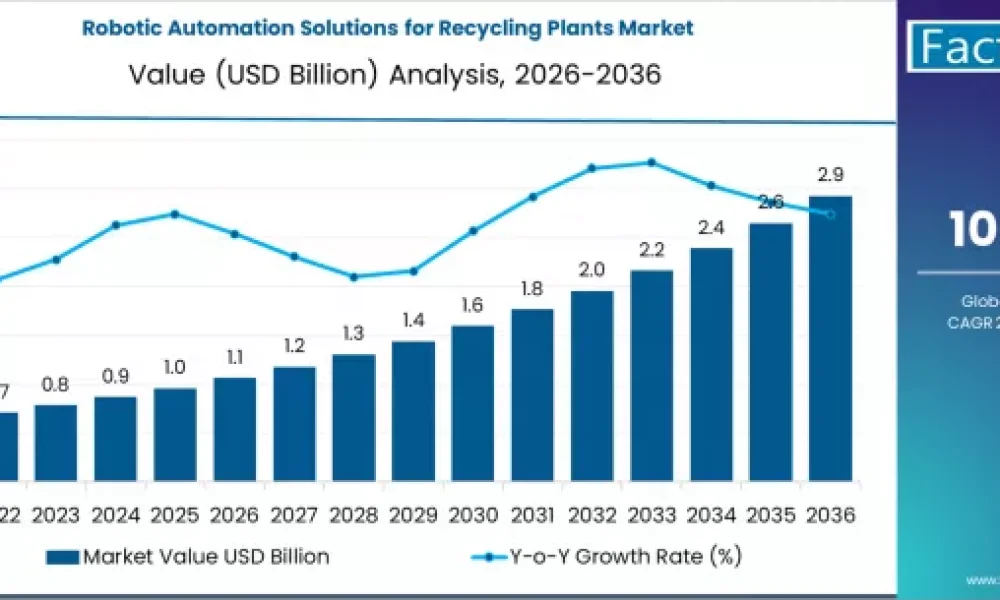
The global Robotic Automation Solutions for Recycling Plants Market is undergoing a profound structural shift, with industry valuations projected to reach USD 1.06 billion by the end of 2026. This rapid growth, characterized by an 18.2% compound annual growth rate (CAGR), marks the transition of recycling facilities from labor-intensive manual sorting to high-throughput, AI-integrated autonomous environments.
This surge is being driven by a convergence of critical factors: chronic labor shortages, tightening landfill-diversion mandates, and a skyrocketing demand for “closed-loop” recycled polymers. As global brands commit to higher percentages of recycled content in their packaging, the burden of purity falls on Material Recovery Facilities (MRFs), which are now turning to robotics to achieve the 99% accuracy levels that manual sorting cannot sustain.
The “Who and Why” of the Automation Wave
The primary adopters of these solutions are Municipal MRFs and Plastic Re-processors, which together account for over 60% of current installations. Industry leaders—including AMP, ZenRobotics (Terex), Machinex, and Bulk Handling Systems (BHS)—are deploying fourth-generation robotic arms capable of performing up to 80 to 100 picks per minute. This nearly doubles the capacity of a human sorter, who typically averages 30 to 45 picks.
The “Why” is rooted in economic survival. With turnover rates in hazardous waste-sorting roles often exceeding 100%, facility managers are utilizing Robotics-as-a-Service (RaaS) models to shift high upfront capital costs (CAPEX) into manageable operating expenses (OPEX). This allows even mid-sized plants to deploy advanced sensors and vision systems that identify not just material types (PET vs. HDPE), but specific brands and packaging formats.
Request for Sample Report | Customize Report |purchase Full Report – https://www.factmr.com/connectus/sample?flag=S&rep_id=13475
Key Market Drivers and Regional Insights
- Regulatory Catalysts: Strict Extended Producer Responsibility (EPR) laws in the European Union and North America are penalizing contaminated waste streams, making high-precision robotic sorting a fiscal necessity.
- Technological Sophistication: In 2026, the market is moving toward “Agentic AI” and Hybrid Multi-Sensor platforms. By combining Near-Infrared (NIR) sensors with 3D laser scanning and hyperspectral imaging, robots can now “see” through flattened containers and identify polymers even when labels are missing or soiled.
- Geographic Leadership: While North America remains the largest market due to early adoption, the Asia-Pacific region—led by China, Japan, and South Korea—is the fastest-growing segment. Rapid urbanization and massive government investments in “Smart City” waste infrastructure are fueling a regional CAGR of over 18%.
Closing the Circular Economy Loop
A significant trend in 2026 is the specialization of robots for Plastic Re-processing. These systems are specifically designed to extract color-sorted PET and HDPE flakes, which command price premiums of up to 30% over mixed-bale equivalents. By isolating high-value resins with surgical precision, robotic automation is making the circular economy economically viable for the first time on a global scale.
“We are no longer just ‘sorting’ trash; we are ‘mining’ commodities,” says a lead industrial automation analyst. “The recycling plant of 2026 is effectively a data-driven factory where every piece of waste is treated as a traceable asset.”
Competitive Landscape and Future Outlook
The market is characterized by a mix of established industrial giants and agile tech startups. Companies like ABB and FANUC provide the robust robotic hardware, while firms like Recycleye and Glacier focus on the “brain”—the AI vision software that allows robots to adapt to ever-changing waste streams in real-time.
As the industry looks toward 2030, the integration of Edge Computing will allow these robots to make split-second decisions locally, reducing dependence on the cloud and further increasing sorting speeds. The market is expected to surpass USD 7.7 billion by 2031, cementing robotic automation as the backbone of global sustainability efforts.
About the Recycling Automation Sector
The Robotic Automation Solutions for Recycling Plants sector focuses on the development of AI-powered systems designed to identify, sort, and process waste materials. By integrating computer vision, machine learning, and high-speed robotics, the industry provides the essential infrastructure needed to reduce landfill reliance and support the global transition to a circular economy.
About Fact.MR
Fact.MR is a global market research and consulting firm, trusted by Fortune 500 companies and emerging businesses for reliable insights and strategic intelligence. With a presence across the U.S., UK, India, and Dubai, we deliver data-driven research and tailored consulting solutions across 30+ industries and 1,000+ markets. Backed by deep expertise and advanced analytics, Fact.MR helps organizations uncover opportunities, reduce risks, and make informed decisions for sustainable growth.



