
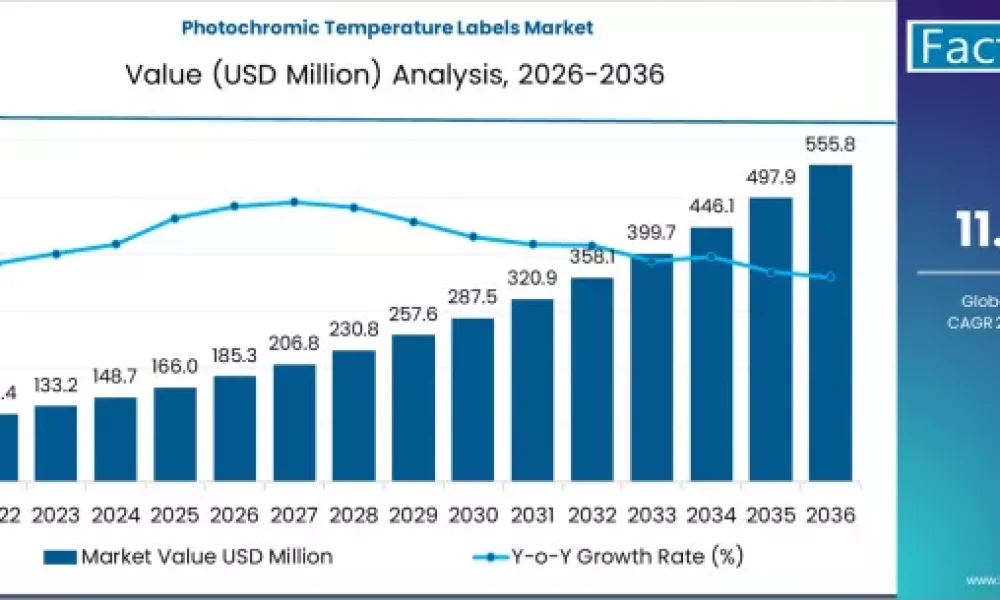
The global Photochromic Temperature Labels Market is entering a decade of sustained expansion as visual compliance becomes a standard requirement for high-stakes logistics. Valued at USD 185.25 million in 2026, the market is projected to reach USD 555.75 million by 2036, advancing at a compound annual growth rate (CAGR) of 11.6%.
This surge represents a fundamental transition in how the pharmaceutical and food industries manage “last-mile” integrity. Rather than relying solely on expensive, battery-powered electronic data loggers, global supply chains are increasingly deploying passive, photochromic indicators. These labels utilize light-sensitive and temperature-responsive inks to provide immediate, irreversible visual evidence of temperature excursions, ensuring safety from the manufacturing floor to the end consumer.
The Critical Role of Visual Temperature Verification
The “Who and Why” of this market shift is centered on the Cold Chain Pharmaceutical sector, which currently commands a 45% market share. With the rise of temperature-sensitive biologics and mRNA-based treatments, healthcare providers require “go/no-go” decision tools that are instantly readable without specialized scanning equipment.
Industry leaders such as Avery Dennison, Toppan, and the Schreiner Group are responding by integrating photochromic technology directly into pressure-sensitive packaging. By utilizing micro-encapsulated dyes that undergo a molecular structural transformation when specific thermal thresholds are breached, these labels bridge the gap between complex digital monitoring and manual inspections.
Request for Sample Report | Customize Report |purchase Full Report – https://www.factmr.com/connectus/sample?flag=S&rep_id=12738
Key Market Drivers and Regional Insights
- Regulatory Rigor: Heightened FDA and EMA standards for the transport of perishable goods have made secondary visual indicators a necessity for audit trails and quality assurance.
- Cost-Efficiency at Scale: Photochromic labels offer a low-cost, scalable alternative for high-volume shipments, particularly in e-commerce grocery delivery where electronic sensors are cost-prohibitive.
- Regional Growth Hubs: While North America and Europe lead in high-spec pharmaceutical applications, the Asia-Pacific region—specifically India and China—is emerging as a growth leader due to rapid urbanization and the expansion of domestic cold-chain infrastructure.
Technological Evolution: Beyond Traditional Indicators
Modern photochromic labels in 2026 are no longer limited to simple color flips. Current innovations include:
- Dual-Stimuli Response: Labels that react to both UV light and temperature, preventing “false positives” and ensuring the indicator was only activated at the point of shipment.
- Precision Thresholds: New ink formulations allow for sharper color contrast at narrow intervals (e.g., ±1°C), crucial for specialized chemical and medical storage.
- Substrate Versatility: Advances in printing technology now allow these reactive inks to be applied to a wide variety of materials, including recycled films and flexible medical pouches.
Market Challenges and Sustainability
Despite the strong growth trajectory, the industry faces headwinds regarding the longevity of reactive dyes under prolonged environmental exposure. Manufacturers are currently focusing on “fatigue-resistant” molecules that maintain accuracy despite repeated handling. Furthermore, the move toward sustainability is pushing the market toward bio-based dyes and liner-less constructions to align with global zero-waste initiatives.
“The photochromic label is becoming the ‘silent guardian’ of the supply chain,” notes a lead analyst in smart packaging. “It democratizes quality control by putting the data directly in the hands of the person receiving the package.”
Competitive Landscape and Investment Outlook
The market remains highly competitive, with a mix of global material science giants and specialized security printers. Strategic partnerships are on the rise, particularly between ink manufacturers like Chromatic Technologies Inc. (CTI) and large-scale converters like UFlex and Brady Corp, to bring “smart” packaging to emerging markets.
As we move toward 2030, the integration of photochromic labels with NFC and QR technology is expected to create a hybrid “Phygital” (physical + digital) monitoring system, further cementing these labels as an essential component of the global logistics ecosystem.
About the Photochromic Temperature Labels Industry
The Photochromic Temperature Labels industry specializes in the development of responsive, color-changing materials used for environmental monitoring. By combining advanced chemical engineering with high-speed printing, the sector provides the food, medical, and industrial industries with reliable, passive tools to verify product safety and thermal compliance.
About Fact.MR
Fact.MR is a global market research and consulting firm, trusted by Fortune 500 companies and emerging businesses for reliable insights and strategic intelligence. With a presence across the U.S., UK, India, and Dubai, we deliver data-driven research and tailored consulting solutions across 30+ industries and 1,000+ markets. Backed by deep expertise and advanced analytics, Fact.MR helps organizations uncover opportunities, reduce risks, and make informed decisions for sustainable growth.



