
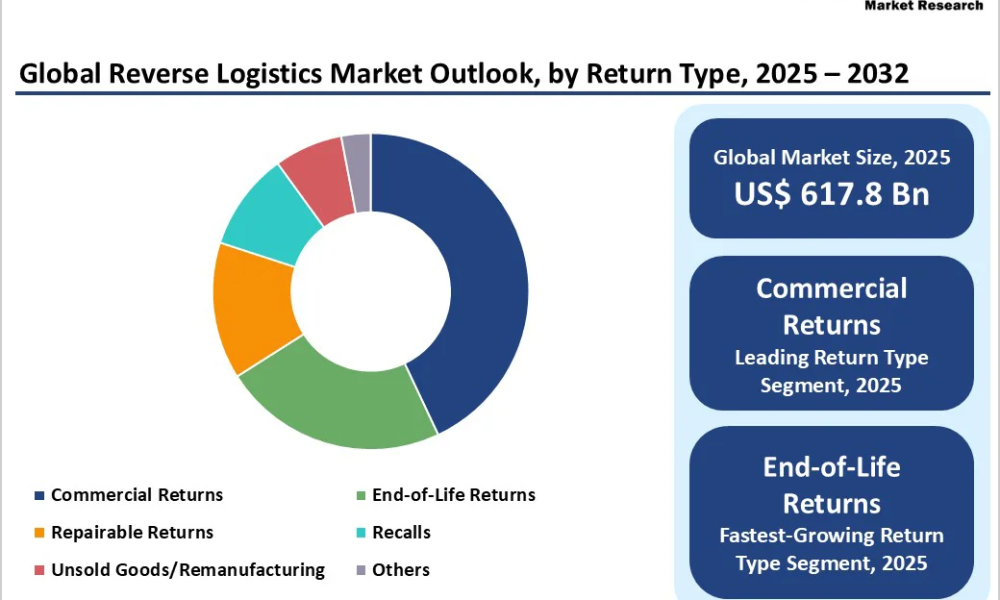
The global reverse logistics market is entering a phase of sustained and structurally driven growth as businesses across industries place increasing emphasis on returns management, asset recovery, recycling, and circular supply chains. In 2025, the global reverse logistics market size is expected to be valued at approximately US$827.1 billion, reflecting the growing scale and complexity of product return flows worldwide. Over the forecast period from 2025 to 2032, the market is projected to expand to US$1,156.1 billion, registering a compound annual growth rate (CAGR) of 4.9%.
This growth trajectory is primarily underpinned by the rapid proliferation of e-commerce operations, which has fundamentally altered consumer purchasing behavior and significantly increased product return volumes. High return rates in online retail, particularly in categories such as apparel, consumer electronics, and home goods, have made efficient reverse logistics capabilities a strategic necessity rather than an operational afterthought. Additionally, tightening sustainability regulations across major economies are compelling manufacturers, retailers, and logistics providers to adopt structured reverse logistics frameworks that enable recycling, refurbishment, remanufacturing, and responsible disposal.
Technological advancements in supply chain management are further accelerating market expansion. The integration of artificial intelligence, advanced analytics, automation, and real-time tracking technologies is enabling organizations to improve visibility, reduce processing costs, and optimize recovery value from returned goods. As reverse logistics transitions from a cost center to a value-generating function, enterprises are increasingly investing in sophisticated solutions that enhance operational efficiency while supporting environmental, social, and governance (ESG) objectives.
Get Your FREE Sample Report Instantly Click Now: https://www.persistencemarketresearch.com/samples/35863
Segmentation Analysis
By Type
By type, the reverse logistics market is broadly segmented into returns management, remanufacturing, refurbishment, recycling, and disposal. Among these, returns management currently represents the dominant segment, driven by the sheer volume of consumer returns generated by e-commerce and omnichannel retail models. Efficient handling of customer returns, including inspection, sorting, and redistribution, has become critical for maintaining customer satisfaction and controlling operational costs.
The recycling and refurbishment segments are expected to witness faster growth during the forecast period, supported by increasing regulatory pressure and corporate sustainability commitments. Electronics, automotive components, and industrial equipment manufacturers are increasingly prioritizing refurbishment and recycling to extend product life cycles and reduce dependency on virgin raw materials. Remanufacturing is also gaining traction in sectors such as automotive and heavy machinery, where high-value components can be restored to original specifications and reintroduced into the supply chain.
By Vehicle, Product, and Service Type
From a product and service perspective, the market encompasses consumer electronics, retail and e-commerce goods, automotive parts, pharmaceuticals, industrial equipment, and packaging materials. The retail and e-commerce goods segment remains the largest contributor to market revenue, reflecting high return rates and the growing adoption of liberal return policies as a competitive differentiator among online retailers.
The consumer electronics segment is emerging as a high-growth area due to the increasing volume of end-of-life devices and the rising importance of secure data destruction, component recovery, and regulatory compliance. Automotive reverse logistics, particularly for batteries, tires, and spare parts, is also expanding steadily, supported by the transition toward electric vehicles and stricter environmental regulations governing waste and emissions.
Service-based offerings, including third-party reverse logistics providers and integrated returns management platforms, are experiencing strong adoption as enterprises seek to outsource complex reverse flows and focus on core business activities.
By Technology and Channel
In terms of technology and operational channels, the market is segmented into traditional reverse logistics systems and digitally enabled reverse logistics platforms. Digitally driven solutions are witnessing faster adoption, driven by the need for real-time visibility, data-driven decision-making, and automation. Cloud-based platforms, integrated with warehouse management systems and transportation management systems, are enabling seamless coordination across multiple stakeholders in the reverse supply chain.
Omnichannel reverse logistics, which integrates online and offline return channels, is gaining prominence as retailers aim to provide flexible and convenient return options while optimizing inventory recovery and redistribution.
Regional Insights
Geographically, North America currently holds a leading position in the global reverse logistics market, supported by a mature e-commerce ecosystem, advanced logistics infrastructure, and early adoption of digital supply chain technologies. The presence of major retailers, technology providers, and third-party logistics companies has contributed to the region’s strong market penetration.
Europe represents another significant market, driven by stringent environmental regulations, extended producer responsibility (EPR) frameworks, and a strong focus on circular economy principles. European enterprises are increasingly investing in reverse logistics capabilities to comply with regulatory mandates and meet sustainability targets.
The Asia-Pacific region is expected to emerge as the fastest-growing market during the forecast period. Rapid growth in e-commerce, expanding manufacturing activity, rising consumer awareness, and improving logistics infrastructure are key factors driving regional expansion. Countries such as China, India, and Southeast Asian economies are witnessing sharp increases in product returns and end-of-life goods, creating substantial demand for scalable reverse logistics solutions. Additionally, government initiatives promoting waste reduction, recycling, and resource efficiency are accelerating market development across the region.
Customize This Report for Your Exact Requirements: https://www.persistencemarketresearch.com/request-customization/35863
Unique Features and Innovations in the Market
Modern reverse logistics solutions are increasingly differentiated by their ability to deliver end-to-end visibility, automation, and value recovery optimization. Unlike traditional, fragmented return processes, contemporary systems are designed to integrate returns management seamlessly into forward supply chains, enabling faster decision-making and reduced cycle times.
Artificial intelligence is playing a pivotal role in enhancing reverse logistics operations by enabling predictive analytics, automated sorting, and intelligent routing of returned goods. AI-driven inspection systems can assess product condition more accurately, determining whether items should be resold, refurbished, recycled, or disposed of. This capability significantly improves recovery rates and minimizes unnecessary handling costs.
The Internet of Things (IoT) is further enhancing traceability and transparency across reverse supply chains. Connected sensors and smart tags allow organizations to track returned products in real time, monitor condition during transit, and optimize warehouse operations. In parallel, the adoption of advanced connectivity technologies is improving data exchange and coordination among manufacturers, retailers, and logistics providers.
Market Highlights
One of the primary reasons businesses are increasingly adopting reverse logistics solutions is the opportunity to reduce operational costs while unlocking new revenue streams. Efficient returns management minimizes losses associated with unsellable inventory, while refurbishment and resale programs enable companies to recover value from returned or end-of-life products.
Sustainability considerations are also a major market driver. Regulatory frameworks mandating responsible waste management, recycling, and emissions reduction are compelling organizations to invest in structured reverse logistics processes. Beyond compliance, many enterprises are leveraging reverse logistics as a strategic tool to enhance brand reputation and meet consumer expectations for environmentally responsible practices.
The growing emphasis on customer experience is another critical factor shaping the market. Flexible and transparent return policies, supported by efficient reverse logistics operations, are increasingly viewed as a competitive advantage in retail and e-commerce.
Key Players and Competitive Landscape
The global reverse logistics market is characterized by the presence of established logistics providers, specialized reverse logistics firms, and technology-driven solution providers. Leading companies are focusing on digital transformation, strategic partnerships, and geographic expansion to strengthen their market positions.
✦ DHL Supply Chain continues to invest in technology-enabled reverse logistics solutions, leveraging advanced analytics and automation to enhance returns processing efficiency across multiple industries.
✦ UPS Supply Chain Solutions focuses on integrated returns management and value recovery services, particularly for retail and healthcare sectors, supported by its extensive global logistics network.
✦ FedEx Logistics is expanding its reverse logistics capabilities through digital platforms and specialized services designed to support e-commerce and high-value product returns.
✦ XPO Logistics emphasizes data-driven optimization and customized reverse logistics solutions, targeting complex industrial and retail supply chains.
✦ DB Schenker is strengthening its position through sustainability-focused reverse logistics offerings, including recycling and circular economy solutions for manufacturing clients.
✦ CEVA Logistics is investing in scalable returns management systems and regional expansion, particularly in emerging Asia-Pacific markets.
✦ Kuehne + Nagel leverages its global footprint and technology expertise to provide end-to-end reverse logistics services, with a strong focus on electronics and industrial sectors.
Recent Developments
✦ Several leading logistics providers have recently launched AI-powered returns management platforms designed to automate inspection, grading, and routing of returned goods, significantly reducing processing times and operational costs.
✦ Major retailers and third-party logistics firms have announced strategic collaborations to develop centralized reverse logistics hubs aimed at improving inventory recovery rates and supporting circular economy initiatives across regional markets.
Ready to Dive Deep? Buy Full Report Today: https://www.persistencemarketresearch.com/checkout/35863
Future Opportunities and Growth Prospects
The future of the reverse logistics market is closely tied to the continued evolution of digital supply chains and sustainability-driven business models. As product life cycles shorten and consumer expectations for seamless returns increase, demand for advanced reverse logistics capabilities is expected to rise steadily.
Emerging technologies such as machine learning, robotics, and advanced analytics will further enhance process efficiency and decision-making accuracy, enabling organizations to maximize value recovery while minimizing environmental impact. At the same time, evolving regulatory frameworks related to waste management, carbon emissions, and producer responsibility will continue to shape market dynamics, encouraging greater investment in compliant and scalable reverse logistics solutions.
Overall, the global reverse logistics market is poised for steady growth through 2032, supported by structural shifts in commerce, technology adoption, and sustainability priorities. As enterprises increasingly recognize reverse logistics as a strategic enabler rather than a cost burden, the market is expected to play a central role in the transformation toward more resilient, efficient, and circular global supply chains.




