
In today’s hyperconnected digital economy, products and pricing alone no longer determine brand success. Customer experience (CX) has emerged as a critical differentiator, shaping brand perception, loyalty, and long-term profitability. Organizations across industries are now investing heavily in Customer Experience Management (CXM) solutions to design, manage, and optimize interactions across every customer touchpoint.
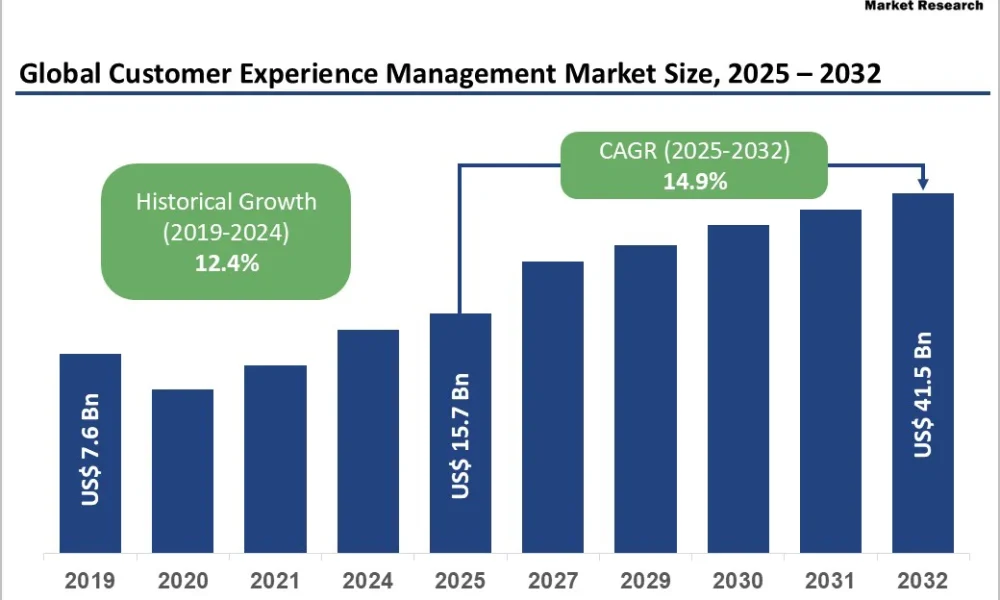
The global customer experience management market is expected to reach US$15.7 billion in 2025 and is projected to expand to US$41.5 billion by 2032, growing at a robust CAGR of 14.9% during the forecast period from 2025 to 2032. This accelerated growth reflects businesses’ increasing focus on delivering personalized, seamless, and consistent omnichannel experiences, fueled by digital transformation, AI adoption, and rising customer expectations.
Market Overview and Growth Outlook
Customer experience management refers to the technologies, platforms, and services that help organizations track, analyze, and improve customer interactions across multiple channels, including call centers, websites, mobile applications, social media, and in-store touchpoints. CXM solutions integrate data, analytics, automation, and AI to enable organizations to understand customer behavior, anticipate needs, and respond proactively.
Historically, the CXM market grew at a CAGR of 12.4% between 2019 and 2024, reflecting early digital adoption and customer-centric business strategies. However, the pace of growth is accelerating as customer journeys become more complex and fragmented.
Key growth drivers include:
- Rapid digitalization across industries
- Rising demand for real-time customer insights
- Proliferation of omnichannel engagement models
- Expansion of e-commerce and mobile commerce
- Increased use of AI, machine learning, and analytics in CX platforms
As organizations compete on experience rather than price, CXM is transitioning from a support function to a strategic enterprise investment.
Key Market Drivers
Rising Customer Expectations
Today’s customers expect frictionless, personalized experiences across all channels. Delays, inconsistent messaging, or poor service can quickly lead to churn. CXM platforms enable businesses to maintain a unified customer view and deliver consistent experiences regardless of touchpoint.
Omnichannel Engagement Expansion
Customers interact with brands through multiple channels—websites, mobile apps, call centers, chatbots, and social media. CXM solutions help integrate these channels into a seamless journey, reducing silos and improving engagement continuity.
AI and Analytics Integration
Advanced CXM platforms leverage AI-powered analytics, sentiment analysis, predictive modeling, and automation to deliver personalized recommendations, proactive support, and real-time insights. These capabilities are becoming essential for large enterprises managing high customer volumes.
Growth of Digital Commerce
Expanding e-commerce activity, mobile-first shopping, and social commerce are increasing the need for personalized digital experiences, driving adoption of CXM platforms across retail and consumer-focused industries.
Elevate your business strategy with comprehensive market data. Request a sample report now: https://www.persistencemarketresearch.com/samples/33042
Market Segmentation Analysis
By Offering: Software Leads, Services Grow Fastest
Software and platforms dominate the CXM market, accounting for over 55% of market share in 2025. These solutions enable organizations to unify customer data, automate engagement workflows, and deploy AI-driven personalization across channels.
Key capabilities include:
- Customer journey orchestration
- Real-time analytics and dashboards
- AI-driven recommendations
- CRM and ERP integration
Meanwhile, services represent the fastest-growing segment, driven by increasing demand for:
- CX strategy consulting
- Digital journey mapping
- Platform integration and customization
- Managed services and analytics support
As CX ecosystems become more complex, organizations increasingly rely on service providers to maximize ROI and accelerate implementation.
By Deployment: On-Premises Dominance, Cloud Accelerates
The on-premises deployment model holds over 47% market share in 2025, particularly among large enterprises and regulated industries. Organizations prefer on-premises CXM solutions for greater data control, enhanced security, and deep customization.
However, cloud-based CXM solutions are growing at the highest CAGR, driven by:
- Scalability and flexibility
- Faster deployment timelines
- Subscription-based pricing models
- Continuous updates and AI innovation
- Improved compliance and security features
As cloud security and regulatory compliance mature, more organizations—especially SMEs—are shifting toward cloud-native CXM platforms.
By Touchpoint: Call Centers Lead, Mobile Apps Surge
Call centers remain the most significant customer interaction channel, accounting for over 32% of market share in 2025. Modern CXM platforms enhance call centers with:
- AI-powered speech analytics
- Predictive call routing
- Real-time agent assistance
- Customer sentiment analysis
Despite call center dominance, mobile applications are the fastest-growing touchpoint segment. With rising smartphone usage and mobile-first consumer behavior, organizations are prioritizing:
- Personalized in-app experiences
- Push notifications and real-time alerts
- Self-service capabilities
- Seamless integration with digital wallets and loyalty programs
Mobile CX is becoming a critical driver of customer retention and engagement.
By Industry: Retail Leads, Healthcare Gains Momentum
Retail and e-commerce account for over 25% of the global CXM market, leveraging CX platforms to deliver personalized shopping journeys, optimize omnichannel retailing, and improve customer loyalty.
Key retail use cases include:
- Personalized product recommendations
- Cart abandonment recovery
- Omnichannel order management
- Loyalty and rewards optimization
Healthcare is one of the fastest-growing CXM segments. The rise of telehealth, digital appointment scheduling, and patient engagement platforms is driving demand for CXM solutions that improve patient experience while ensuring regulatory compliance.
Other major adopting industries include:
- Banking, financial services, and insurance (BFSI)
- Telecommunications
- Travel and hospitality
- Media and entertainment
Regional Analysis
North America: Market Leader
North America dominates the global CXM market with over 38% share, supported by advanced IT infrastructure, early technology adoption, and strong presence of leading CXM vendors. Regulatory frameworks such as CCPA and HIPAA further encourage investments in secure, compliant customer engagement platforms.
The U.S. remains the largest contributor, driven by AI innovation, cloud adoption, and customer-centric business models.
Asia Pacific: Fastest-Growing Region
The Asia Pacific region is projected to grow at the fastest CAGR during the forecast period. Countries such as China and India are leading adoption due to:
- Rapid internet and smartphone penetration
- Expanding e-commerce ecosystems
- Growing middle-class population
- Government-led digital transformation initiatives
Enterprises in Asia Pacific are increasingly investing in scalable, cloud-based CXM platforms to manage high customer volumes and digital engagement
Europe and Other Regions
Europe remains a strong CXM market, driven by GDPR compliance, digital retail growth, and customer-centric regulatory frameworks. Latin America and the Middle East & Africa are emerging markets, offering long-term growth opportunities as digital adoption accelerates.
Competitive Landscape and Innovation Trends
The CXM market is highly competitive, with vendors focusing on innovation, AI integration, and ecosystem partnerships. Key trends shaping competition include:
- AI-driven customer intelligence
- Conversational AI and chatbots
- Real-time personalization engines
- Integration with CRM, ERP, and marketing platforms
- Vertical-specific CX solutions
Vendors are also expanding their service portfolios to offer end-to-end CX transformation rather than standalone software products.
Future Outlook
The future of customer experience management lies in hyper-personalization, predictive engagement, and autonomous CX ecosystems. As AI capabilities mature, CXM platforms will shift from reactive insights to proactive and prescriptive decision-making.
Organizations that invest early in integrated, data-driven CX strategies will gain a sustainable competitive advantage by improving customer loyalty, reducing churn, and increasing lifetime value.
Conclusion
The global customer experience management market is on a strong growth trajectory, expanding from US$15.7 billion in 2025 to US$41.5 billion by 2032 at a CAGR of 14.9%. Driven by rising customer expectations, omnichannel engagement, and AI-powered innovation, CXM has become a strategic priority across industries.
With software platforms leading adoption, cloud deployments accelerating, and Asia Pacific emerging as a high-growth region, the CXM market presents significant opportunities for technology providers and enterprises alike. In an experience-driven economy, organizations that place customers at the center of their digital strategies will define the next era of business success.
Related Reports:




