
Regenerative Thermal Oxidizer Market Overview
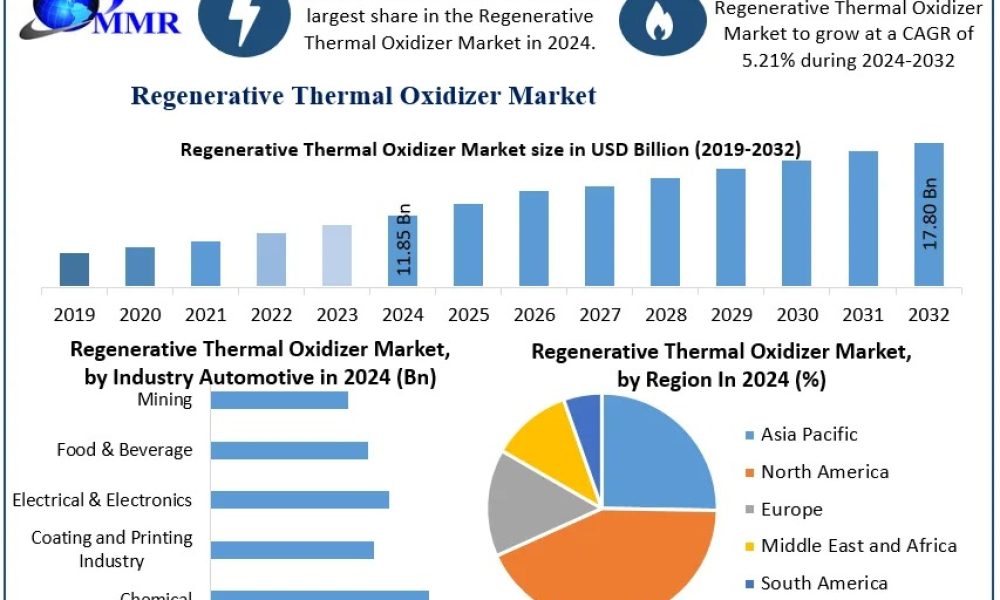
Regenerative Thermal Oxidizer (RTO) Market was valued at approximately USD 11.85 billion in 2024 and is projected to grow to USD 17.80 billion by 2032, growing at a CAGR of 5.21% during the forecast period from 2025 to 2032[attached file, ref: MMR report].
Regenerative thermal oxidizers are critical air pollution control technologies used to treat exhaust streams contaminated with volatile organic compounds (VOCs) and hazardous air pollutants (HAPs) from various industrial sources. RTOs operate by thermally oxidizing pollutants at temperatures above 800°C, converting them into carbon dioxide and water vapor. High thermal efficiency (up to 95%) is maintained by passing exhaust gases through ceramic heat recovery media.
Drivers of Market Growth
Stringent Environmental Regulations: Governments worldwide are imposing tough emission control standards, particularly targeting VOCs and HAPs in industries such as chemical manufacturing, pharmaceuticals, automotive, food processing, and printing.
Sustainability Initiatives: Growing focus on reducing pollution and achieving carbon neutrality drive investments in environmentally compliant technologies like RTOs.
Technological Advancements: Innovations such as multi-bed RTO designs, electric-operated RTO systems, and integration with IoT and automation improve efficiency, reduce operational costs, and enhance performance.
Industrial Expansion in Asia-Pacific: Rapid industrialization and stringent air quality regulations in China, India, Southeast Asia, and other parts of Asia-Pacific accelerate market growth.
Replacement of Conventional Systems: The shift from inefficient flaring and less sustainable oxidizer types to advanced RTOs aids emissions reduction and energy savings.
For full access to the data, request a sample report now :https://www.maximizemarketresearch.com/request-sample/89591/
Market Segmentation
By Type: The market includes single-bed, double-bed, and triple-bed regenerative thermal oxidizers. Triple-bed RTOs dominate due to their superior energy recovery and combustion efficiency, particularly for large-volume applications.
By Industry: Key industries include automotive, chemical, pharmaceutical, printing, food & beverage, mining, electronics, and aerospace.
By Vertical: ESC (Energy Saving Catalytic) devices, thermal exhaust cleaning, among others.
Regional Insights
North America: Holds the largest share, driven by stringent EPA regulations, mature industrial sectors, and strong emphasis on clean technology adoption.
Europe: Growth fueled by EU directives on air quality and sustainability, with Germany, UK, and France as top markets.
Asia-Pacific: Fastest growing region due to industrial proliferation and enhanced environmental policies, especially in China, India, Japan, and South Korea.
Rest of the World: Emerging markets in Latin America, Middle East, and Africa gain traction with industrialization and environmental regulation tightening.
Recent Developments
Installation of high-capacity RTOs in the U.S. by Catalytic Products International, providing 98% VOC destruction with 95% thermal efficiency in paint operation exhaust treatment.
Dürr’s delivery of one of the world’s largest RTO projects in China, comprising seven units with over 2.3 million Nm³/h capacity, exemplifies the scalability of the technology.
Development of newer electric RTO models that eliminate natural gas usage and further reduce emissions.
Challenges
Alternatives such as bio-filters and bio-scrubbers pose competition.
High initial investment and maintenance costs for RTO systems.
Low technology awareness and adoption rates in developing regions hinder growth.
Outlook
With environmental regulations tightening globally and industries focusing on sustainability, the regenerative thermal oxidizer market is set for sustained growth. Innovations improving energy efficiency, performance, and cost-effectiveness will further boost adoption across diverse sectors. North America remains the dominant region, with Asia-Pacific rapidly scaling up installations. By 2032, the market is poised to be a vital component of global clean technology ecosystems, essential for pollution control and sustainable manufacturing.
This detailed analysis highlights RTO market dynamics, segmentation, regional outlook, and technological advances shaping the global landscape through 2032.




