
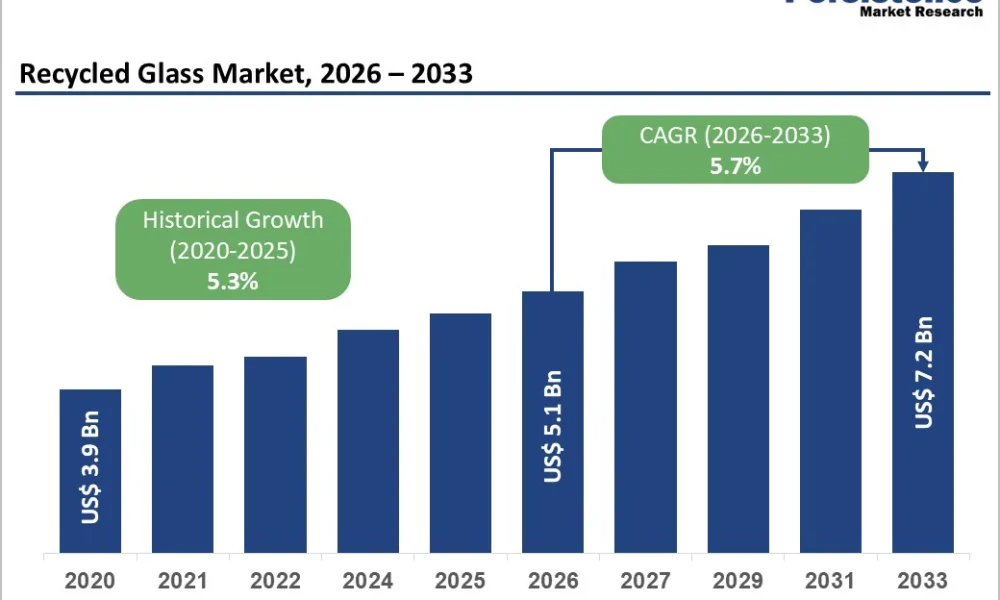
The global Recycled Glass Market is entering a steady growth phase as sustainability mandates and circular economy frameworks reshape the packaging and construction industries. According to Persistence Market Research, the market is projected to be valued at US$5.1 billion in 2026 and is expected to reach US$7.5 billion by 2033, expanding at a CAGR of 5.7% between 2026 and 2033. Growth is being driven by stricter packaging regulations, expanding circular economy mandates, and increasing glass collection and remelt rates across developed economies. Rising environmental awareness and resource efficiency goals are accelerating the adoption of recycled glass across multiple end use sectors.
Recycled glass, often referred to as cullet, is widely used in container glass manufacturing, fiberglass production, and construction aggregates. The leading segment in the market is container glass manufacturing, as recycled glass reduces energy consumption and raw material dependency in bottle and jar production. Developed economies are leading in terms of regional contribution due to well established recycling infrastructure and strong regulatory enforcement. High remelt rates and structured collection systems in these regions support consistent supply and cost efficiency, reinforcing their dominance in the global recycled glass industry.
Get Your FREE Sample Report Instantly – Click Now : https://www.persistencemarketresearch.com/samples/35983
Key Highlights from the Report
➤ The recycled glass market is forecast to expand from US$5.1 billion in 2026 to US$7.5 billion by 2033
➤ The market is projected to grow at a CAGR of 5.7% between 2026 and 2033
➤ Growth is supported by stricter packaging regulations across developed economies
➤ Circular economy mandates are accelerating adoption of recycled glass in manufacturing
➤ Rising glass collection and remelt rates are strengthening supply chain efficiency
➤ Container glass manufacturing remains the leading end use segment
Market Segmentation
The recycled glass market can be segmented based on product type into clear glass, green glass, and amber glass. Clear glass holds a significant share due to its versatility and high demand in food and beverage packaging. Green and amber glass are commonly used in beverage and pharmaceutical containers where light protection is essential. The increasing adoption of recycled cullet in glass bottle production enhances cost savings and reduces carbon emissions, supporting segment growth. Higher remelt efficiency and compatibility with existing furnaces make recycled container glass a preferred raw material.
By end user, the market is segmented into container glass manufacturing, fiberglass production, construction aggregates, and others. Container glass manufacturing dominates due to its continuous demand from beverage, food, and pharmaceutical industries. Fiberglass production is also witnessing steady demand as recycled glass improves insulation performance and reduces energy input. In construction, recycled glass is used in aggregates, tiles, and decorative applications. Growing environmental compliance in infrastructure projects further supports segment expansion and reinforces circular resource utilization practices.
Get Custom Insights Designed for Your Business : https://www.persistencemarketresearch.com/request-customization/35983
Regional Insights
Developed economies are leading the recycled glass market due to established recycling frameworks and high public awareness regarding waste management. Structured collection systems and strong regulatory enforcement ensure consistent supply of recyclable glass. High remelt rates and advanced processing facilities further strengthen regional dominance. Government policies promoting sustainable packaging continue to encourage manufacturers to increase recycled content in production cycles.
Other regions are steadily improving their glass recycling infrastructure to align with global sustainability targets. Expanding urbanization and industrialization are creating new opportunities for recycled glass usage in construction and packaging. While collection efficiency may vary, regulatory reforms and corporate sustainability commitments are expected to enhance adoption rates. Investments in recycling facilities and waste segregation programs are anticipated to improve long term growth prospects across emerging markets.
Market Drivers
The primary driver of the recycled glass market is the implementation of stricter packaging regulations aimed at reducing landfill waste and carbon emissions. Governments across developed economies are enforcing mandatory recycled content targets in packaging materials. These measures encourage manufacturers to incorporate higher proportions of recycled cullet in glass production. Recycled glass reduces energy consumption in furnaces and lowers greenhouse gas emissions compared to virgin raw materials. As sustainability reporting becomes central to corporate strategies, companies are prioritizing recycled inputs to meet environmental goals. Rising consumer awareness regarding eco friendly packaging further strengthens demand for recycled glass products.
Another significant growth driver is the expansion of circular economy mandates. Policymakers are focusing on resource efficiency and waste minimization to create closed loop systems. Recycled glass plays a critical role in these initiatives due to its ability to be remelted repeatedly without quality degradation. Increasing glass collection rates ensure steady availability of cullet for manufacturers. Enhanced sorting and processing technologies are improving yield and quality consistency. These advancements make recycled glass a reliable and cost effective alternative to virgin materials.
Market Restraints
Despite positive growth momentum, the recycled glass market faces certain restraints. One major challenge is contamination during collection and sorting processes. Impurities such as ceramics and metals can disrupt remelting operations and affect product quality. Managing contamination requires advanced sorting technologies and strict quality controls, which can increase operational costs. In regions with underdeveloped recycling infrastructure, inconsistent supply of clean cullet may hinder production efficiency. These factors can limit widespread adoption in some markets.
Transportation and logistics costs also present constraints, particularly in areas where recycling facilities are located far from collection centers. Glass is heavy and bulky, increasing handling expenses. In addition, fluctuations in demand from container glass manufacturers may affect pricing stability. Limited awareness in certain developing economies regarding proper glass segregation can further reduce collection efficiency. Addressing these structural challenges is essential for sustaining long term market growth.
Market Opportunities
The recycled glass market presents strong opportunities driven by sustainability commitments and technological advancements. Increasing investment in advanced sorting systems can enhance cullet purity and processing efficiency. This creates opportunities for recycling companies to expand capacity and improve operational margins. Growing corporate commitments toward carbon neutrality are encouraging manufacturers to increase recycled content in glass products. These sustainability goals open avenues for long term supply contracts and strategic partnerships within the recycling ecosystem.
Rising construction activities also offer growth prospects for recycled glass aggregates and decorative applications. Green building certifications and sustainable infrastructure projects are encouraging the use of recycled materials. Expanding public private collaborations in waste management can improve collection rates and infrastructure development. As environmental regulations continue to tighten, recycled glass is positioned to become a core material in circular manufacturing systems, ensuring sustained demand through 2033.
Checkout Now & Download Complete Market Report : https://www.persistencemarketresearch.com/checkout/35983
Company Insights
Key players operating in the recycled glass market include
- Sibelco
- Strategic Materials, Inc.
- Owens-Illinois
- Ardagh Group
- Verallia
- Vetropack Holding
- Guardian Glass
- AGC Glass
- Nippon Sheet Glass
- Saint-Gobain
- Reiling Glas Recycling
- Momentum Recycling
- Ripple Glass
- Gallo Glass Company
- Visy Industries
- Orora Group
- URRC (United Resource Recovery Corporation)
- Harsco Environmental
Recent Developments
January 2024 A leading recycled glass processor expanded its cullet processing capacity to meet rising remelt demand from container glass manufacturers.
September 2023 A major glass packaging company increased recycled content usage in its production lines to align with circular economy targets.
Future Opportunities and Growth Prospects
The future of the recycled glass market appears stable and growth oriented, supported by regulatory alignment and sustainability commitments. With a projected value of US$7.5 billion by 2033 and a CAGR of 5.7%, the market is poised to benefit from stronger recycling ecosystems and improved remelt technologies. Continuous improvements in collection infrastructure and policy enforcement will further strengthen supply chains. As industries accelerate their transition toward circular production models, recycled glass is expected to remain a cornerstone material in sustainable manufacturing strategies.




