
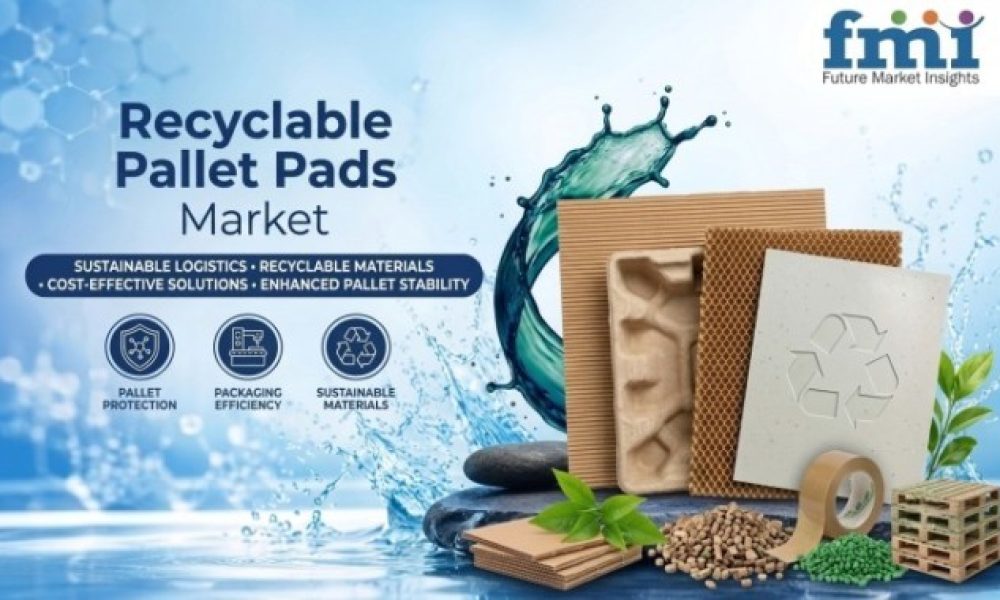
The global Recyclable Pallet Pads Market is projected to grow from USD 648.4 million in 2026 to USD 1,194.5 million by 2036, advancing at a 6.3% CAGR, according to Future Market Insights. Demand is being shaped by the need to protect palletized products while meeting growing expectations around recyclable or reusable packaging systems.
Pallet pads are used to control movement between product layers and support more consistent unit loads. For shippers handling cases, bottles, bags, components, and drums, pad selection increasingly involves more than basic protection. Caliper, friction, compression, moisture tolerance, debris control, and compatibility with palletizing equipment can all affect operating performance.
Load Security Is Becoming Part of the Sustainability Decision
Load movement can result in damaged products, rework, line disruption, or failed receiving requirements. This keeps load stabilization central to pallet pad specifications, while recovery expectations are adding another layer to procurement decisions.
Open distribution networks generally favor recyclable paperboard and molded fiber because the pad leaves the shipper’s control after delivery. Closed-loop systems can support reusable HDPE or PP formats when collection, cleaning, tracking, return logistics, and asset turns are dependable.
The distinction matters because a material being technically recyclable does not automatically mean that every used pad will enter a viable recovery stream. Moisture, contamination, coatings, cleaning requirements, and local collection infrastructure can all influence the end-of-life outcome.
Get detailed market forecasts, competitive benchmarking, and pricing trends:
https://www.futuremarketinsights.com/reports/sample/rep-gb-34236
Recyclable Paperboard Holds the Material Lead
Recyclable Paperboard accounts for 44.0% of the market in 2026. Its position reflects the flexibility available to converters in adjusting caliper, dimensions, die cuts, corners, and surface characteristics without requiring a return network.
Paperboard is particularly relevant to open distribution, where pads can enter local collection systems after a single shipment. However, moisture exposure, waxes, polymer coatings, contamination, and compression can affect recovery performance.
Molded fiber provides another fiber-based option, while recyclable HDPE and PP remain relevant where durability and controlled return systems justify reusable formats.
Tier / Layer Pads Lead Product Types
Tier / Layer Pads represent 40.0% of 2026 market revenue. These pads separate product levels, distribute pressure, reduce abrasion, and provide a consistent stacking and depalletizing surface.
Their broad interface also makes them suitable for standardized pallet patterns. Buyers still need to evaluate thickness, flatness, dust, edge quality, moisture behavior, and automated handling performance before qualification.
Single-Use Recyclable pads account for 56.0% of the reusability segment. Their position reflects the prevalence of open pallet flows, where one-way formats avoid deposits, backhaul space, cleaning, tracking, and loss-related costs.
Food and Beverage Remains a Major Application Environment
Food & Beverage represents 30.0% of market revenue by end use, with bottles, cans, jars, cartons, trays, and bags moving through repetitive pallet configurations.
The operating requirements are demanding. Pads need to remain clean and flat while tolerating moisture and running reliably with fast automated equipment. Paperboard can suit one-way dry shipments, while washable PP or HDPE can be considered for controlled brewery and reusable-container loops.
Direct / OEM supply leads the sales channel with a 41.0% share. Technical qualification is important because pad dimensions, friction treatment, pallet patterns, line speeds, stack heights, and recovery requirements can be connected to wider packaging and automation specifications.
India and China Show Faster Country-Level Growth
Country-level forecasts show different growth rates across established and developing markets. India is projected to grow at an 8.4% CAGR through 2036, followed by China at 7.6% and Brazil at 6.7%.
India’s market development is linked to considerations such as price, load performance, segregation simplicity, and channel partnerships. In China, exporters are focused on thin, consistent formats, high-speed handling, local converting, lot control, and material identification.
The USA and UK are both forecast at 5.9% CAGR, while Germany is projected at 5.7% and Japan at 5.1%.
Analyst Perspective
“The recyclable pallet pads market is moving from broad sustainability claims toward measurable operating performance. Buyers want pads that protect loads, run reliably on automated lines, and have a practical recycling or reuse route after delivery. Paperboard will remain central to open distribution networks, while reusable HDPE and PP pads will gain ground in controlled return loops. Suppliers that connect load stability with recovery economics will be better positioned as the market grows from USD 648.4 million in 2026 to USD 1,194.5 million by 2036.”
Nandini Roy Choudhury, Principal Consultant, Future Market Insights
Competitive Landscape
The competitive environment includes integrated fiber suppliers, reusable-plastic specialists, and regional converters.
Smurfit WestRock, DS Smith, International Paper, and Mondi Group provide integrated fiber and converting capabilities. Sonoco, ORBIS Corporation, and Signode compete through engineered sheets, reusable plastics, and unit-load support. Cascades, Menasha Packaging, and Litco International add regional service and customization.
The report also identifies developments including ORBIS’s April 2024 launch of ORBIShield Eco dunnage using recovered and reprocessed resins, Cascades producing its first roll of 100% recycled containerboard at its Bear Island, Virginia, mill in May 2023, and the April 2024 announcement of the International Paper and DS Smith all-share combination.
Dive Deeper into the Data—View the Full Report Here!
https://www.futuremarketinsights.com/reports/recyclable-pallet-pads-market
What the Report Covers
Future Market Insights analyzes the Recyclable Pallet Pads Market across Material, Product Type, Reusability, Application, End Use, Sales Channel, and Region.
The study covers recyclable paperboard, HDPE, PP, and molded-fiber pads or sheets used on, between, or around palletized layers. The forecast spans 2026 to 2036 and covers North America, Latin America, Western Europe, Eastern Europe, East Asia, South Asia and Pacific, and the Middle East and Africa.
The research combines primary inputs from manufacturers, converters, distributors, packaging and logistics specialists, procurement teams, end users, and subject-matter experts with desk research, market sizing, forecasting, and data validation.
FMI Custom Research: Strategic Intelligence for Confident Decision-Making
In today’s rapidly evolving business environment, leadership teams need more than market data—they need clear, actionable intelligence tailored to their strategic objectives. FMI’s Custom Research solutions are designed around the specific business questions organizations need answered, enabling executives to evaluate growth opportunities, validate investments, assess competitive dynamics, and reduce uncertainty before making critical decisions. By combining deep industry expertise, primary research, and proprietary market intelligence, FMI delivers insights that help organizations move from assumptions to evidence-based strategies with greater speed and confidence.
Business Impact
FMI helps organizations transform market complexity into strategic clarity, enabling leadership teams to identify growth opportunities faster, optimize resource allocation, strengthen competitive positioning, and make high-stakes business decisions with confidence.
To explore how FMI Custom Research can support your strategic priorities, please connect with our team at – [email protected]
About Future Market Insights (FMI)
Future Market Insights, Inc. (FMI) is an ESOMAR-certified, ISO 9001:2015 market research and consulting organization, trusted by Fortune 500 clients and global enterprises. With operations in the U.S., UK, India, and Dubai, FMI provides data-backed insights and strategic intelligence across 30+ industries and 1200 markets worldwide.



