
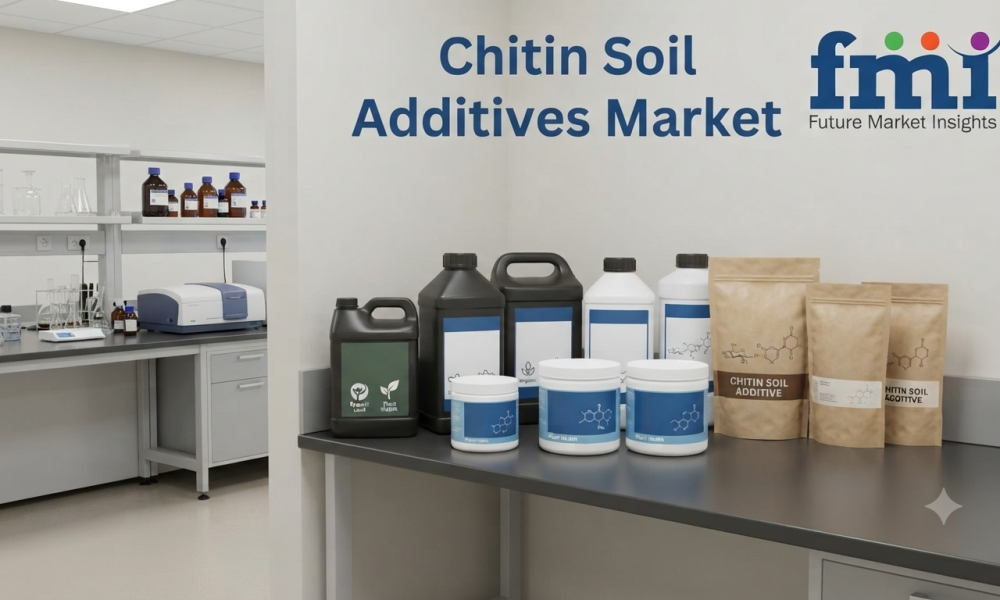
The global chitin soil additives market is projected to reach USD 695.2 million by 2036, up from USD 249.3 million in 2026, expanding at a 10.8% CAGR during the forecast period. Demand is increasing as growers and agronomists evaluate biological soil inputs that combine defined chitin chemistry with crop-specific application guidance, field evidence, and practical distribution channels.
Commercial adoption is increasingly linked to whether formulations solve a clearly identified crop or soil problem and can move through established agricultural sales routes. In February 2025, Tidal Grow AgriScience introduced two chitosan-based crop inputs in Canada after receiving authorization for distribution and sale, demonstrating how regulatory clearance can connect formulation development with commercial availability.
Key Market Drivers
The shift toward lower-chemical farming programs is creating additional evaluation opportunities for chitin-based soil inputs. Growers are assessing biological alternatives alongside established fertilizer, soil-conditioning, and crop-protection programs, but purchasing decisions remain closely tied to cost per treated hectare, application simplicity, and field performance.
Feedstock consistency is another important factor. Agronomists require predictable composition and application rates before moving from small trials to routine use. Products that combine standardized material characteristics with clear crop-specific recommendations can therefore address one of the principal barriers to repeat purchasing.
Regulatory and qualification pathways are also shaping commercialization. In April 2025, the European Food Safety Authority noted that European Union rules authorize chitin for use as a fertilizer, soil conditioner, and nutrient, while national chitosan and chitin biostimulant authorizations provide additional routes for agricultural applications.
Get detailed market forecasts, competitive benchmarking, and pricing trends: https://www.futuremarketinsights.com/reports/sample/rep-gb-34998
Product and Crop Insights
Raw-crude extract grades are estimated to account for 40.0% of the market in 2026, supported by their suitability for direct soil-amendment applications and cost-sensitive field programs. Their commercial relevance depends on consistent composition and the ability to integrate with existing soil-management practices.
By crop type, cereals and grains are expected to hold a 36.9% share in 2026. Large treated acreage makes cost efficiency, straightforward application, and compatibility with existing fertility operations particularly important for cereal producers.
By application method, soil application is forecast to account for 44.3% of demand in 2026. Direct placement within the root zone allows agronomists to evaluate chitin products alongside established soil-conditioning and biological-input programs.
The agri-input distributor channel is projected to capture 42.4% share in 2026. Local distributors and agronomists can provide technical guidance on application rates, timing, and compatibility, helping manufacturers convert field trials into repeat commercial orders.
Regional Market Outlook
Country-level market conditions differ according to crop systems, regulatory requirements, certification practices, and distribution structures.
The United States is forecast to expand at a 10.5% CAGR, supported by its large commercial crop base and established specialty-input distribution networks. South Korea follows with a projected 10.2% CAGR, while Germany is expected to register 9.9% CAGR as professional agricultural operations provide opportunities for structured field evaluation.
The UK is projected to grow at 9.6% CAGR, supported by increasing consideration of biological inputs within documented farm-management programs. Japan is forecast to expand at 8.8% CAGR, with localized field evidence and clear application guidance remaining important to distributor adoption.
Germany also illustrates the importance of an established organic farming base. The country recorded approximately 1.8 million organic hectares in 2024, representing 11.1% of agricultural area. Such conditions provide a meaningful environment for trials, although repeat purchasing continues to depend on product documentation and field economics.
Challenges and Opportunities
The market faces challenges related to feedstock variation, formulation consistency, regulatory qualification, application-rate validation, and the cost of building technical distribution networks. Manufacturers must demonstrate that products can deliver reproducible results under commercial field conditions rather than relying solely on the biological attributes of chitin or chitosan.
At the same time, standardized formulations create opportunities for manufacturers to build repeat purchasing models. Partnerships with established agricultural distributors can reduce market-entry friction by providing access to growers and agronomists already familiar with biological inputs.
Analyst Perspective
“Chitin soil additives earn repeat orders after formulation teams turn material chemistry into application rates that agronomists can test under commercial field conditions. Commercial value depends on stable composition and crop-level evidence because growers compare cost per treated hectare before extending a trial into routine use.”
— Nikhil Kaitwade, Principal Consultant, Future Market Insights
Access the Complete Report in PDF Format: https://www.futuremarketinsights.com/reports/brochure/rep-gb-34998
Competitive Landscape
The competitive landscape includes agricultural chitin and chitosan formulators, insect-frass fertilizer producers, biological-input companies, and specialized distribution and crop-protection businesses.
Key companies profiled include Tidal Grow AgriScience, Sym-Agro Inc., REPLOID Group AG, Innovafeed, HiProMine S.A., Novochizol SA, Cascade Columbia Distribution, and FytoFend SA.
Recent developments include REPLOID Group AG securing inclusion of AgriVio insect-frass fertilizer in the German Input List in December 2025, Novochizol SA and Aquagri launching AgrINovo in August 2025, and Sym-Agro Inc. launching KitoGard as a soil-applied chitosan nematicide in May 2025.
Report Scope
The Chitin Soil Additives Market report covers product type, crop type, application method, farm type, sales channel, and regional markets. The study covers 2026 to 2036 and provides analysis across North America, Latin America, Europe, East Asia, South Asia and Pacific, and the Middle East and Africa.
The market is defined around commercial chitin-containing or chitosan-derived soil additives and agricultural formulations used to influence soil, root-zone, or crop-input performance within the defined market boundaries. The research combines primary and secondary research, market triangulation, market sizing, forecasting, and data validation.
About Future Market Insights
Future Market Insights (FMI) is an ESOMAR-certified and ISO 9001:2015-certified market intelligence and consulting organization. FMI provides syndicated and customized research across more than 30 industries, covering over 1,200 markets. Its research supports manufacturers, investors, procurement leaders, technology providers, and business executives with data-driven insights for strategic decision-making.
Have a specific Requirements and Need Assistant on Report Pricing or Limited Budget please contact us – [email protected]



