
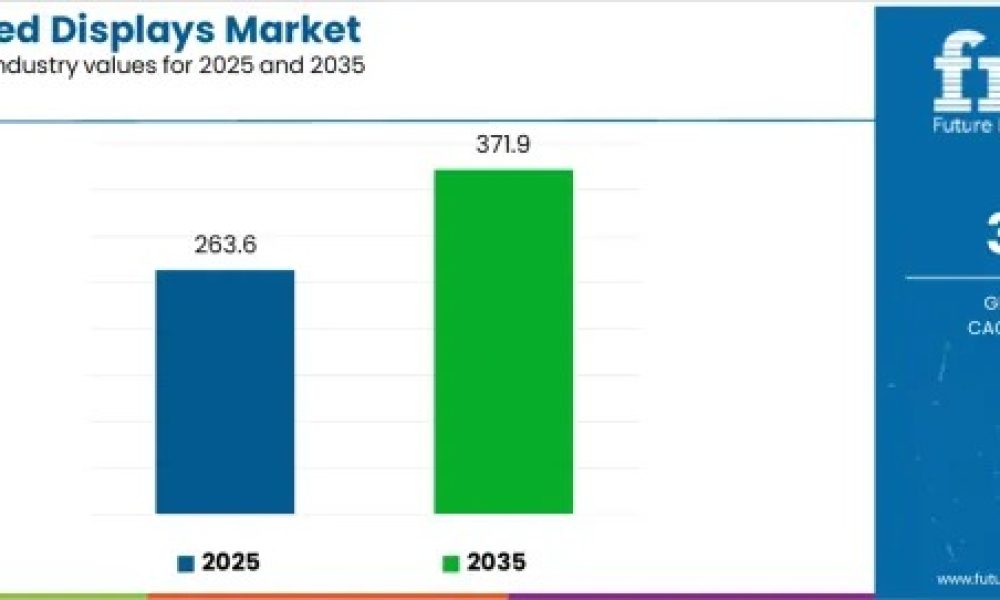
The global radar speed displays market is set to maintain a steady and resilient growth trajectory over the next decade, underpinned by sustained investments in traffic safety, urban infrastructure modernization, and intelligent transportation systems. Market demand is projected to expand from USD 263.6 million in 2025 to USD 371.9 million by 2035, reflecting a compound annual growth rate (CAGR) of 3.5%. While growth remains measured rather than explosive, compound absolute value analysis highlights meaningful cumulative revenue expansion driven by consistent deployment and technological enhancement across regions.
Between 2025 and 2030, the market is expected to record stable value accumulation as governments and transportation authorities continue to deploy radar speed displays as core tools in traffic management and accident prevention programs. Road safety initiatives, including Vision Zero–style frameworks and national speed-reduction campaigns, remain a key catalyst during this phase. Urban infrastructure development—particularly in highways, arterial roads, school zones, and residential areas—supports early adoption, contributing to a predictable increase in installed base and recurring replacement demand.
From 2030 to 2035, compound growth continues as emerging economies expand road networks and integrate intelligent traffic systems into new and existing infrastructure. During this period, the market benefits not only from geographic expansion but also from technology-led upgrades, including solar-powered displays, wireless connectivity, and improved radar accuracy. These innovations enhance lifecycle value, improve operational efficiency, and broaden applicability across urban, suburban, and temporary deployment environments. The resulting absolute value gain over the decade reflects balanced, incremental expansion rather than abrupt surges, reinforcing the market’s long-term stability.
Fixed Type Displays Anchor Market Fundamentals
Fixed type radar speed display systems dominate the market, accounting for approximately 62% of total revenue in 2025. Their leadership is rooted in permanent installation advantages, high visibility, and compatibility with established traffic management infrastructure. Highway applications, in particular, rely heavily on fixed displays to provide continuous speed monitoring, reinforce compliance, and deliver measurable safety outcomes.
These systems benefit from proven radar processing technologies, durable construction, and the ability to integrate power and communication modules—often incorporating solar energy solutions to reduce operating costs. With uptime levels typically reaching 95–98%, fixed type displays remain the preferred option for transportation authorities seeking long-term reliability and predictable performance.
Get access to comprehensive data tables and detailed market insights — request your sample report today!
Mobile trailer-mounted systems hold around 28% market share, serving construction zones, temporary traffic control, and short-term safety initiatives. Their portability and rapid deployment capabilities make them essential for dynamic environments, while ongoing enhancements in wireless connectivity and power efficiency are improving their appeal. Portable battery-powered units, though smaller in share, continue to serve niche applications such as special events and pilot traffic programs.
Highway Applications Drive Core Demand
By application, highways represent the leading segment with roughly 36% market share and an estimated 4.2% CAGR, reflecting the prioritization of speed monitoring on high-volume corridors and interstate systems. Highway operators value radar speed displays for their visibility consistency, enforcement support, and compatibility with federal and state transportation standards.
State-level highway expansion programs increasingly include radar speed displays as standard components of traffic safety infrastructure. Integration with intelligent transportation systems (ITS) further enhances their role, enabling data collection, performance monitoring, and centralized reporting that support evidence-based traffic management strategies.
City road applications account for approximately 35% of demand, driven by traffic calming requirements in residential zones, school areas, and municipal streets. Construction and work zones contribute around 18%, relying heavily on mobile and temporary installations to protect workers and manage speed compliance in evolving environments.
Regional Growth Concentrated in Developed and Rapidly Urbanizing Markets
Geographically, growth remains concentrated in East Asia, North America, and Western Europe, where established traffic management infrastructure and regulatory frameworks support consistent adoption. East Asia stands out as a growth leader, with China posting an estimated 4.7% growth rate driven by aggressive infrastructure development and smart city initiatives. India follows closely at 4.4%, supported by urbanization, highway expansion, and government-led traffic modernization programs.
Developed European markets such as Germany (4.0%) and the United Kingdom (3.0%) continue to invest in premium, integrated display systems aligned with safety and compliance requirements. The United States, while a mature market, maintains steady growth at 3.3%, supported by established regulatory standards, infrastructure renewal, and ongoing technology upgrades across highways and municipalities.
Technology and Policy Shape Market Direction
Several structural drivers continue to reinforce demand. Traffic safety initiatives and accident reduction targets remain the most influential, requiring effective speed awareness tools with proven behavioral impact. Infrastructure modernization and smart city development are transforming radar speed displays from standalone devices into connected assets within broader traffic ecosystems.
Key trends shaping the market include solar power integration, which enables off-grid operation and reduces lifecycle costs, and data analytics and IoT connectivity, which allow authorities to move beyond basic speed display toward intelligent monitoring and reporting. These features are increasingly differentiating suppliers and opening higher-margin opportunities through service contracts, analytics platforms, and integration support.
Budget constraints, particularly among smaller municipalities, and competition from alternative traffic calming measures such as speed bumps and enforcement cameras remain moderating factors. However, the flexibility, visibility, and non-punitive nature of radar speed displays continue to support their role as complementary safety solutions.
Competitive Landscape Favors Integrated Solutions
The radar speed displays market comprises 15–20 credible players, with the top tier controlling an estimated 60–65% of total revenue. Companies such as Ver-Mac, All Traffic Solutions, Traffic Logix, and TAPCO maintain leadership through strong distribution networks, reliable product portfolios, and continuous innovation in radar accuracy and display visibility.
As basic display construction becomes increasingly commoditized, competitive advantage is shifting toward end-to-end traffic solutions, including mounting systems, power supplies, connectivity modules, installation support, and ongoing monitoring services. Providers that align products with traffic workflows and smart city platforms are best positioned to capture long-term value.
Outlook: Consistent Value Accumulation in a Stable Market
Overall, the radar speed displays market demonstrates predictable compound growth, supported by policy-driven demand, steady infrastructure investment, and incremental technological improvement. While not characterized by rapid expansion, the market’s reliability, visibility, and long-term relevance to traffic safety create sustained opportunities for suppliers, integrators, and service providers worldwide.
With market value expected to reach USD 371.9 million by 2035, radar speed displays remain a foundational component of modern traffic management—delivering cumulative value through continuous deployment, innovation, and integration into intelligent transportation ecosystems.
About Future Market Insights (FMI)
Future Market Insights, Inc. (FMI) is an ESOMAR-certified, ISO 9001:2015 market research and consulting organization, trusted by Fortune 500 clients and global enterprises. With operations in the U.S., UK, India, and Dubai, FMI provides data-backed insights and strategic intelligence across 30+ industries and 1200 markets worldwide.



