
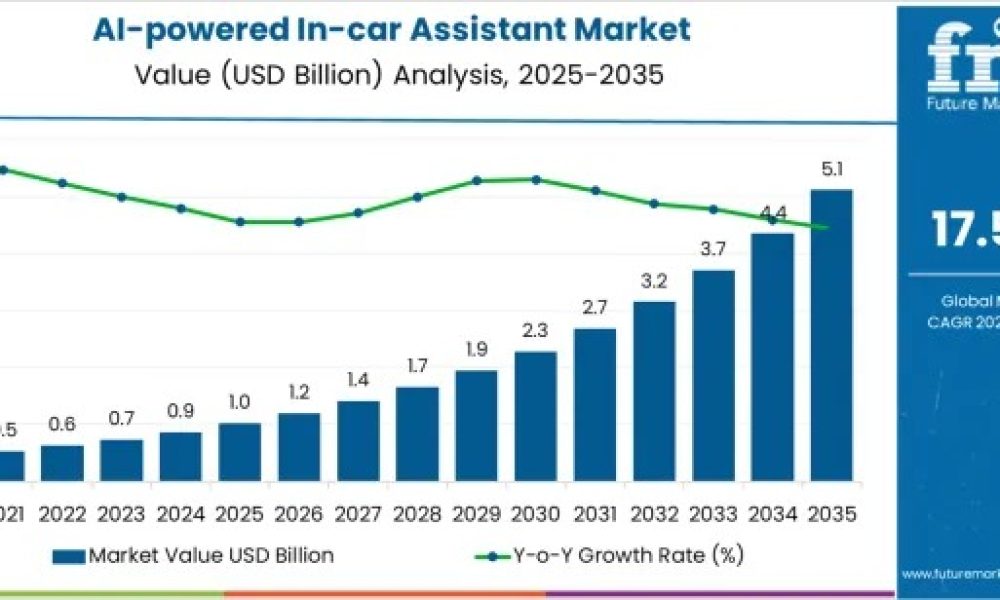
The global AI-powered in-car assistant market is set for rapid expansion, growing from USD 1 billion in 2025 to USD 5.1 billion by 2035, representing an absolute increase of USD 4 billion over the forecast period. This translates into 401.5% total growth and a robust CAGR of 17.5%, underscoring the accelerating role of artificial intelligence in reshaping vehicle cockpit experiences worldwide.
Market growth is being driven by the rising adoption of connected vehicle technologies, expanding use of voice-activated and conversational AI systems, and increasing consumer preference for hands-free, intelligent driver assistance solutions across both OEM and aftermarket channels. AI-powered in-car assistants are rapidly transitioning from optional infotainment features to core digital interfaces that enhance safety, convenience, and user engagement.
Intelligent Cockpits Redefine Automotive User Experience
As automotive interiors evolve into software-defined, connected environments, traditional control interfaces are giving way to natural language-based interaction systems. AI-powered assistants now function as central control hubs for navigation, infotainment, vehicle diagnostics, climate control, and contextual driver support. Their ability to reduce driver distraction while improving operational efficiency is reinforcing adoption across passenger, commercial, and fleet vehicle segments.
Consumer demand reflects a broader shift toward smart mobility ecosystems, where personalization, voice recognition accuracy, and contextual awareness are increasingly valued. Advanced AI assistants deliver both functional benefits and perceived safety enhancements, supporting sustained demand across multiple vehicle categories.
Get access to comprehensive data tables and detailed market insights — request your sample report today!
Conversational AI and OEM Integration Lead Market Adoption
By type, conversational AI dominates the market with a 63.4% share, reflecting its superior natural language processing capabilities, contextual understanding, and high user acceptance. These systems form the backbone of modern in-car assistant platforms, enabling seamless interaction across diverse driving conditions and vehicle architectures.
From an application standpoint, OEMs and Tier-1 suppliers account for 71.8% of total market demand, as vehicle manufacturers prioritize factory-integrated AI solutions to differentiate models, standardize digital features, and ensure consistent performance at scale. Full system integration and hybrid cloud-edge deployment models are becoming increasingly common to support real-time responsiveness and over-the-air updates.
Asia-Pacific Emerges as High-Growth Engine
Regionally, adoption patterns vary, with North America and Europe demonstrating strong uptake of premium voice-controlled systems, while Asia-Pacific emerges as the fastest-growing region. China (23.6% CAGR), India (21.9%), and Germany (20.1%) are identified as key growth markets, driven by aggressive smart vehicle adoption, expanding AI investment, and rising consumer demand for advanced digital cockpit experiences.
Premium and luxury vehicle manufacturers continue to lead implementation, reflecting consumer willingness to pay for enhanced connectivity, personalization, and intelligent interaction features.
Competitive Landscape Driven by AI Innovation and OEM Partnerships
The competitive environment includes established technology leaders and specialized automotive AI providers focused on machine learning, natural language processing, and multi-modal interaction systems. Key players such as Cerence, Google, VW-Mobvoi, Stellantis, TomTom, Sensory, SoundHound AI, Baidu, Alibaba, and iFLYTEK are competing through platform innovation, cloud-edge integration, and strategic OEM partnerships.
Market consolidation is accelerating as major automotive suppliers acquire AI specialists to strengthen digital capabilities and accelerate time-to-market. Personalized assistant configurations, driver-specific voice recognition, and context-aware intelligence are emerging as critical differentiators.
Outlook Through 2035
As connected mobility, autonomous driving development, and software-defined vehicles gain momentum, AI-powered in-car assistants are positioned as strategic enablers of next-generation automotive experiences. Continuous advancements in conversational AI, personalization, and cloud integration will reinforce their role as foundational components of intelligent vehicle ecosystems—supporting strong, sustained market growth through 2035 and beyond.
About Future Market Insights (FMI)
Future Market Insights, Inc. (FMI) is an ESOMAR-certified, ISO 9001:2015 market research and consulting organization, trusted by Fortune 500 clients and global enterprises. With operations in the U.S., UK, India, and Dubai, FMI provides data-backed insights and strategic intelligence across 30+ industries and 1200 markets worldwide.



