
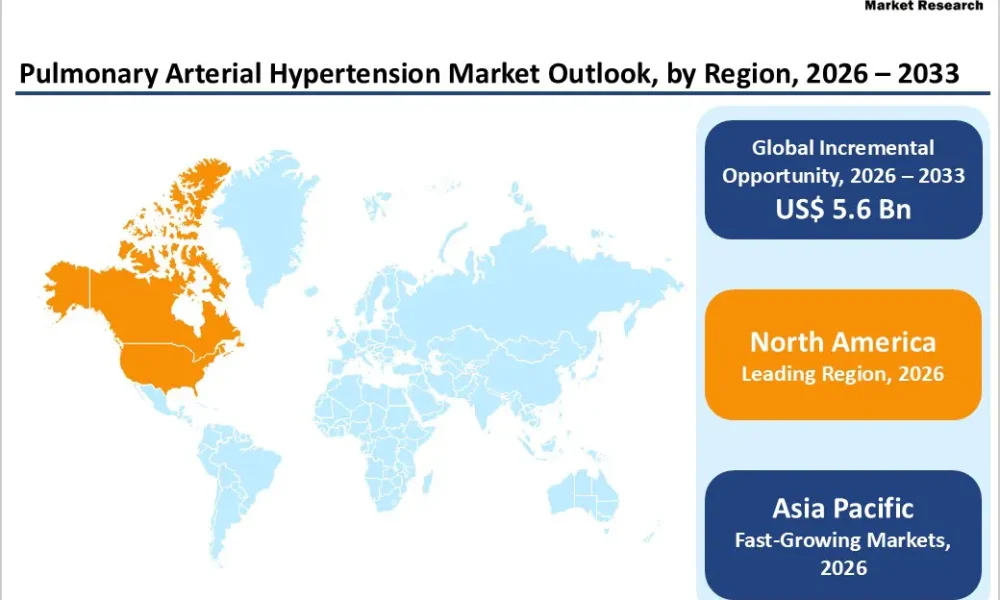
The global pulmonary arterial hypertension (PAH) market is witnessing substantial growth, with the market size estimated at US$ 8.7 billion in 2026 and projected to reach US$ 14.3 billion by 2033, registering a CAGR of 5.7% during the forecast period. Pulmonary arterial hypertension is a progressive and debilitating cardiovascular condition characterized by elevated blood pressure in the pulmonary arteries, leading to right heart failure and reduced survival if left untreated. The increasing prevalence of risk factors, including connective tissue disorders, congenital heart disease, genetic predispositions, and chronic cardiopulmonary conditions, has contributed to the expansion of the patient population globally. Advances in cardiopulmonary diagnostics, early detection, and guideline-based treatment strategies are driving the demand for PAH-specific therapies. The market is further supported by the ongoing shift toward patient-centric approaches, oral administration, combination therapies, and innovative pharmacological interventions.
Download Your Free Sample & Explore Key Insights: https://www.persistencemarketresearch.com/samples/33199
Market Drivers
The growth of the pulmonary arterial hypertension market is primarily driven by increasing disease awareness, enhanced diagnostic capabilities, and the adoption of targeted combination therapies. Non-invasive diagnostic modalities such as echocardiography, right heart catheterization, and biomarker-driven risk assessment have significantly improved early detection, particularly among high-risk populations. Clinical guidelines now emphasize early intervention and escalation to combination therapy, including endothelin receptor antagonists, prostacyclin analogs, PDE-5 inhibitors, and soluble guanylate cyclase (sGC) stimulators. The availability of oral and patient-friendly regimens has enhanced adherence and long-term therapy continuation, while specialized pulmonary hypertension centers provide comprehensive care that supports optimal treatment outcomes. Favorable reimbursement policies in developed markets and inclusion of PAH under rare disease frameworks further encourage uptake of high-cost therapies.
Market Restraints
Despite positive growth trends, the pulmonary arterial hypertension market faces challenges related to high treatment costs, complex administration, and delayed diagnosis. Advanced prostacyclin formulations and combination regimens often involve significant financial burdens for patients and healthcare systems, particularly in regions with limited reimbursement coverage. Parenteral and inhaled therapies require complex dosing, continuous monitoring, and intensive management, which can limit patient compliance. Additionally, early-stage symptoms of PAH often mimic other cardiopulmonary conditions, leading to delayed diagnosis and late-stage treatment initiation. In emerging markets, restricted access to specialized diagnostic tools and trained specialists further hampers timely intervention. Adverse effects associated with certain drug classes, including hypotension, gastrointestinal symptoms, and infusion-site complications, also impact treatment persistence. Regulatory hurdles and prolonged clinical development timelines pose additional constraints on market growth.
Market Opportunities
Significant opportunities exist in the pulmonary arterial hypertension market through innovation in disease-modifying therapies and expansion into emerging regions. Novel biologics, next-generation prostacyclin formulations, and activin signaling inhibitors are expected to improve clinical outcomes, patient adherence, and dosing convenience. Oral and inhaled therapies with extended duration of action and reduced side effects are increasingly adopted in earlier disease stages, further broadening the treatment landscape. Advances in genetic testing, biomarker-based risk stratification, and digital health monitoring enable personalized therapy approaches. Emerging economies in Asia Pacific, Latin America, and the Middle East present strong growth potential due to rising healthcare investment, improving reimbursement mechanisms, and the expansion of specialty care infrastructure. Public–private collaborations, local manufacturing, and generic introduction are improving affordability and accessibility, while regulatory support for orphan drugs is accelerating innovation in the PAH therapeutic space.
Market Segmentation by Drug Class
Prostacyclin and Prostacyclin Analogs
Prostacyclin and prostacyclin analogs lead the pulmonary arterial hypertension market, projected to account for 44.8% of revenue in 2026. These agents are highly effective in managing moderate-to-severe PAH, improving hemodynamics, exercise capacity, and long-term survival. They are primarily prescribed for advanced-stage patients or those showing inadequate response to oral monotherapy. Availability in multiple delivery formats, including intravenous, subcutaneous, inhaled, and oral formulations, enhances patient flexibility and adherence. Innovations in long-acting formulations, improved delivery systems, and next-generation prostacyclin therapies further support their continued dominance. Clinical guideline endorsements and adoption in combination regimens reinforce their market leadership throughout the forecast period.
Soluble Guanylate Cyclase (sGC) Stimulators
sGC stimulators are the fastest-growing drug class segment due to increasing adoption for earlier-stage treatment and combination therapy. Clinical trials and guideline recommendations highlight favorable outcomes in terms of exercise capacity, functional class improvement, and reduced disease progression. Their growth is also supported by patient-friendly oral dosing, convenient combination strategies, and expanding prescriber familiarity in both developed and emerging markets.
Get Custom Insights Designed for Your Businecss: https://www.persistencemarketresearch.com/request-customization/33199
Market Segmentation by Route of Administration
Oral Therapies
Oral administration remains the dominant segment in the PAH market, capturing an estimated 66.0% revenue share in 2026. Oral therapies are preferred due to their ease of use, suitability for long-term outpatient management, and improved adherence compared to parenteral regimens. Endothelin receptor antagonists, PDE-5 inhibitors, and sGC stimulators are commonly prescribed orally across early- and intermediate-risk patient populations. Once-daily dosing, fixed-dose combinations, and safer profiles are increasing oral therapy uptake, supported by hospital and retail pharmacy distribution along with robust reimbursement coverage.
Intravenous Therapies
Intravenous administration is witnessing renewed growth, particularly in severe, pediatric, or complex PAH cases where oral therapy is inadequate. Hospital-based administration ensures continuous monitoring, dose titration, and adverse event management. Despite higher complexity, IV therapies remain critical for advanced disease management and emergency care settings, reinforcing their relevance in specialized pulmonary hypertension centers.
Market Segmentation by Distribution Channel
Hospital pharmacies dominate the PAH market, accounting for an estimated 58.0% of revenue in 2026. Hospitals serve as primary hubs for diagnosis, treatment initiation, and long-term management due to access to right heart catheterization, advanced imaging, and multidisciplinary care teams. High-cost prostacyclin therapies and combination regimens are often dispensed through hospital pharmacies, ensuring therapy titration and safety monitoring. Government-supported rare disease programs and favorable reimbursement policies further reinforce hospital pharmacies as the preferred distribution channel.
Regional Market Insights
North America
North America leads the global PAH market with a 47.7% share in 2026, driven by the U.S. Advanced healthcare infrastructure, high diagnostic penetration, and widespread access to specialized treatment centers support early diagnosis and therapy adoption. Strong reimbursement coverage, patient advocacy networks, and physician education programs enhance adherence and clinical outcomes. Leading pharmaceutical companies, robust R&D investment, and rapid commercialization of novel therapies further solidify regional dominance. Continuous guideline updates and digital patient monitoring initiatives ensure sustained market leadership.
Europe
Europe exhibits steady growth supported by well-established public healthcare systems and specialized hospital networks. Countries such as Germany, the U.K., France, Italy, and Spain lead adoption through structured referral pathways and early disease detection initiatives. National coverage ensures access to both oral and parenteral therapies, supporting consistent adherence. Increasing use of combination therapy, growing adoption of inhaled and oral prostacyclin formulations, and emphasis on risk-based escalation drive market expansion. Collaborative research and professional training further enhance management of complex PAH cases across the region.
Asia Pacific
The Asia Pacific market is the fastest-growing region, with a projected CAGR of approximately 7.7% from 2026 to 2033. Growth is driven by rising healthcare expenditure, improved access to echocardiography and tertiary care centers, and expanding specialty cardiopulmonary infrastructure in countries including China, India, Japan, South Korea, and Australia. Government investments in hospital infrastructure and rare disease programs enhance therapy adoption, while local manufacturing and generics improve affordability. Physician training, digital health platforms, and reimbursement initiatives further increase treatment penetration. Increased patient awareness and early intervention strategies position Asia Pacific as a key growth driver in the global PAH market.
Checkout Now & Download Complete Market Report: https://www.persistencemarketresearch.com/checkout/33199
Competitive Landscape
The pulmonary arterial hypertension market is highly competitive, featuring key players such as United Therapeutics Corporation, Bayer AG, Gilead Sciences, Inc., Merck & Co., Inc., Pfizer Inc., Johnson & Johnson, Viatris Inc., GSK Plc., Sandoz Group AG, Lupin Pharmaceuticals, Inc., Sun Pharmaceutical Industries Ltd, Teva Pharmaceutical Industries Ltd, and Shubham Pharmachem Pvt Ltd. These companies focus on targeted therapies including prostacyclin analogs, endothelin receptor antagonists, PDE-5 inhibitors, and sGC stimulators, along with combination regimens and patient-centric formulations designed to enhance adherence and outcomes. Continuous innovation in clinical efficacy, safety, and regulatory compliance remains critical for maintaining competitive positioning.
Key Developments
In June 2024, the FDA approval of sotatercept marked a major advancement for PAH therapy, supported by clinical trials conducted by UCHealth and the University of Colorado. In March 2024, Merck received FDA approval for WINREVAIR™ (sotatercept-csrk) to improve exercise capacity, functional class, and reduce clinical worsening in adults with WHO Group 1 PAH. WINREVAIR, the first activin signaling inhibitor for PAH, represents a breakthrough in disease-modifying therapy and highlights the innovation pipeline in the global PAH market.
Conclusion
The pulmonary arterial hypertension market is poised for robust growth over the forecast period, driven by increasing disease awareness, early diagnosis, and adoption of advanced therapies. Prostacyclin analogs continue to lead the market due to their efficacy in advanced PAH, while sGC stimulators show rapid growth owing to guideline-supported early-stage use. Oral administration dominates due to convenience and long-term management benefits, while hospital pharmacies remain the primary distribution channel. North America retains market leadership, Europe sustains steady growth, and Asia Pacific emerges as the fastest-growing region. Innovation in disease-modifying therapies, improved diagnostics, and expansion into emerging markets offer significant growth opportunities. Despite challenges such as high treatment costs, complex administration, and delayed diagnosis, ongoing R&D, patient-centric approaches, and supportive reimbursement frameworks are expected to drive the global PAH market toward sustained expansion, ultimately improving patient outcomes and quality of life.




