
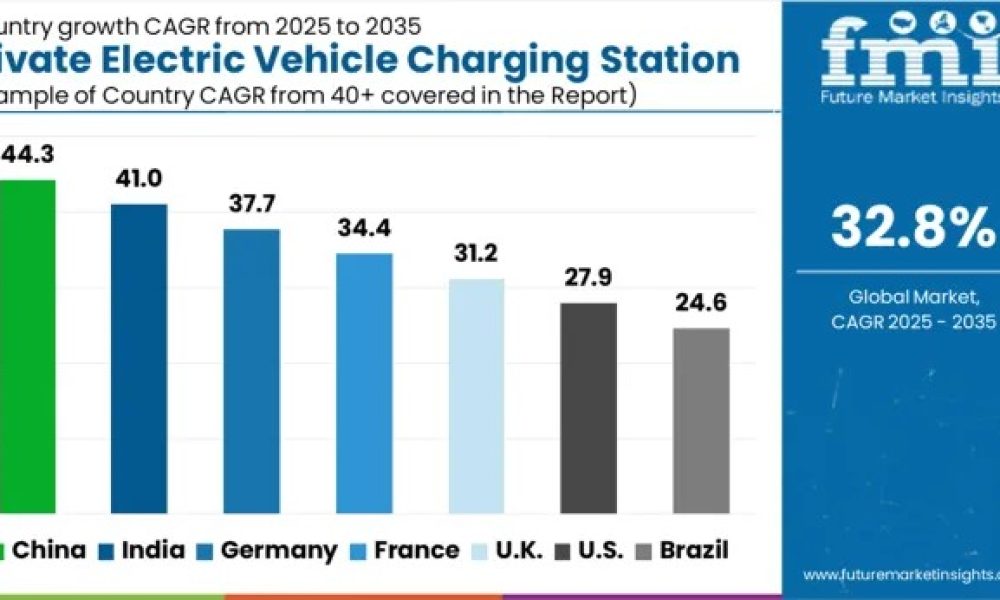
The global private electric vehicle (EV) charging station market is entering a decisive growth phase, underpinned by accelerating electric vehicle adoption, supportive policy frameworks, and rapid technological advancements. The market is projected to expand from USD 6.9 billion in 2025 to USD 117.3 billion by 2035, registering an exceptional compound annual growth rate (CAGR) of 32.8% over the forecast period. This trajectory reflects a fundamental shift from early experimentation toward a large-scale, structured, and commercially mature charging ecosystem.
From Early Adoption to Scaled Deployment
Between 2020 and 2024, the private EV charging station market experienced a measured but formative growth phase, increasing from USD 1.7 billion to USD 6.9 billion. This period was characterized by pilot installations, localized charging networks, and the validation of business models. Market participants focused on building foundational infrastructure, refining hardware and software offerings, and educating early adopters on the benefits of private charging solutions.
By 2025, the market reaches a critical inflection point. With a sizable installed base and improving consumer confidence, private charging infrastructure begins transitioning from a supplementary convenience to a core component of EV ownership. This shift sets the stage for rapid scaling between 2025 and 2030, during which the market is expected to surpass USD 21.4 billion, driven by surging installations across residential properties, workplaces, and private parking facilities.
From 2030 to 2035, the market enters a consolidation phase. Growth remains strong but becomes more structured as leading providers establish dominant networks, standardize service offerings, and integrate charging solutions with broader energy management systems. By 2035, the market is forecast to reach USD 117.3 billion, highlighting the scale of opportunity created by mainstream EV adoption and long-term infrastructure investment.
Get access to comprehensive data tables and detailed market insights — request your sample report today!
Market Fundamentals Driving Growth
The private EV charging station market is being shaped by the convergence of several high-impact sectors. The global electric vehicle market alone accounts for approximately 30% of growth influence, as rising EV penetration directly translates into demand for home and private charging solutions. Residential infrastructure development contributes another 20%, reflecting the integration of charging readiness into new housing projects and multi-family dwellings.
Renewable energy generation influences roughly 15% of market growth, as private charging increasingly aligns with solar power, energy storage, and low-carbon electricity sources. Automotive services and maintenance represent 10%, supporting installation, monitoring, and long-term system reliability. Smart grid and energy management systems contribute 8%, enabling load balancing, cost optimization, and grid stability. Real estate and property management (7%), consumer electronics and battery storage (5%), and digital platforms and mobile applications (5%) further reinforce the ecosystem by improving accessibility, usability, and integration.
Technology and Policy Accelerate Adoption
Rising numbers of private EV owners are seeking convenient, reliable, and fast charging options within residential and commercial premises. Government incentives, emissions regulations, and sustainability targets across major economies are accelerating investments in private charging infrastructure. These policies are complemented by technological innovation, particularly in charging speed, interoperability, safety, and user experience.
Manufacturers are expanding product portfolios with high-efficiency direct current (DC) chargers, intuitive user interfaces, and seamless digital payment and monitoring systems. Continued integration with renewable energy and smart grid technologies is expected to further strengthen the value proposition of private charging solutions, positioning them as a critical pillar of urban mobility and energy transition strategies.
Segmental Leadership: DC Charging Takes the Lead
By current type, the market is segmented into DC and AC charging. The DC charging segment is projected to account for 64.5% of market revenue, establishing itself as the dominant category. This leadership is driven by DC chargers’ ability to deliver high power output and significantly reduce charging time, aligning with consumer expectations for speed and convenience.
DC charging solutions are increasingly favored in private settings such as multi-family residential complexes, gated communities, and workplace parking areas where time efficiency is paramount. Advancements in power electronics, thermal management, and compatibility with next-generation battery technologies have improved charger reliability and lifespan, further accelerating adoption.
Regional Momentum and Country-Level Growth
Regionally, North America, Europe, and Asia-Pacific represent the primary growth engines of the private EV charging station market. Among individual countries, growth rates are particularly pronounced:
- China leads with a 44.3% CAGR, supported by large-scale EV adoption, strong policy backing, and rapid urban infrastructure development.
- India follows at 41.0% CAGR, driven by government initiatives for clean mobility and expanding urban EV ownership.
- Germany records 37.7% CAGR, reflecting high EV penetration and robust incentives for residential charging infrastructure.
- France (34.4%) and the UK (31.2%) benefit from supportive regulatory environments and rising consumer preference for home charging.
- The United States, growing at 27.9% CAGR, remains a mature yet steadily expanding market, supported by federal and state incentives and strong residential demand.
These markets collectively illustrate how policy alignment, infrastructure readiness, and consumer behavior shape adoption patterns globally.
Competitive Landscape and Strategic Positioning
The competitive landscape is defined by a mix of global engineering leaders and specialized charging solution providers, including ChargePoint Inc., ABB, Blink Charging Co., Delta Electronics, Eaton, EVBox, Schneider Electric, Siemens, SK Signet, Volta, and others. Competition centers on charging speed, smart functionality, interoperability, installation flexibility, and after-sales support.
Leading players differentiate through integrated hardware-software ecosystems, IoT-enabled platforms, mobile applications, and energy management capabilities. Partnerships with automakers, energy providers, and real estate developers are becoming increasingly important for market access and scale. As the market matures, suppliers that combine technological innovation with service reliability and regulatory compliance are expected to strengthen their competitive positions.
Outlook
With a forecast CAGR of 32.8%, the private electric vehicle charging station market represents one of the fastest-growing segments within the broader EV ecosystem. The transition from early adoption to mass deployment, coupled with strong regional momentum and technological progress, underscores the market’s long-term potential. Detailed insights into country-level dynamics, segment performance, and competitive strategies reveal substantial opportunities for stakeholders seeking to participate in the next phase of global electric mobility infrastructure development.
Why Choose FMI: Empowering Decisions that Drive Real-World Outcomes: https://www.futuremarketinsights.com/why-fmi
About Future Market Insights (FMI)
Future Market Insights, Inc. (FMI) is an ESOMAR-certified, ISO 9001:2015 market research and consulting organization, trusted by Fortune 500 clients and global enterprises. With operations in the U.S., UK, India, and Dubai, FMI provides data-backed insights and strategic intelligence across 30+ industries and 1200 markets worldwide.



